Every textbook says the same thing: central banks move interest rates through open market operations, buying government securities to push rates down and selling them to push rates up. The sentence is true, historically important, and a misleading guide to how the largest central banks have actually steered rates for more than a decade. Understanding both versions, the classic mechanism the textbooks teach and the administered system that quietly replaced it, is the difference between knowing the vocabulary of monetary policy and knowing how the machine in front of you actually runs.
The classic version deserves to be learned first, because it explains the vocabulary, the plumbing, and the emerging-market central banks that still operate this way. The modern version deserves to be learned second, because it explains the Federal Reserve, and because the transition between the two is one of the least reported structural changes in modern finance.
The Classic Mechanism: Moving a Scarce Commodity
The traditional system runs on scarcity. Commercial banks must hold reserves, balances at the central bank, to settle payments and meet requirements, and in the classic regime those reserves are deliberately kept scarce. Banks that run short borrow reserves overnight from banks with a surplus, and the interest rate on that borrowing, the federal funds rate in America’s case, is the price of scarce reserves. That price is what the central bank targets.
Open market operations are how it hits the target. When the central bank buys government securities from dealers, it pays by crediting bank reserves into existence; the supply of the scarce commodity rises, and its price, the overnight rate, falls. Selling securities does the reverse, draining reserves and pushing the rate up. Because reserves are scarce, small operations move the rate precisely, and the desk conducting them can steer the market to the target with daily fine-tuning, mostly through repurchase agreements, short-term collateralized loans that add or drain reserves temporarily rather than permanently. The overnight rate then propagates outward into every other borrowing cost, the transmission our guide to central banking and monetary policy follows through the economy. The deeper machinery here, that paying for bonds with reserves creates central bank money, is the same one our explainer on the money supply dissects layer by layer.
The Modern Reality: A Floor, Not a Scalpel
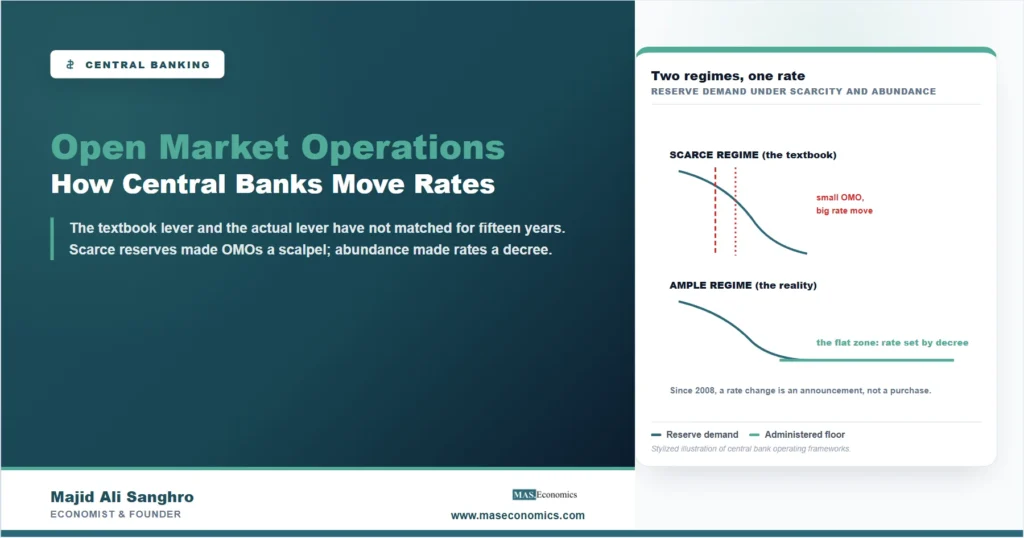
The classic system died in the crisis of 2008, as a side effect of the rescue. When the Federal Reserve began buying assets on a massive scale, the operation examined in our article on quantitative easing, it flooded the system with reserves. Scarcity, the foundation of the old steering method, ceased to exist: banks came to hold reserves in such abundance that no bank needed to borrow them overnight, and no daily operation could meaningfully move their price. The scalpel had no purchase left.
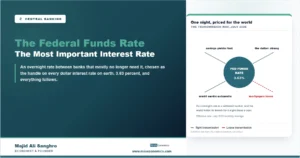
The replacement steers by decree rather than quantity. In the ample-reserves framework, the central bank simply pays interest on the reserves banks hold, and no bank will lend overnight below the rate it can earn risk-free at the central bank, so that administered rate becomes a floor under the market. A second facility, taking cash from money market funds and other non-banks, seals the floor from below. When the Federal Reserve changes policy today, it announces new administered rates and the market rate moves instantly, with no securities bought or sold at all. What remain of open market operations are supporting roles: repo facilities that cap spikes when the plumbing tightens, purchases that maintain the balance sheet’s size, and the standing readiness that keeps the framework credible. The dramatic exception came in September 2019, when reserves briefly became scarcer than intended and overnight repo rates spiked, forcing the desk back into large daily operations, a reminder that “ample” is a level someone must actually maintain.
The division of labor behind this sits inside the institution: the policy committee votes the target, and a trading desk implements it, structures our profile of the Federal Reserve lays out. And the old mechanism is not extinct: many emerging-market central banks still run scarce-reserve corridors steered by genuine daily operations, so both regimes are live on the map, which is one more reason the full toolkit survey in the functions of central banks keeps both in view.
Why the Distinction Earns Its Keep
Reading policy through the wrong regime produces real mistakes. Commentary still describes the Fed “injecting money” to cut rates, implying every cut expands the money supply; in the administered system, a rate change is an announcement, not a purchase, and the monetary base can shrink while rates fall. Conversely, when the balance sheet does move, under quantitative easing or its reversal, that is a separate lever with its own purposes, and conflating it with ordinary rate policy muddles both. The scarce-regime intuition also misprices crisis responses: the 2019 repo episode and the standing facilities built after it are about maintaining the floor’s foundations, not about stimulus. One structural change, the move from scarcity to abundance, quietly rewired what every headline verb about the central bank actually means, and the textbooks have mostly not caught up.
MASEconomics Explains
3 economic concepts behind open market operations
These concepts are explored in depth across our educational articles library.
Explore the MASEconomics BlogConclusion
Open market operations are both the textbook answer to how central banks move rates and, in the largest economies, no longer the actual answer. The classic mechanism, buying and selling securities to adjust scarce reserves and steer their price, built the vocabulary of monetary policy and still runs corridors across much of the emerging world. The modern Federal Reserve steers instead by administered rates on abundant reserves, with operations demoted to maintaining the floor, capping plumbing spikes, and managing the balance sheet as a separate instrument.
The practical takeaway is a translation rule. In the old regime, a rate decision was a market operation; in the new one, it is an announcement backed by standing facilities, and balance sheet moves are their own policy with their own names. Most confusion about “money printing,” rate cuts, and the Fed’s balance sheet dissolves once the two regimes are kept apart, which is precisely what the standard one-sentence definition never asks a reader to do.
Frequently Asked Questions
What are open market operations in simple terms?
They are a central bank’s purchases and sales of securities, mostly government bonds and mostly through short-term repurchase agreements, used to adjust the amount of bank reserves in the system. In the traditional framework, adding reserves lowers the overnight interest rate and draining them raises it.
How do open market operations change interest rates?
Through scarcity. When reserves are deliberately kept scarce, banks borrow them overnight from each other, and the rate on that borrowing is the price of reserves. Central bank purchases increase the supply of reserves and lower that price; sales reduce supply and raise it. The overnight rate then spreads into all other borrowing costs.
Does the Federal Reserve still use open market operations to set rates?
Not in the classic sense. Since reserves became abundant after 2008, the Fed steers the federal funds rate with administered rates, interest on reserve balances and its money-fund facility, which floor the market. Operations now maintain the balance sheet and cap funding spikes, as in September 2019, rather than fine-tuning the daily rate.
What is the difference between open market operations and quantitative easing?
Scale, purpose, and target. Classic operations are small, short-term, and aimed at keeping the overnight rate on target. Quantitative easing is large-scale, long-duration asset buying aimed at lowering long-term yields and easing conditions when the short rate has little room left. They use similar transactions for different policies.
Who conducts open market operations?
A dedicated trading desk at the central bank, acting on instructions from the policy committee. In the United States, the Federal Open Market Committee sets the target and the desk at the New York Fed implements it, transacting with a set of approved dealers and counterparties.
Thanks for reading! The textbook lever and the actual lever have not matched for fifteen years, and knowing both is what reading the Fed requires now. Happy learning with MASEconomics