An airline flies a half-empty red-eye that loses money on paper, a restaurant stays open through a dead afternoon, and a factory keeps running the month after its product’s price collapses, and none of the three managers is confused. Each is acting on the most practical distinction in all of cost theory. Fixed and variable costs split a firm’s outlays by one question: does the cost change with how much is produced? The rent, the aircraft lease, and the license fee march on whether output is zero or maximal; the fuel, the ingredients, and the overtime rise and fall with every unit. The split sounds like accounting housekeeping, and it is actually the hinge of real decisions, because the two kinds of cost are relevant to entirely different questions. Confusing them produces the classic business errors, closing what should stay open, pricing to “cover costs” that pricing cannot affect, and its mastery explains conduct that looks irrational from outside, including why so much of the modern economy sells things whose next unit costs almost nothing.
The Split, and the Family of Curves It Generates
Begin with what belongs where. Fixed costs are the outlays committed for the period regardless of output: rent, insurance, the lease on machines, the salaries of staff who are kept whatever the week brings, all of them the price of standing ready to produce, which is why the theory of the firm treats them as the cost of the organization’s existence rather than of its activity. Variable costs are the outlays each unit drags with it: materials, energy for the machines, piece-rate and overtime labor, shipping. The boundary is real but not printed on the invoice, wages being the standard ambiguity, fixed for the salaried core and variable for the shift-scheduled margin, and the classification is a fact about the decision horizon as much as about the cost, a point the distinction’s fine print returns to below.
From the split, the whole textbook family of curves follows with almost no further assumptions. Average fixed cost falls forever as output rises, the same rent spread across more units, a pure and powerful arithmetic sometimes called spreading the overhead. Average variable cost typically falls and then rises, as the operation finds its rhythm and then strains against capacity. Marginal cost, the cost of the next unit, is the derivative concept our article on marginal analysis formalizes, and it is built from variable cost alone: fixed cost, unchanged by the next unit, cannot appear in it by definition. That one sentence, fixed costs never enter marginal cost, is the distinction’s sharpest edge, because prices and production levels are chosen at the margin, which means an entire category of a firm’s spending is irrelevant to its operating decisions, however painfully real it is to the owner’s bank account.
The Shutdown Rule: Why Losing Money Can Be Optimal
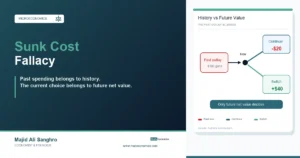
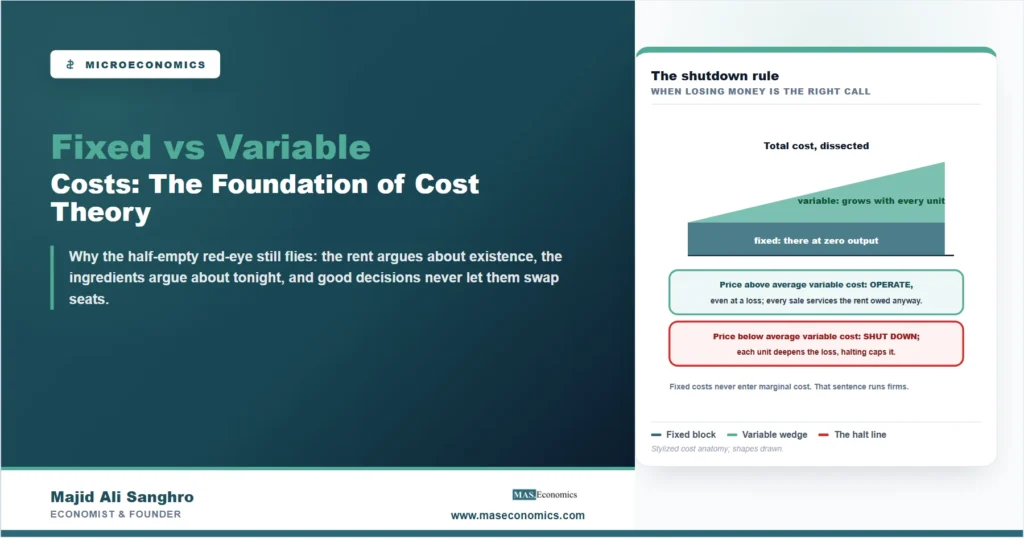
The distinction’s most counterintuitive teaching is the shutdown rule, and the airline’s red-eye is its cleanest classroom. Suppose the flight’s ticket revenue falls short of its full cost, fuel, crew, and a share of the aircraft’s lease, so the accounts call it a loser. The lease, however, is owed whether the plane flies or parks; the true choice is between flying, which costs the fuel and crew and brings in the fares, and parking, which costs nothing extra and brings in nothing. If fares exceed the fuel-and-crew bill, flying loses less than parking: the flight is not profitable, and it is still correct, because every euro of revenue above variable cost is a euro contributed toward fixed obligations that exist either way. The general rule follows: in the short run, operate whenever price covers average variable cost, and shut down only when it does not, at which point each unit produced makes things worse and halting caps the loss at the fixed costs alone. The restaurant’s quiet afternoon, the factory’s grim month, and the loss-making flight are all the rule in action, and the everyday errors run both ways: closing an operation whose revenues were covering variable costs and contributing to overheads, and, conversely, keeping a doomed operation alive “because we’ve spent so much already”, the fallacy of counting unrecoverable spending that our article on the sunk cost fallacy dissects. The two mistakes share a root, fixed and sunk costs intruding on margins where they have no business, and one distinction is worth drawing carefully: fixed is about not varying with output, sunk is about being unrecoverable, and a cost can be either without the other, a paid-up lease that could be sublet being fixed but not sunk, a bespoke advertising campaign being sunk but finished.
Horizons, and the Economy Where Marginal Cost Went to Zero
The fine print on the whole distinction is the clock. Fixed costs are fixed for a period, not forever: the lease expires, the salaried staff can be resized, the factory can be sold, so in the long run every cost becomes variable and the shutdown question matures into the exit question, whether price covers all costs, the horizon logic our article on short run versus long run develops as economics’ general habit. This is why chronic losses that are rationally endured for a season are rationally not endured for a decade, and why the same firm can be right to operate this quarter and right to exit this year. The formal machinery behind these curves, how input combinations map to output and costs, is the territory of production functions and isoquants with the isocost line pricing the inputs.
The distinction also explains the strangest-looking economics of the present: industries whose cost structure is nearly all fixed. A software product, a streaming catalog, or a designed-but-not-yet-fabricated chip costs enormous sums to create and nearly nothing to serve to one more customer; development is fixed, the marginal unit is close to free. Everything peculiar about such markets follows from that shape: prices bear no resemblance to marginal cost because there would be no revenue if they did; competition tilts toward winner-take-most, since the firm with the most customers spreads the identical fixed cost thinnest; and giving the product away to some users can be rational when scale itself feeds the business, economics visible at industrial scale in our study of the semiconductor industry, where a fabrication plant’s fixed cost is measured in the tens of billions and the arithmetic of spreading it governs world strategy. The humble split between the rent and the ingredients, scaled up, turns out to organize the digital economy.
MASEconomics Explains
3 economic concepts behind fixed and variable costs
These concepts are explored in depth across our educational articles library.
Explore the MASEconomics BlogConclusion
Fixed and variable costs divide a firm’s spending by the only question operating decisions care about: does this cost change with output? The split generates the textbook curve family almost by itself, average fixed cost falling forever, marginal cost built from variable cost alone, and it delivers cost theory’s most practical theorem, the shutdown rule, under which operating at an accounting loss is correct exactly when price covers the variable bill, because revenue beyond it services obligations that exist regardless. The rule’s mirror-image errors, closing contributors and nursing sunk causes, are the distinction ignored in opposite directions.
The two refinements worth permanent residence are the clock and the shape. Fixity is a property of the horizon: every cost is variable eventually, so shutdown logic governs the season and exit logic the era, and firms rightly answer the two questions differently. And cost structure is destiny at scale: where almost everything is fixed and the next unit is nearly free, as across the digital and high-technology economy, pricing detaches from marginal cost and markets tilt toward the biggest spreader of the overhead. The rent-versus-ingredients split learned for a single restaurant, followed far enough, explains why the modern economy’s fiercest competition is a race to be the one dividing the fixed cost by the largest number.
Frequently Asked Questions
What is the difference between fixed and variable costs?
Fixed costs do not change with output for the period in question: rent, leases, insurance, salaried staff. Variable costs move with every unit produced: materials, energy, shift labor, shipping. The test is not the cost’s name but its behavior when production rises or falls.
Why would a firm keep operating while losing money?
Because the fixed costs are owed whether it operates or not. If revenue covers the variable costs with something left over, that remainder contributes toward the fixed obligations, so operating loses less than halting. The accounting loss is real, but the alternative, shutting down, would be a larger one.
Are fixed costs the same as sunk costs?
No. Fixed describes behavior with output; sunk describes recoverability. A leased office is a fixed cost that may not be sunk if the lease can be sublet, and a finished advertising campaign is sunk but no longer a cost at all. Both mislead the same way when they contaminate marginal decisions, but the concepts answer different questions.
Are wages a fixed or variable cost?
Both, depending on the arrangement and the horizon: the salaried core kept through slow weeks is fixed, while shift-scheduled, overtime, and piece-rate labor is variable. The ambiguity is itself instructive, since classification follows the cost’s behavior under the decision at hand rather than the payroll category it sits in.
Do fixed costs matter at all if they are irrelevant at the margin?
They matter enormously to different questions: whether to enter, whether to exit when commitments lapse, and whether the enterprise is worth its existence, all of which compare revenue with total cost over the long horizon where nothing is fixed. The discipline is matching each cost category to its question, not ranking the categories by importance.
Thanks for reading! The rent argues about existence, the ingredients argue about tonight, and good decisions never let them swap seats. Happy learning with MASEconomics