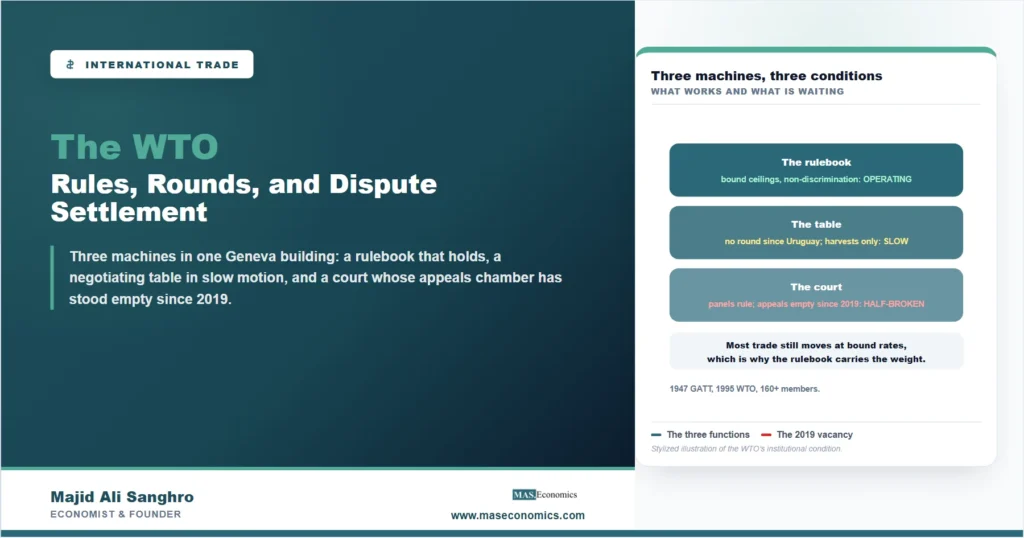
The organization that referees most of world trade employs fewer people than a mid-sized university and cannot compel any government to do anything. The WTO explained properly is not one institution but three machines sharing a building in Geneva: a rulebook that turns trade promises into enforceable ceilings, a negotiating table where those promises are bargained, and a court where members sue each other, with the unusual feature that the court’s appeals chamber has been out of action since 2019 while the caseload continues. The World Trade Organization was created in 1995 as the successor to the GATT, the postwar General Agreement on Tariffs and Trade, and today covers more than 160 members accounting for the overwhelming bulk of world commerce. Whether it is dying or merely wounded is one of the standing debates of this decade; either way, the shelf price of nearly everything imported still rests on commitments filed in its schedules, which makes the machinery worth understanding on its own terms.
The Rulebook: Promises Made Enforceable
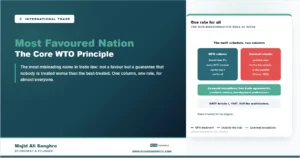
The WTO’s first machine is legal. Its agreements, the GATT for goods, the GATS for services, and TRIPS for intellectual property, adopted as a single package every member accepts whole, rest on a small set of norms. Non-discrimination comes first, in two forms: most favored nation treatment between foreign suppliers at the border, and national treatment between foreign and domestic goods once inside. Bindings come second: each member files a schedule of ceiling tariffs it commits not to exceed, so market access becomes a legal entitlement rather than a courtesy. Around these sit rules disciplining the rest of the arsenal, quotas largely prohibited, subsidies policed, product standards and licensing constrained so they do not become non-tariff barriers, plus a transparency obligation that forces trade policy into the open. The full institutional description sits on the WTO’s own what-is pages; the analytical catalog of the instruments it governs is in our overview of trade policies.
The Table: Rounds and Their Diminishing Returns
The second machine is the negotiation, and its history explains both the system’s success and its present exhaustion. Under the GATT, eight successive rounds of bargaining cut the industrial tariffs of the major economies from the high double digits of the late 1940s to low single digits, one of the quietest large achievements in economic history. The final and greatest of them, the Uruguay Round of 1986 to 1994, did much more: it created the WTO itself, brought agriculture and textiles under discipline, extended the rules to services and intellectual property, and built the binding dispute system. Then the machine stalled. The Doha Round, launched in 2001 as a development round, ran into the divide between established and emerging powers and never concluded, and no comprehensive round has been attempted since.
What replaced the grand round is harvest diplomacy: narrower deals gathered at ministerial conferences, a trade facilitation agreement streamlining customs procedures, the 2015 decision eliminating agricultural export subsidies, a 2022 agreement disciplining fisheries subsidies, alongside plurilateral talks among willing subsets. The pattern is unmistakable, and it mirrors the wider drift of trade policy away from multilateral bargains toward regional agreements and national industrial strategies. The table still functions; it just produces side dishes where it once produced feasts.
The Court, and the Hole in It
The third machine was the boldest. Before 1995, a country accused of breaking trade rules could simply block the case; the Uruguay Round reversed the default, so a dispute panel is established, and its report adopted, unless every member including the winner objects. That reversal made the WTO’s dispute system the only genuinely binding tribunal most great powers have ever submitted to, and they used it: hundreds of disputes have been filed since 1995, between rivals and allies alike, over aircraft subsidies, food safety rules, dumping duties, and cotton, with compliance the normal outcome and authorized retaliation the sanction behind it.
The hole appeared at the top. Appeals from panel rulings go to a standing Appellate Body, and since December 2019 that body has had no members, because the United States, citing longstanding concerns that the tribunal had overreached its mandate, blocked all new appointments. Panels still hear cases, but a losing party can now appeal into the void, suspending an unwelcome ruling indefinitely. A coalition of members including the European Union and China runs a stopgap arbitration arrangement that preserves working appeals among themselves, while others live with the vacuum. The court, in short, functions for those who want it to, which is a diplomatic condition, not a legal one.
The tariff conflict of the mid-2020s, traced in our account of the global tariff war, has pressed on exactly this weakness, with major economies invoking national security exceptions the rules leave nearly unreviewable and striking bilateral arrangements outside the framework. Yet the reflex conclusion, that the system is finished, runs ahead of the evidence: most members continue trading with most members at bound rates, disputes keep being filed, and the data examined in our piece on whether deglobalization is real shows world trade adapting more than collapsing. The honest description is an institution whose rulebook still carries the weight while its table and court wait for politics to change.
MASEconomics Explains
3 economic concepts behind the WTO
These concepts are explored in depth across our educational articles library.
Explore the MASEconomics BlogConclusion
The WTO explained in one sentence is a rulebook, a table, and a court, and their conditions today are, respectively, holding, stalled, and half-broken. The rulebook remains the system’s real achievement: ceilings bound by treaty, discrimination disciplined by default, and the tariff schedules of more than 160 members functioning as the price floor plan of world commerce. The table has produced no comprehensive round since Uruguay, surviving on narrower harvests, and the court decides cases at panel level beneath an appeals chamber that has stood empty since 2019.
What the last years have demonstrated is that the machinery degrades politely rather than dramatically. Members who want binding appeals arrange them among themselves; members who want tariffs the rules forbid route them through the security exception; and the great majority of trade, belonging to countries with no appetite for either fight, continues at bound rates as if the architecture were whole. That is a weaker system than the one built in 1995, and also a far more durable one than the obituaries suggest. Institutions that price the world’s shelves do not die of vacancy; they wait, and the waiting is itself the current chapter.
Frequently Asked Questions
What is the WTO in simple terms?
It is the organization where governments agree the rules of international trade, negotiate reductions in trade barriers, and settle disputes about breaches. Created in 1995 as the successor to the GATT of 1947, it now covers more than 160 members and rests on two core promises: non-discrimination between partners and tariff ceilings bound by treaty.
What is the difference between the GATT and the WTO?
The GATT was a provisional agreement covering goods, administered by a small secretariat, with a dispute system any defendant could block. The WTO is a permanent organization that absorbed the GATT and extended rules to services and intellectual property, with a dispute system whose rulings are adopted automatically unless all members object.
How does WTO dispute settlement work?
A complaining member requests consultations; if those fail, a panel hears the case and rules; the ruling may be appealed; and a member that loses and refuses to comply can face retaliation authorized in proportion to the harm. The stage that is currently impaired is the appeal, since the Appellate Body has lacked members since December 2019.
Why is the WTO’s Appellate Body not functioning?
Because appointments to it require consensus, and the United States has blocked new appointments since 2019, citing concerns that the body exceeded its mandate in its rulings. Without members, appeals cannot be heard, so a party losing at panel level can appeal into the void and suspend the ruling. A group of members runs an interim arbitration arrangement that preserves appeals among themselves.
Does the WTO still matter given the recent tariff wars?
More than the headlines imply. The disputes of the mid-2020s involve a subset of large economies acting largely through security exceptions and bilateral deals, while most members continue trading with most members at bound rates, filing disputes, and negotiating narrower agreements. The rulebook still prices the great majority of world trade even while the court and the negotiating table struggle.
Thanks for reading! The most powerful court in world commerce enforces nothing; its members obey because the alternative is a world where nobody does. Happy learning with MASEconomics