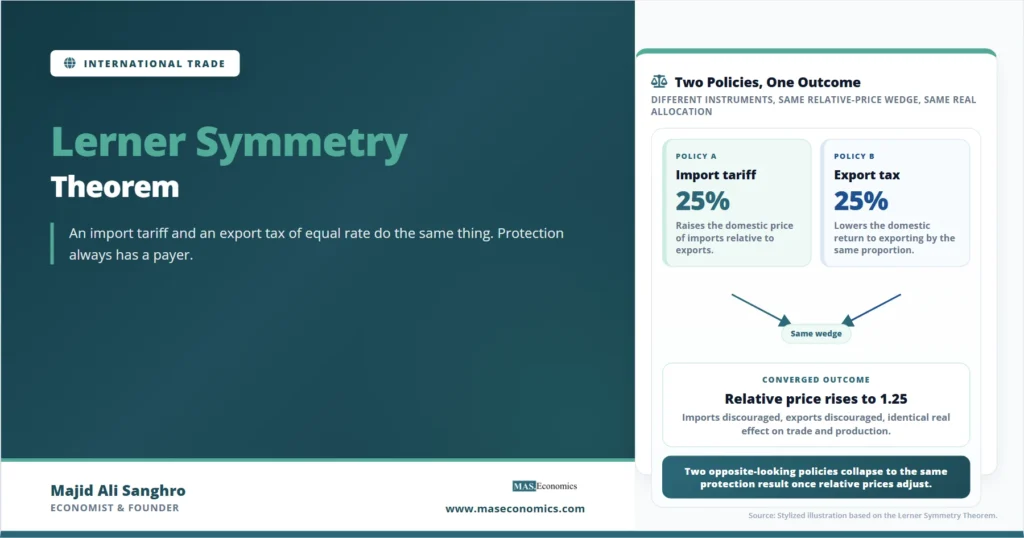
In 1936, the economist Abba Lerner proved a result that still unsettles people who think of trade policy as a menu of separate tools. A tax on imports, he showed, has exactly the same real effects as a tax on exports of the same rate. The two policies look like opposites, one aimed at goods coming in and the other at goods going out, yet under the right assumptions they are economically identical. The Lerner symmetry theorem is the formal statement of this equivalence, and its central lesson is that a country cannot protect its import-competing industries with a tariff without simultaneously taxing its exporters by the same logic.
The result matters because trade debates are almost always framed asymmetrically. Politicians promise tariffs to shield domestic manufacturers while promoting exports as the path to growth, treating the two as independent levers. Lerner’s theorem says they are not independent. The protection handed to one set of domestic producers is paid for, in real terms, by another set of domestic producers, and the mechanism that links them runs through the relative price of traded goods and the exchange rate.
Not the Lerner Index. Abba Lerner’s name attaches to several distinct ideas. This article is about the symmetry theorem in trade policy. It is not the Lerner Index, which measures a firm’s market power as the markup of price over marginal cost, and it is not the Marshall-Lerner condition, which concerns when a currency devaluation improves the trade balance. Same economist, three separate results.
Intuitive Basis of Symmetry
Start with the simplest possible economy: one country, two goods, and balanced trade, meaning the value of what the country exports equals the value of what it imports. Call the export good \(X\) and the import good \(M\). The only thing that matters for production and consumption decisions is the relative price between the two goods, the rate at which the market lets you trade one for the other.
Now impose an import tariff at rate \(t\). The tariff raises the domestic price of imports relative to exports. Domestic consumers face more expensive imports, domestic producers of the import-competing good are shielded, and resources flow toward import substitution and away from exporting. The key variable that has changed is the domestic relative price of imports to exports, which has risen by a factor of \((1 + t)\).
Next, erase the tariff and instead impose an export tax at the same rate \(t\). The export tax lowers the price exporters receive relative to the price of imports. Exporting becomes less attractive, resources flow away from exports, and the import-competing sector again expands. The domestic relative price of imports to exports has risen by exactly the same factor of \((1 + t)\). Because production and consumption respond only to that relative price, the two policies produce the identical reallocation of resources, the identical pattern of consumption, and the identical reduction in trade volume. That equivalence is the whole theorem.
THE CORE EQUIVALENCE
The reason the result feels surprising is that it works through the relative price, not the nominal direction of the tax. A tariff makes imports dearer; an export tax makes exports cheaper to foreigners and therefore less rewarding to produce at home. Either way, the home economy tilts toward the import-competing good and away from the export good by the same amount. The label on the tax is cosmetic. The relative-price wedge is what bites.
Exchange Rate Channel
The exchange rate is what makes the equivalence operate in a world with money, and it is also where most of the confusion arises. Suppose a country imposes an import tariff. By reducing demand for imports, the tariff reduces demand for foreign currency, which tends to make the domestic currency appreciate. That appreciation makes the country’s exports more expensive to foreigners, hurting exporters. The damage to exports that the tariff causes indirectly, through currency appreciation, is the same damage an explicit export tax would cause directly.
This is why the theorem is sometimes stated as the claim that there is no such thing as a purely pro-export, anti-import policy. A tariff that discourages imports puts upward pressure on the currency, and a strong currency discourages exports. The protected sector’s gain is the exporting sector’s loss, mediated by the exchange rate. A government cannot suppress imports and boost exports at the same time using trade taxes, because the two are bound together by the requirement that, over time, trade roughly balances.
Why balanced trade matters. The clean version of the theorem assumes trade balances, so that the value of exports equals the value of imports. This is the assumption that forces a tax on one side of the trade account to act as a tax on the other. Relax it, and the exact equivalence weakens, though the underlying tension between protecting imports and promoting exports remains.
A Numerical Illustration
Concrete numbers make the equivalence visible. Suppose world prices set one unit of the export good equal in value to one unit of the import good, so the world relative price is 1. The home country considers a 25 percent intervention, applied first as an import tariff and then as an export tax, and we track the domestic relative price that drives behavior.
| Channel | Import tariff (t = 25%) | Export tax (t = 25%) |
|---|---|---|
| Direct price effect | Domestic import price rises 25% | Domestic export price falls to 1/1.25 |
| Domestic relative price of imports to exports | 1.25 | 1.25 |
| Resource movement | Toward import-competing sector | Toward import-competing sector |
| Effect on exporters | Indirect, via currency appreciation | Direct, via the tax |
| Trade volume | Falls | Falls |
| Real outcome | Identical under balanced trade | |
|
Stylized example based on the standard Lerner symmetry derivation. Values illustrative.

|
||
The right-hand columns reach the same domestic relative price of 1.25 by opposite-looking routes. A 25 percent tariff multiplies the import price by 1.25 while leaving the export price unchanged. A 25 percent export tax leaves the import price unchanged while cutting the export price to 1/1.25 of its world level, which raises the price of imports relative to exports by the same 1.25 factor. Producers and consumers see one number, the relative price, and respond identically.
Assumptions of the Symmetry
Like every clean theorem in trade, Lerner symmetry rests on assumptions that the real world only partly satisfies. Naming them is not a way of dismissing the result; it is how the result is correctly applied. The exact equivalence requires balanced trade, so that taxing one side of the account necessarily burdens the other. It requires that the taxes be uniform across all goods on each side, since the proof works on the aggregate relative price of exports to imports. It abstracts from time, treating the comparison as a long-run equilibrium rather than a year-by-year path in which an economy can run temporary surpluses and deficits.
It also assumes that the revenue from the two taxes is handled the same way and that the taxes do not interact with other distortions. Once a country can borrow and lend internationally, run persistent imbalances, or apply tariffs selectively to some goods and not others, the equivalence becomes approximate rather than exact. The deeper point survives the relaxations: any policy that discourages imports also, through the exchange rate and the trade balance, discourages exports. The strict theorem is the clean limiting case of a robust tendency.
Common misreading. Symmetry does not mean tariffs have no effect. It means an import tariff and an equivalent export tax have the same effect. Both distort the economy away from free trade and both reduce trade volume. The theorem equates two interventions; it does not bless either as harmless.
Connections to Trade Theory
Lerner symmetry is a foundational consistency check on the rest of trade policy analysis. The welfare cost of an import tariff, the subject of standard work on measuring the gains from trade, must equal the welfare cost of the equivalent export tax, or the analysis would be internally inconsistent. The theorem also frames why a large country might still gain from a tariff. The optimal tariff argument works by turning the terms of trade in the country’s favor, and by symmetry an optimal export tax can achieve the same terms-of-trade gain, which is why economists speak of optimal trade taxes rather than optimal tariffs specifically.
The result sits alongside the other classical theorems that connect prices to real outcomes. Where the Stolper-Samuelson theorem links goods prices to factor returns, Lerner symmetry links the direction of a trade tax to its real incidence, and both insist that the nominal form of a policy can hide its true economic effect. The same caution underlies the distinction between headline and true protection in the effective rate of protection: in trade policy, what a measure is called rarely tells you what it does. Lerner’s contribution was to show that even the most basic intuition, that tariffs help and export taxes hurt the same producers, dissolves once the relative-price logic is followed through.
Explains
Three ideas behind the symmetry result
Explore more on the theorems that shape trade policy.
Explore the MASEconomics BlogConclusion
The Lerner symmetry theorem establishes that an import tariff and an export tax of the same rate are, under balanced trade and uniform application, economically identical. Both raise the domestic price of imports relative to exports by the same factor, both pull resources into the import-competing sector, and both shrink trade volume by the same amount. The exchange rate is the channel that enforces the equivalence in a monetary economy: a tariff that suppresses imports tends to strengthen the currency, and a stronger currency penalizes exporters exactly as an explicit export tax would.
The practical force of the theorem is political as much as analytical. It denies the possibility of a trade policy that genuinely favors import-competing producers while leaving exporters untouched, because the two groups are linked through the relative price of traded goods. Protection always has a payer, and under Lerner symmetry that payer is the export sector. The assumptions that deliver the exact result do not all hold in practice, so the equivalence is a tendency rather than an identity in any given year. But the core insight, that the direction of a trade tax disguises a burden that falls on both sides of the trade account, remains one of the most durable and most ignored results in the theory of trade policy.
Frequently Asked Questions
What does the Lerner symmetry theorem state?
It states that an import tariff and an export tax of the same rate have identical real effects under balanced trade and uniform application. Both raise the domestic price of imports relative to exports by the same factor, shift resources toward the import-competing sector, and reduce the volume of trade. The direction of the tax does not change its real incidence.
Is the Lerner symmetry theorem the same as the Lerner Index?
No. They share the name of Abba Lerner but are unrelated. The Lerner symmetry theorem is a trade-policy result about the equivalence of import tariffs and export taxes. The Lerner Index is a microeconomics measure of a firm’s market power, calculated as the markup of price over marginal cost relative to price. A third concept, the Marshall-Lerner condition, concerns currency devaluation and the trade balance.
Why does a tariff hurt a country’s own exporters?
A tariff reduces demand for imports and therefore for foreign currency, which tends to make the domestic currency appreciate. A stronger currency makes the country’s exports more expensive to foreign buyers, reducing export sales. This indirect penalty on exporters is the same penalty an explicit export tax would impose, which is the heart of the symmetry result.
Does Lerner symmetry hold in the real world?
The exact equivalence depends on balanced trade, uniform taxes, and a long-run view, which the real world only partly satisfies. Countries can run persistent surpluses or deficits, tax some goods and not others, and borrow internationally, so the equivalence becomes approximate. The underlying tendency, that discouraging imports also discourages exports through the exchange rate, remains robust even when the strict theorem does not hold exactly.
Thanks for reading! If you found this helpful, share it with friends and spread the knowledge. Happy learning with MASEconomics