In 1845, the price of potatoes in Ireland rose dramatically, and the quantity demanded rose with it. Or did it? That single observation, half-remembered and never properly documented, became the most stubborn anomaly in price theory. Giffen goods are the textbook exception to the law of demand: rare inferior goods whose quantity demanded rises when their price rises, because the income effect on a near-subsistence consumer outweighs the substitution effect. The phenomenon takes its name from the Victorian statistician Sir Robert Giffen, who Alfred Marshall credited with the observation in the third edition of his Principles of Economics. The case sits at the edge of standard consumer choice theory, and more than a century later, economists still debate whether Giffen behaviour has ever been cleanly documented outside of a controlled experiment.
The Irish Potato Hypothesis
The story most undergraduates first hear runs like this. Nineteenth-century rural Ireland depended on the potato for as much as eighty percent of caloric intake among the labouring poor. When potato blight raised potato prices in the 1840s, families that had supplemented their diet with small amounts of meat, dairy, or bread suddenly faced a budget crisis. To stay alive, they cut the better foods first and shifted what little remained toward more potatoes, the cheapest source of calories per penny. Higher potato prices, higher potato consumption. The law of demand appeared to fail.
The mechanism is intuitive verbally. Mathematically, three conditions must hold simultaneously. The good must be inferior, so the consumer buys less of it as income rises. The good must absorb a large share of the budget, large enough that a price change shifts real purchasing power meaningfully. And close substitutes must be absent or relatively expensive, so the consumer cannot easily switch when the price climbs.
Marshall did not invent the example. George Stigler’s 1947 paper in the Journal of Political Economy showed that Marshall added the Giffen passage in the third edition of the Principles without citing any published work by Giffen establishing the result. The example survived not because it had been demonstrated but because it was theoretically possible and pedagogically irresistible.
Income Effect Overwhelming Substitution
The formal logic comes from the Slutsky decomposition of a price change into two parts. When the price of a good rises, two things happen at once. The substitution effect pushes the consumer toward cheaper alternatives, holding utility constant. The income effect reflects the loss of real purchasing power: a price rise on something the household consumes is mathematically equivalent to a fall in income.
For a normal good, both effects work in the same direction. A higher price means less consumption through substitution, and the income effect reinforces it, because a lower real income further reduces demand for normal goods. The demand curve slopes downward, unambiguously, and the standard price elasticity of demand is negative.
For an inferior good, the two effects pull in opposite directions. Substitution still pushes consumption down when the price rises. But the income effect now pushes consumption up, because falling real income raises demand for inferior goods. Whether the demand curve slopes up or down depends on which effect dominates. In nearly every empirical case, substitution wins, and the curve still slopes down, even though the good is inferior. The Giffen case is the knife-edge in which the income effect is large enough to flip the sign. The geometry is the same indifference-curve apparatus used in standard consumer choice diagrams, with the budget line rotating around the relevant axis as the price changes.
Writing the Slutsky equation in its standard form clarifies what has to be true. For a price change in good \(i\), the total effect on quantity demanded breaks into:
The substitution term is always negative (Hicksian demand slopes down). The income term is negative for normal goods and positive for inferior goods. A Giffen good requires the inferior-good income effect, weighted by the budget share \(x_i\), to be large enough in magnitude to flip the total derivative positive. That is a strong empirical condition, which is why most inferior goods are not Giffen goods. Hal Varian’s Microeconomic Analysis works through the formal conditions in chapter eight.
The Backward‑Bending Demand Curve
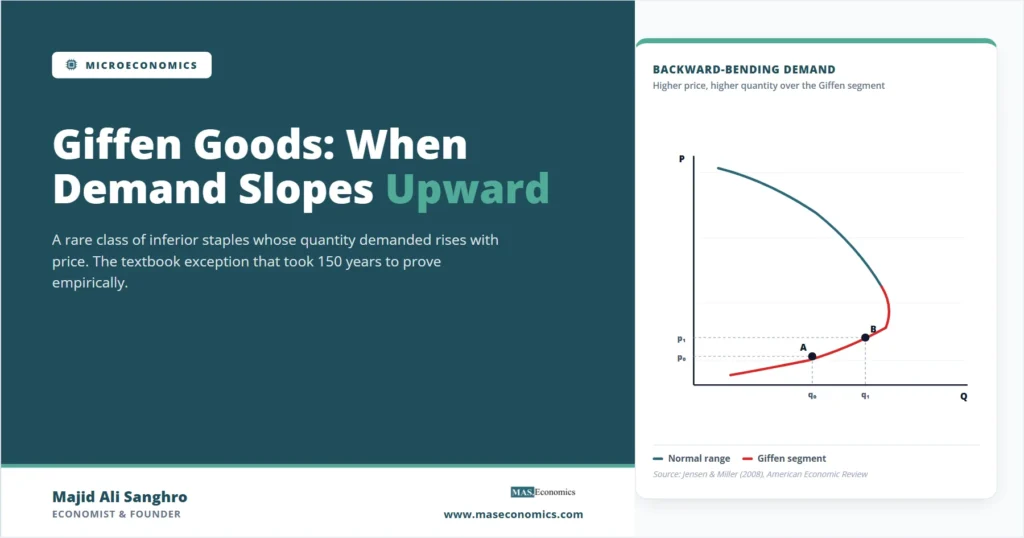
The diagram below shows the Giffen segment as it typically appears in microeconomics textbooks. Quantity sits on the horizontal axis, price on the vertical axis. Across most of the price range, the demand curve slopes downward, just like every other good. But over a specific range of low incomes and high budget shares, the curve bends backward: at higher prices, the quantity demanded is also higher.

The teal segment is the ordinary downward-sloping demand familiar from any first-year textbook. The red segment is the Giffen range. Moving from point A to point B, the price has risen from \(p_0\) to \(p_1\), but the quantity demanded has also risen from \(q_0\) to \(q_1\). The diagram is not drawn to scale; in real-world cases, the Giffen segment is typically narrow and confined to extreme poverty conditions.
Empirical Confirmation Challenges
For more than a hundred years, the Giffen example circulated in textbooks without convincing empirical evidence. Stigler’s 1947 paper argued that no demonstrated case existed and that the conditions required for Giffen behaviour were so restrictive that the phenomenon might be a theoretical curiosity rather than an observable fact.
The empirical problem is identification. A real-world observation of price rising alongside quantity demanded does not by itself prove Giffen behaviour. Supply shocks shift the curve simultaneously, and causation runs both ways in market data. The Irish potato famine illustrates the trap. Potato prices rose because supply collapsed, not because demand expanded along a stable curve. Gerald Dwyer and Cotton Lindsey, in their 1984 paper Robert Giffen and the Irish Potato, showed that potato consumption in Ireland actually fell during the famine, contradicting the standard story.
The clearest evidence did not arrive until 2008. Robert Jensen and Nolan Miller, in the American Economic Review, designed a field experiment in two impoverished Chinese provinces. In Hunan, where rice is the staple, and Gansu, where wheat is the staple, randomly selected households received vouchers subsidising their staple food for five months. The voucher provided clean identification: the price change was exogenous and unaffected by demand conditions.
The result confirmed Giffen behaviour for rice in Hunan among the poorest households. When the subsidy lowered the effective price of rice, those households bought less rice and shifted consumption toward meat. Cheaper rice freed up real income, allowing better foods, which displaced staple consumption. Evidence for wheat in Gansu was weaker, partly because Gansu households had access to closer substitutes. Jensen and Miller’s earlier NBER working paper set out the theoretical framework that made the field design tight.
Why Jensen and Miller succeeded where 150 years of casual observation failed: they used a randomised price subsidy, not a supply shock. A subsidy moves the consumer along the demand curve without shifting it. A famine moves the curve itself. The 2008 experiment is the only widely accepted demonstration of Giffen behaviour in real-world household data.
Distinction from Veblen and Inferior Goods
The most common confusion in undergraduate microeconomics is the distinction between Giffen goods and Veblen goods. Both have upward-sloping demand. The mechanisms could not be more different.
A Veblen good is a luxury whose perceived value rises with price. A higher price signals exclusivity, prestige, or quality, and consumers buy more for that reason. Designer watches and premium champagne often behave this way. The preference structure itself changes with price: the buyer’s utility from the good depends on what other people pay for it. This violates the standard assumption that preferences are independent of prices.
A Giffen good is the opposite case. The consumer’s preferences are perfectly ordinary, and the good is anything but a luxury. It is an inferior staple bought by the very poor. Quantity rises with price purely because of a real-income squeeze: rising prices destroy enough purchasing power that the consumer is forced deeper into the cheapest available source of calories.
The distinction also separates Giffen goods from regular inferior goods. All Giffen goods are inferior, but the reverse is false. Inferior goods like generic-brand canned soup or bus travel fall out of favour as income rises, but their demand curves slope downward in the normal way, because substitution dominates the income effect. Giffen status requires a much sharper set of conditions, which is why the category is so small.
MASEconomics Explains
The single insight behind Giffen goods
These concepts are explored in depth across our educational articles library.
Explore the MASEconomics BlogConclusion
Giffen goods are the textbook exception that nearly never appears in the wild. The theoretical possibility was clear to Marshall, Slutsky, and Hicks, but the empirical proof took until 2008, when Jensen and Miller’s randomised subsidy experiment in rural China produced the first widely accepted real-world demonstration. The conditions are demanding: a deeply inferior staple, a large share of household spending, an absence of close substitutes, and a population poor enough that the income effect of a price change becomes the dominant force on the budget. The case sits at the boundary of standard demand theory and tells economists something useful: the law of demand is a tendency, not a logical necessity, and the structure of consumer preferences combined with a household’s position in the income distribution can, in principle, reverse the slope of the curve. Most of the time it does not. Sometimes, for the very poor, it does.
Frequently Asked Questions
What is an example of a Giffen good?
The most widely accepted real-world example is rice consumption among poor households in Hunan province, China, documented by Jensen and Miller in their 2008 American Economic Review paper. When researchers subsidised rice prices, the poorest households bought less rice and more meat, the opposite of a normal good. Older textbook examples include potatoes during the Irish famine and bread in Victorian England, though both have been challenged empirically. Genuine Giffen goods require extreme poverty, a staple food, and few substitutes.
What is the difference between a Giffen good and a Veblen good?
Both have upward-sloping demand curves, but for opposite reasons. A Giffen good is an inferior staple consumed by the poor, where rising prices force consumers deeper into it because the income effect destroys their purchasing power for substitutes. A Veblen good is a luxury whose higher price signals status or exclusivity, raising perceived value and demand. Giffen behaviour is a real-income phenomenon. Veblen behaviour is a preference phenomenon driven by social signalling.
Are all Giffen goods inferior goods?
Yes, every Giffen good is an inferior good. An inferior good is one whose consumption falls as income rises. For a price increase to raise consumption (the Giffen condition), the income effect must be positive when scaled by the budget share, which only happens for inferior goods. The reverse is not true: most inferior goods are not Giffen, because substitution still dominates. Giffen status requires the additional conditions of a large budget share and few available substitutes.
Why is the Irish potato example controversial?
Stigler’s 1947 paper showed that Marshall never cited any actual published work by Robert Giffen establishing the result. Dwyer and Lindsey’s 1984 study went further, finding that potato consumption in Ireland fell during the famine because supply collapsed, contradicting the Giffen story. The famine produced higher potato prices and lower potato consumption, which is consistent with a leftward supply shift, not with movement along an upward-sloping demand curve.
Do Giffen goods violate the law of demand?
Giffen goods violate the law of demand stated in its strict form, which holds that quantity demanded falls as price rises. In its underlying form, the law follows from the assumption that the substitution effect dominates the income effect. For a Giffen good, that assumption fails: the inferior-good income effect, multiplied by a large budget share, is bigger than the substitution effect. The result is a demand curve that slopes upward over the Giffen range, consistent with the deeper consumer theory even as it violates the empirical regularity.
Thanks for reading! If you found this helpful, share it with friends and spread the knowledge. Happy learning with MASEconomics