Weeks before a price change reaches a store shelf, it usually passes through an invoice between businesses, and there is an index standing at that door. The producer price index measures the prices domestic producers receive for their output, recorded at the factory gate, the mine mouth, and the service contract, before wholesalers, retailers, and taxes add their layers. Because it samples the pipeline rather than the checkout, the PPI carries a reputation as the consumer index’s early-warning system: watch what producers charge today, the logic runs, and you are reading next quarter’s consumer inflation in advance.
The reputation is about half-earned, and knowing which half is the useful part. The PPI genuinely does see cost shocks first, and it genuinely does answer questions the consumer index cannot. But the pipeline between producer and consumer prices leaks, by design, at every joint, and the interesting information is often in the leak itself rather than in any forecast. Reading the two indexes together, gap and all, tells a story about margins and market power that neither tells alone.
What the Index Actually Prices
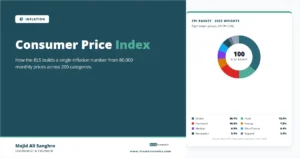
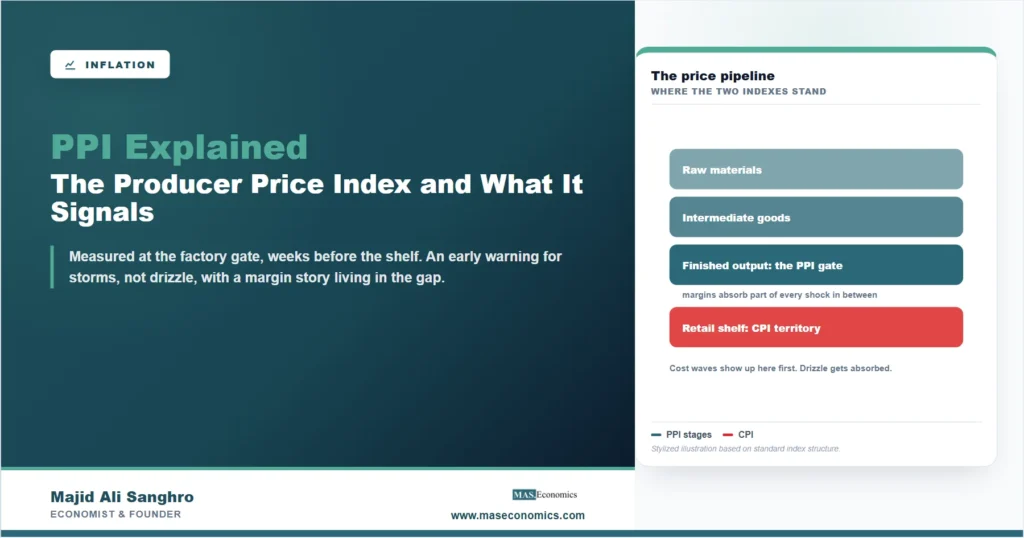
The defining choice is the point of measurement: revenue received by the producer, not cost paid by the consumer. That excludes retail and wholesale margins, transport charges added later, and sales taxes, and it includes a vast territory consumers never see, steel plates, industrial chemicals, freight contracts, business software licenses. Statistical agencies publish the index at several depths of the pipeline, from raw materials through intermediate goods to finished output, and modern versions cover services as well as goods. The consumer-facing counterpart, whose basket logic our closer look at the CPI sets out, prices the end of the chain; the PPI prices everything upstream of it.
Measuring at the gate gives the PPI three jobs the consumer index cannot do. It deflates industrial output: real production statistics divide factory revenue by factory prices, not shelf prices. It settles contracts: long-term supply agreements routinely escalate payments using specific PPI components, so the index is written into private commerce in a way few statistics are. And it isolates domestic producers’ pricing from imported consumer goods, which sit in the CPI basket but not here, a boundary that matters whenever exchange rates or tariffs move, and one reason production-side inflation questions belong to the PPI and the GDP deflator rather than to the checkout index.
The Early-Warning Reputation, Audited
The forecasting story has real mechanics behind it. Cost shocks do enter upstream: when energy or metals jump, the PPI’s raw and intermediate stages move within weeks, while consumer prices respond over months. The disruption years demonstrated the sequence vividly, with freight and input costs surging through producer indexes well before shelf prices followed, the dynamics our piece on supply chain economics traces. When the question is “has a cost shock started,” the PPI is the right place to look.
The leak in the pipeline is everything that happens after the gate. Retail and wholesale margins can absorb or amplify producer-price moves, and firms make that choice strategically, eating cost increases to hold market share in weak demand, or padding margins when demand is strong. Consumer spending is also dominated by services, rent, healthcare, education, whose costs are mostly wages rather than producer goods, so a large share of the CPI never touches the PPI pipeline at all. The result is a correlation that is real but loose: producer and consumer inflation share direction over time, while the month-to-month link routinely disappoints anyone using one to trade the other. Economists therefore read the PPI-CPI gap as its own signal. Producer prices rising faster than consumer prices suggests margins being squeezed, with either future consumer inflation or future profit warnings to follow; the reverse suggests margins fattening, a datapoint in every argument about market power and price-driven inflation.
The honest summary is that the PPI predicts the CPI about as well as weather upstream predicts weather downstream: reliably for large storms, poorly for drizzle. Cost shocks big enough to survive the margins arrive at the shelf with a lag; ordinary fluctuations mostly get absorbed on the way. The index’s calibration quirks, more volatile than the CPI because raw materials swing harder, and historically prone to larger revisions, belong in the same audit. Where the trio of major inflation gauges fits together, and which one each institution actually watches, is mapped in our guide to inflation reports.
Reading It Like a Practitioner
Three uses survive the audit intact. First, direction and breadth: a PPI move spread across many categories, rather than driven by one commodity, is evidence of a genuine cost wave forming, the production-side pressure our explainer on aggregate supply places at the center of supply-shock economics. Second, the stages: pressure visible in raw materials but not yet in finished goods is early; pressure that has reached finished goods is arriving. Third, the gap against consumer prices, read as a margin story rather than a forecast error. What does not survive is the mechanical reading, this month’s PPI as next month’s CPI, which the data has never supported as tightly as the headlines assume.
MASEconomics Explains
3 economic concepts behind the producer price index
These concepts are explored in depth across our educational articles library.
Explore the MASEconomics BlogConclusion
The producer price index is the inflation gauge stationed where price changes begin: at the invoices between businesses, before margins, transport, and taxes shape what consumers eventually pay. That position gives it real jobs, deflating production statistics, escalating contracts, and flagging cost waves while they are still upstream, and it gives the early-warning reputation a true core: large shocks do show up here first.
The half of the reputation to retire is the mechanical one. Margins absorb, services bypass the pipeline, and the month-to-month link to consumer inflation is loose enough that the gap between the two indexes is usually more informative than any forecast built on one of them. Read as a pressure gauge on the production side, and as one half of a margin story whose other half is the consumer index, the PPI earns its place in the monthly calendar, just not the place the headlines usually assign it.
Frequently Asked Questions
What is the producer price index in simple terms?
It is a measure of the prices domestic producers receive for their output, recorded where they sell it, at the factory gate or in the service contract, before retail margins, later transport, and sales taxes are added. It covers raw materials, intermediate goods, finished products, and, in modern versions, many services sold between businesses.
What is the difference between PPI and CPI?
The PPI measures prices from the seller’s side of business transactions; the CPI measures prices from the buyer’s side of consumer purchases. The CPI includes retail margins, sales taxes, and imported goods, which the PPI excludes; the PPI includes business-to-business goods and services consumers never buy. They answer different questions and often move differently.
Does the PPI predict consumer inflation?
Loosely. Large cost shocks appear in producer prices first and reach consumer prices with a lag, so the PPI is a genuine early indicator of major waves. But wholesale and retail margins absorb much of the ordinary movement, and services dominate consumer spending while mostly bypassing the pipeline, so month-to-month the two indexes correlate weakly.
Why would PPI fall while CPI rises?
Because the indexes cover different territory and margins sit between them. Falling commodity prices can pull the PPI down while service costs, rents, and retail margins keep consumer prices climbing. A widening gap in that direction typically signals fattening margins or service-driven inflation rather than a contradiction in the data.
Who actually uses the producer price index?
Statistical agencies use it to convert nominal industrial output into real terms; businesses write specific PPI components into long-term contracts to escalate prices automatically; and analysts use its pipeline stages to judge whether cost pressure is forming upstream. Central banks watch it as context for consumer inflation rather than as a target.
Thanks for reading! Upstream weather forecasts downstream weather for storms, not drizzle, and that is the whole art of reading producer prices. Happy learning with MASEconomics