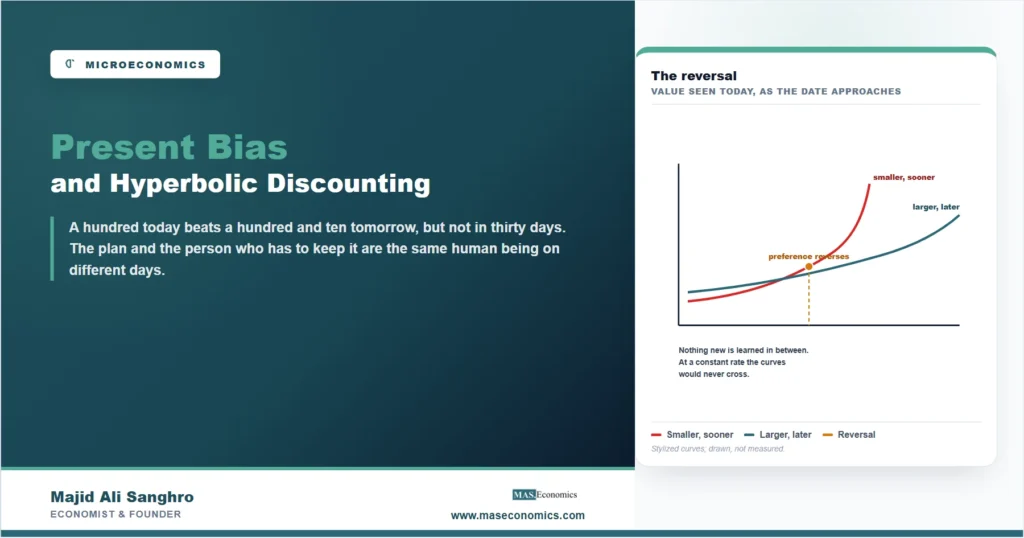
Offer someone a hundred dollars today or a hundred and ten tomorrow and most take the hundred. Offer the same person a hundred in thirty days or a hundred and ten in thirty-one days and most take the hundred and ten. The delay is one day in both cases and the reward for waiting is identical, yet the answers reverse. That reversal is present bias, and it is not a rounding error in the standard model but a contradiction of it: a person who chooses this way will make a plan in advance and then break it when the moment arrives, without any new information and without changing their mind about anything except the date. Gym memberships bought in January, savings targets set every year and deadlines missed by people who genuinely intended to meet them are all the same arithmetic.
The Reversal Exponential Discounting Cannot Produce
The conventional treatment of time in economics discounts the future at a constant rate. A reward arriving t periods from now is worth its size multiplied by a discount factor raised to the power of t.
The important property of that formula is not impatience but consistency. Because the same factor applies to every period, the ranking of two future rewards does not depend on when the comparison is made. A person who prefers the larger later reward when both are distant will still prefer it when both are close, so plans made today survive contact with tomorrow. This is the assumption underneath the saving models in our articles on the life-cycle hypothesis and the permanent income hypothesis, and it is what makes a household’s plan for the next forty years meaningful in those models.
The observed pattern is different. Discounting is steep over the near term and much flatter further out, which is what hyperbolic discounting means. The version economists mostly use is a simplification of it, quasi-hyperbolic discounting, which keeps the exponential machinery and adds a single extra parameter that applies to everything except the present.
That one parameter does all the work. The delta captures ordinary long-run patience, the same as before. The beta is an extra penalty applied to anything that is not immediate, so the gap between now and soon is treated as larger than the identical gap between later and slightly later. Set beta to one and the model collapses back to the consistent case; set it below one and every prediction below follows.
What Time Inconsistency Predicts
The model earns its place by predicting several things at once that a constant discount rate cannot produce together.
The first is systematic procrastination on tasks with immediate costs and delayed benefits, and its mirror image, over-consumption of things with immediate benefits and delayed costs. The second is that plans and actions diverge in a predictable direction rather than at random: people save less than they intended, exercise less than they intended and study later than they intended, and almost nobody overshoots. The third, and the most useful for testing the theory, concerns what people do about it.
Here the distinction between naive and sophisticated agents matters. A naive agent is present-biased and does not know it, so they keep making plans they will break and are repeatedly surprised. A sophisticated agent is present-biased and knows it, which changes their behaviour today: they will pay to restrict their own future options. That prediction is sharp, because a consistent agent would never pay for fewer choices. The observed demand for commitment devices, savings accounts that cannot be drawn on until a date, deposits forfeited if a goal is missed, applications that lock a user out of their own accounts, is evidence that some people are sophisticated about their own inconsistency, and that behaviour is very hard to explain any other way.
The Evidence, and the Objection Worth Knowing
Most early measurement asked people to choose between amounts of money at different dates, and that design has a problem serious enough that it changed the field. A person short of cash today who takes the smaller sooner payment may be perfectly consistent and simply liquidity-constrained, valuing money now because they need it now. A person who can borrow and lend at a market rate should arbitrage the choice rather than reveal a preference at all. And the curvature of utility over money is entangled with the discount rate in these designs, so what looks like impatience can be risk aversion in disguise. Corrections for these confounds substantially reduce the estimated present bias in monetary experiments, and some careful studies find little of it left.
The response has been to measure time preference over things that cannot be borrowed against or stored: effort, unpleasant tasks, food, screen time. Experiments that ask people to allocate work between an earlier and a later date find present bias much more consistently, which is what the theory would predict, since nobody can borrow leisure from next week. The honest position is therefore narrower than the popular one. Present bias over effort and consumption is well supported; present bias inferred from money choices is contaminated and probably overstated. That distinction matters for policy, because a savings shortfall caused by impatience calls for commitment and defaults, while one caused by liquidity constraints calls for credit or income.
| Type | How they discount | Do plans hold? | Would they pay to limit their own options? |
|---|---|---|---|
| Time-consistent | A constant rate for every period | Yes, always | No, never; fewer choices can only hurt |
| Naive present-biased | Extra weight on the present, unaware of it | No, and they are surprised each time | No; they expect to follow the plan |
| Sophisticated present-biased | Extra weight on the present, aware of it | No, and they know it in advance | Yes, and this is the model’s sharpest prediction |

|
|||
Where the Money Actually Goes
Four markets are shaped by the pattern, and in each the design of the product is the evidence.
Consumer credit is the clearest. Borrowing at very high short-term rates makes sense for a genuine emergency and is expensive for anything else, and the repeat use that characterises the sector is what a present-biased borrower would do, taking the immediate relief and treating the repayment as a future problem. The same logic runs through credit card balances carried by people who report intending to clear them, a plan made in the flat part of the discount curve and broken in the steep part. Our article on the mortgage market covers the long-horizon version of the same decision, where the commitment is built into the contract.
Subscription pricing is the second. A monthly fee is small in the present and the cancellation is a task, so the immediate cost of continuing is lower than the immediate cost of stopping even when the service is unused, which our article on the economics of subscription services examines as a business model. Gym contracts are the studied case: members frequently choose monthly plans that cost more per visit than paying at the door, which is what someone expecting to attend more often than they will would choose.
Saving is the third, and it is where policy has responded most successfully. If the barrier to saving is a decision that is easy to postpone, then removing the decision changes the outcome, which is why automatic enrolment in retirement plans raises participation so much more than education campaigns do. The fourth is human capital, where the cost is immediate and the return arrives over decades, the shape our articles on human capital and student loans describe. It is also the case where present bias and a genuine liquidity constraint are hardest to tell apart, which is exactly the measurement problem above appearing in a real policy question.
MASEconomics Explains
3 concepts behind present bias
These concepts are explored in depth across our educational articles library.
Conclusion
Present bias is the extra weight placed on the immediate, and hyperbolic discounting is the shape that produces it: steep discounting over the near term and much flatter discounting further out. The workable form adds one parameter to the standard model, a penalty applied to everything that is not now, and that single change generates the whole family of predictions. Plans and actions diverge in one direction rather than at random. Preferences reverse as a date approaches, with no new information involved. And people who know this about themselves will pay to have their future options removed, which a consistent person would never do.
The caveat is about measurement rather than the idea. Present bias inferred from choices between sums of money is confounded with liquidity constraints, borrowing opportunities and the curvature of utility, and correcting for those shrinks the estimates considerably. Present bias measured over effort and consumption, which cannot be borrowed against, holds up much better. The practical distinction is worth carrying: a household that saves too little because the decision is easy to postpone is helped by automatic enrolment and commitment accounts, and a household that saves too little because it has no spare income is not helped by either. Both look identical in the data, and telling them apart is the whole job.
Frequently Asked Questions
What is present bias?
The tendency to place extra weight on immediate outcomes relative to future ones, beyond ordinary impatience. Its signature is a preference reversal: choosing the larger later reward when both dates are distant, then switching to the smaller sooner one as that date arrives, without learning anything new in between.
What is hyperbolic discounting?
A pattern of valuing the future in which the discount rate is very high over short horizons and much lower over long ones, rather than constant. The version economists usually estimate is quasi-hyperbolic, which keeps standard exponential discounting and adds one extra penalty applied to everything that is not immediate.
How is present bias different from impatience?
An impatient but time-consistent person discounts the future heavily at a constant rate, so they plan to take the money now and they do. They are consistent, just impatient. A present-biased person makes a different plan when the choice is distant than the one they carry out when it is near, so plans and behaviour diverge systematically.
What is the difference between naive and sophisticated present bias?
A naive agent is present-biased and unaware of it, so they keep making plans they will break and are surprised each time. A sophisticated agent knows about their own bias and acts on that knowledge today, typically by restricting their own future options through commitment devices. Only the sophisticated type would ever pay for fewer choices.
Is the evidence for present bias strong?
It depends on what is measured. Estimates from choices between amounts of money are confounded with liquidity constraints, borrowing opportunities and the curvature of utility, and correcting for those substantially reduces the measured bias. Estimates from effort and consumption, which cannot be borrowed against or stored, find it far more consistently. The narrower claim is the defensible one.
What is a commitment device?
An arrangement entered into deliberately to remove a future option: a savings account with no early access, a deposit forfeited if a target is missed, software that blocks a distraction. It is costly by design, which is the point, and a time-consistent person would never want one. Demand for them is the clearest behavioural evidence that people anticipate breaking their own plans.
Thanks for reading! The plan and the person who has to carry it out are the same human being on different days, and that is the whole problem in one sentence. Happy learning with MASEconomics