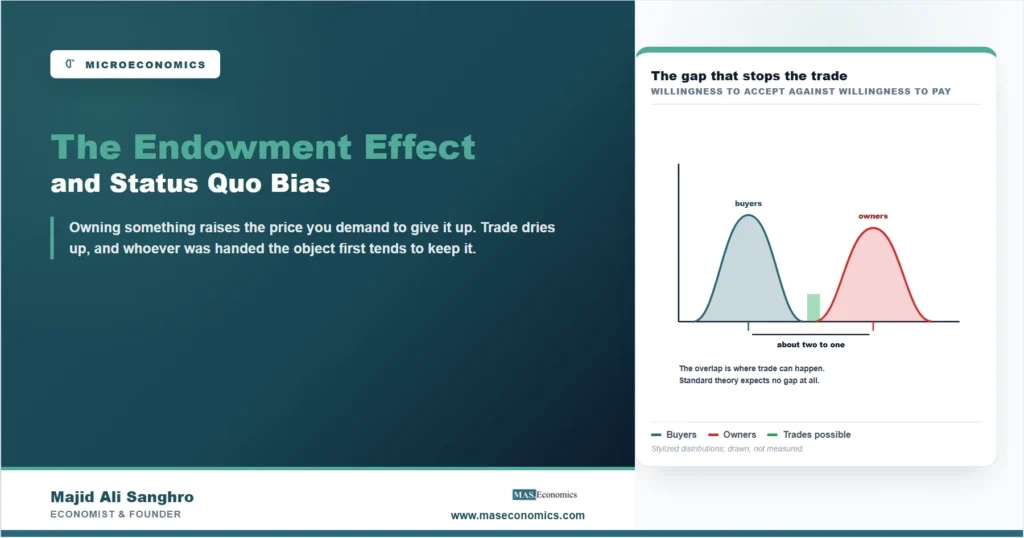
Hand every second person in a room a coffee mug, then run a market. Ask the owners the least they would accept to sell and the others the most they would pay to buy. Standard theory expects the two numbers to be close, because for an object worth a few dollars the wealth effect of owning it is negligible, and it expects roughly half the mugs to change hands as they find the people who value them most. Neither happens. Sellers ask for around twice what buyers offer, and trade nearly dries up. That gap is the endowment effect: the observation that owning something raises what a person demands to give it up, and its policy-facing twin is status quo bias, the tendency to stay with whatever arrangement is already in place. Both matter far beyond the laboratory, because a great deal of law and policy assumes that value is a property of the object rather than of who currently holds it.
The Gap Between Selling and Buying
The formal statement is about two prices. Willingness to accept is the smallest amount that would persuade an owner to part with a good. Willingness to pay is the largest amount a non-owner would give to obtain it. In conventional consumer theory these are the same number for small stakes, give or take an income effect too small to see, because the good is worth what its consumption is worth and nothing about the direction of the trade should change that. The ratio observed in experiments is routinely around two to one, sometimes more, and it appears for mugs, pens, lottery tickets, chocolate and hunting licences.
The consequence for the market is larger than the gap itself. If every owner’s asking price sits above most buyers’ offers, the volume of trade collapses, and the goods stay where they were randomly assigned rather than moving to whoever values them most. That is the part that should worry an economist. It is not that people are odd about mugs; it is that the allocation the market produces depends on the allocation it started from.
Why Ownership Might Change the Number
The standard explanation is reference dependence. If people evaluate outcomes as gains and losses measured from a reference point rather than as final states of wealth, and if losses weigh more heavily than equivalent gains, then giving up a mug you hold is coded as a loss while acquiring one is coded as a gain, and the two are not valued symmetrically. That machinery belongs to prospect theory, and our article on prospect theory sets out the value function and the asymmetry in full. What matters here is the consequence: the reference point moves when ownership moves, so the same object is worth more to whoever happens to hold it.
Three competing explanations are worth knowing, because they predict different things. One is that the gap reflects the order in which people consider reasons: an owner asked to sell thinks first about what they would lose, a buyer thinks first about what else the money could do, and the valuations that follow inherit the starting point. Another is ordinary attachment, which predicts that the effect grows with the time an object has been held and does not appear for goods bought purely for resale, and that pattern is broadly what is observed. A third is that the gap is not a preference at all but a bargaining posture: people asked to name a selling price state a high one because that is what one does when selling, which is a claim about the experiment rather than about value.
The Challenge That Has to Be Taken Seriously
The endowment effect is one of the most cited findings in behavioural economics and it has also been the subject of the field’s most substantial methodological critique. Charles Plott and Kathryn Zeiler showed that the gap shrinks dramatically, and in their experiments effectively disappears, once the procedure controls for things that have nothing to do with ownership: an elicitation method that makes truthful answers the best strategy, enough practice rounds for subjects to understand it, anonymity so that answers are not a performance, and instructions that do not signal what the experimenter expects. Their conclusion is not that people are perfectly rational but that the classic result may be measuring subject confusion rather than a preference.
The defence is partly experimental and partly from the field. Careful replications continue to find gaps under controlled conditions for some goods, and field work has established a pattern that is hard to attribute to confusion: traders with market experience show much smaller gaps than novices, and the effect fades as experience accumulates. That finding is important in both directions. It rescues the effect as a real phenomenon among inexperienced participants, which is most people for most unfamiliar decisions, and it limits the claim, because the professionals who set prices in real markets are exactly the group in whom it is weakest. The honest summary is that the endowment effect holds for unfamiliar goods and inexperienced traders, contested in its magnitude, and demonstrably reducible by experience and by better procedure, which is more useful than either the textbook version or the dismissal. Our articles on lab experiments and field experiments cover why the two settings disagree so often and what each is good for.
| Account | The mechanism | A prediction that distinguishes it |
|---|---|---|
| Reference dependence | Giving up is coded as a loss, acquiring as a gain, and losses weigh more | The gap should appear immediately on assignment, before any attachment can form |
| Query order | Owners think first about what they lose, buyers about what else the money buys | Changing the order of the questions asked should change the gap |
| Attachment | Holding a good builds a psychological claim on it | The gap should grow with time held and vanish for goods bought to resell |
| Procedure and confusion | Subjects misunderstand the task or state a bargaining posture | The gap should shrink with incentive-compatible elicitation, practice and anonymity |

|
||
Status Quo Bias: the Same Force Where the Stakes Are Real
Status quo bias is the endowment effect applied to arrangements rather than objects. Whatever is currently in place acquires the protection that ownership gives a mug, so a change is evaluated as a loss of the present position rather than on its merits against the alternative. The evidence is visible wherever a default exists and switching is easy: retirement plans enrol far more people when participation is automatic and opting out is a form to complete, and consumers stay with energy, insurance and banking providers long after a better offer is available, in numbers that a search-cost explanation alone struggles to carry.
The important thing about a default is that it is never neutral. Someone has to choose which option applies to a person who does not choose, and whichever one is selected will be what most people end up with. That is the foundation of the policy programme built on these findings, which our article on prospect theory covers in its sections on nudges, along with the critiques. It is also why the boundary between helping people and steering them is a live argument rather than a settled one: the same evidence that shows a default works shows that it works whether or not it is the option a person would have chosen.
What It Changes in Economics
Two consequences reach well outside behavioural economics, and they are the reason this is not a curiosity.
The first is about property rights. The Coase theorem holds that with well-defined rights and no transaction costs, bargaining delivers the efficient outcome regardless of who is granted the right initially, so the assignment of rights affects distribution but not allocation. That conclusion depends on willingness to accept equalling willingness to pay. If owners systematically demand more than non-owners will pay, then the party granted the right tends to keep it whichever party that is, and the initial assignment shapes the final allocation. Deciding who holds a right becomes a decision about outcomes, not only about fairness.
The second is about measurement. Environmental damages, public goods and anything without a market price are commonly valued by asking people what they would pay, or what they would accept, and the two questions can give answers that differ by a factor of two or more for the same asset. A regulator choosing which question to ask is choosing the answer, which is why the framing of a valuation study is scrutinised as heavily as its sample. The same asymmetry underlies commercial practice that works for entirely non-mysterious reasons: free trials, generous return policies and taking a product home before deciding all move a person from buyer to owner before the price is settled. The classical machinery in our articles on revealed preference and utility assumes a preference that exists before the question is asked. The endowment effect is the clearest evidence that the question can help create it.
MASEconomics Explains
3 concepts behind the endowment effect
These concepts are explored in depth across our educational articles library.
Conclusion
The endowment effect is the finding that ownership raises the price a person demands to give something up, so that willingness to accept exceeds willingness to pay for the same object, commonly by a factor of around two. Its consequence is not that people are strange about mugs but that trade dries up and goods stay where they were first assigned, which makes the final allocation depend on the initial one. Reference dependence is the standard explanation, with query order, attachment and experimental procedure as the serious competitors, and each of them predicts something different enough to be tested.
Two qualifications belong with the finding and neither cancels it. The gap shrinks sharply under careful experimental procedure, which means part of the classic result was measuring confusion, and it shrinks with market experience, which means the traders who set prices in real markets are the group least affected. What survives is a clear effect among inexperienced people facing unfamiliar goods, which describes most consumers most of the time. Its policy twin, status quo bias, is why defaults determine outcomes and why choosing a default is never a neutral act. And its sharpest theoretical consequence is that the Coase theorem’s independence of the initial assignment of rights does not survive a gap between what owners demand and what buyers will pay: whoever is given the right tends to keep it.
Frequently Asked Questions
What is the endowment effect?
The tendency to value something more highly simply because you own it. It shows up as a gap between willingness to accept, the least an owner would take to sell, and willingness to pay, the most a non-owner would offer to buy, for the same object. Standard theory expects those two numbers to be close for small stakes; experiments typically find owners asking about twice what buyers offer.
What is the difference between the endowment effect and loss aversion?
Loss aversion is the general principle that losses weigh more heavily than equivalent gains, and it belongs to prospect theory. The endowment effect is one specific consequence of it: because giving up an owned object is coded as a loss and acquiring one as a gain, ownership raises the valuation. Loss aversion is the mechanism, the endowment effect is the observation it explains.
Is the endowment effect real, or an experimental artefact?
Both claims have evidence. Plott and Zeiler showed the gap shrinks sharply, and in their design disappears, once the elicitation method rewards truthful answers, subjects have practice rounds, responses are anonymous and the instructions do not signal expectations. Others continue to find gaps under controlled conditions. The reconciling fact is that the effect is strong among inexperienced participants and much weaker among experienced traders.
What is status quo bias?
The tendency to stay with the current arrangement rather than switch, because moving away from it is evaluated as a loss of the present position rather than on the merits of the alternative. It is the endowment effect applied to arrangements instead of objects, and it is why default options determine what most people end up with in pensions, insurance and utilities.
How does the endowment effect affect the Coase theorem?
The Coase theorem concludes that with clear rights and no transaction costs the efficient allocation is reached regardless of who holds the right initially. That relies on willingness to accept equalling willingness to pay. If owners demand systematically more than buyers will pay, the party granted the right tends to keep it, so the initial assignment of rights shapes the final allocation rather than only the distribution of gains.
Why do companies offer free trials and easy returns?
Because both move a customer from considering a purchase to holding the product before the decision is final. Once a person is the owner, giving the item back is evaluated as a loss rather than as forgoing a gain, and the valuation rises accordingly. The tactic works for the same reason the mug experiment does, and it requires no deception to be effective.
Thanks for reading! Value turns out to depend on which side of the counter you are standing on, which is inconvenient for a theory that treats it as a property of the object. Happy learning with MASEconomics