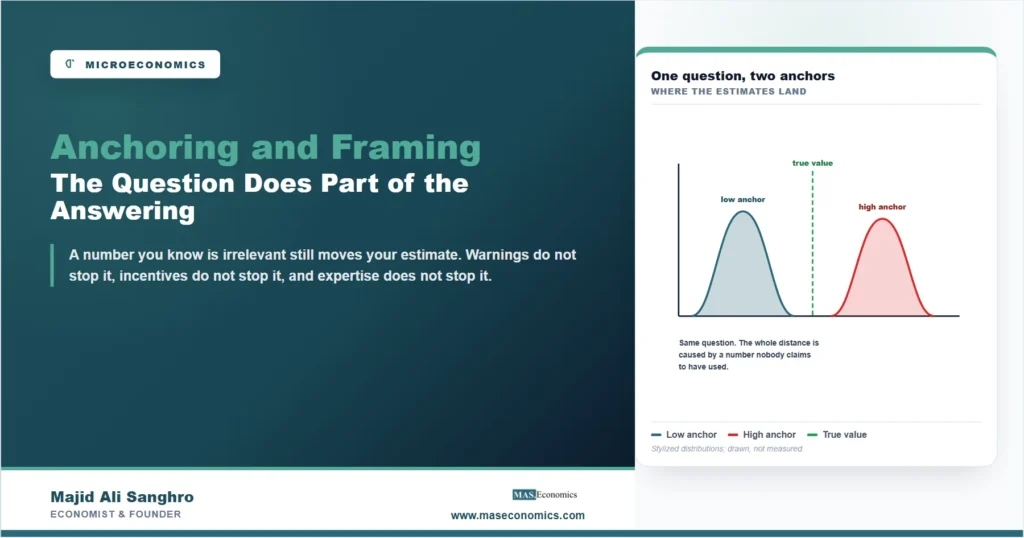
Spin a wheel marked with numbers in front of someone, let it stop, then ask them what percentage of United Nations member states are in Africa. People who watched the wheel stop on a high number give a much higher estimate than people who watched it stop on a low one. Everyone can see the wheel is random. Everyone knows it has nothing to do with Africa. The estimate moves anyway. That is the anchoring effect, and alongside it sits framing, the finding that the same information presented differently produces different choices. Both are about the form a question takes rather than its content, which is why they unsettle the standard model more than a simple mistake would: a preference that changes with the wording is not a preference that was sitting there waiting to be measured.
A Number You Know Is Irrelevant Still Moves You
Anchoring is the tendency for a judgement to be pulled toward a number that was in view beforehand. The pull survives conditions designed to kill it. It works when the anchor is visibly random, as with the wheel. It works when people are told about the effect in advance and asked to resist it. It works when they are paid for accuracy. And it works on experts inside their own field: appraisers and agents given the same property with different asking prices produce valuations that differ in the direction of the price they were shown, while reporting that the asking price played no part in their thinking.
The usual explanation is anchoring and adjustment. Faced with a quantity that is hard to retrieve, people start from whatever number is available and adjust toward what seems right, and the adjustment stops as soon as the answer becomes plausible rather than continuing to the value they would have given unprompted. Because the plausible range is wide for anything uncertain, stopping early leaves the estimate near where it started. A second account, selective accessibility, holds that the anchor makes information consistent with it easier to recall, so the judgement is built from evidence the anchor selected. The two are not exclusive and the practical implication is the same: the damage is done before deliberate reasoning starts, which is why instructing people to be careful does so little.
Framing: the Same Facts, a Different Answer
Framing is the finding that logically equivalent descriptions produce different choices. It comes in three kinds that are often run together and are worth separating, because only one of them is fully explained by the machinery in our article on prospect theory.
Risky choice framing is the classic case: describing the same policy in terms of lives saved rather than lives lost flips the majority from choosing the certain option to choosing the gamble. That reversal is a direct consequence of reference dependence, since the description moves the reference point and the value function is shaped differently above and below it. Prospect theory owns that case and explains it completely.
Attribute framing is simpler and needs no theory of risk. Describing minced beef as three-quarters lean rather than one-quarter fat changes how people rate its taste, healthiness and quality, with no uncertainty involved anywhere. The mechanism is that the description determines which associations are retrieved, and the evaluation is built from those. Goal framing is the third kind: telling people what they gain by acting rather than what they lose by not acting changes take-up rates, and the loss version is usually the more persuasive, which is a practical fact used in public health campaigns and in marketing every day.
| Effect | What changes | Example | Where it is explained |
|---|---|---|---|
| Anchoring | A number in view before the judgement | An asking price shifts an independent valuation | Anchoring and adjustment, selective accessibility |
| Risky choice framing | Gains or losses relative to a reference point | Lives saved against lives lost, same policy | Prospect theory: the reference point and the value function |
| Attribute framing | Which feature of an object is named | Three-quarters lean against one-quarter fat | Which associations the description makes available |
| Goal framing | Whether acting is a gain or not acting a loss | What screening gains you, or what skipping it costs | The loss version is typically the more persuasive |

|
|||
Where This Shows Up in Money
Anchoring is the reason a first offer matters in a negotiation. Whoever names a number first sets the range within which the rest of the conversation happens, and the standard advice to let the other side open is advice to hand them that power. The same logic runs through list prices, recommended retail prices and the higher-priced option placed beside the one a seller expects to sell, which works by supplying a comparison rather than by being bought. It runs through salary negotiations, where the current or previous salary anchors the next one, which is the practical argument behind rules that forbid employers from asking for salary history.
It also runs through anything measured by asking people. Willingness-to-pay surveys, contingent valuation of environmental damage and consumer research all produce numbers that move with the values offered in the question, which is why the design principles in our article on survey design treat the presentation of options as part of the instrument rather than as presentation. A study that offers a payment card starting at a high figure will collect higher valuations than one starting low, using identical respondents and an identical asset.
Framing shows up wherever the same fact can be stated two ways, which is nearly everywhere in economics. An interest rate is a cost of borrowing or a reward for saving. A tax is a payment or a purchase of services. Unemployment of five percent is also employment of ninety-five percent. None of these is a lie, and each will produce a different response, which is why the presentation of statistics is a substantive editorial choice rather than a stylistic one.
What Actually Reduces Them
The interventions that work are structural rather than motivational, and the ones that fail are the intuitive ones. Telling people about the bias does very little. Paying for accuracy does very little. Telling them to think harder does very little, and in the case of anchoring can make things worse by producing more reasons that support the anchor.
What helps is changing the process. Considering the opposite, meaning deliberately generating reasons the estimate might be too high and too low before answering, reduces anchoring measurably. Making an independent estimate before seeing any external number preserves a judgement that can then be compared rather than absorbed, which is why valuation processes that require a private figure before the asking price is revealed are designed the way they are. Collecting several judgements independently and combining them afterwards helps, because anchors that differ across people partly cancel, while a group discussion that starts with one person’s number does the reverse. And for framing, the standard discipline is to state the same fact both ways and check whether the decision changes, which takes a minute and is the only reliable test that a preference is real rather than manufactured by the wording.
The wider lesson connects to the tradition our article on satisficing and optimizing describes. These are not failures of intelligence but consequences of finite attention meeting an unlimited number of judgements. The productive response is not to demand better thinking from people but to design the questions, the defaults and the processes so that the answer depends on the thing being valued rather than on how it was asked. Our survey of behavioural economics places both effects in the wider field, and the experimental evidence they rest on is discussed in lab experiments.
MASEconomics Explains
3 concepts behind anchoring and framing
These concepts are explored in depth across our educational articles library.
Conclusion
The anchoring effect is the pull of a number that was in view before a judgement, and it survives everything intuition says should remove it: visible randomness in the anchor, warnings, financial incentives and professional expertise. The mechanism runs ahead of deliberation, starting from whatever is available and stopping as soon as the answer looks reasonable, which is why more effort does not fix it. Framing is its companion: logically equivalent descriptions produce different choices, and it comes in three kinds. Risky choice framing belongs to prospect theory and is fully explained by reference dependence; attribute and goal framing need no theory of risk at all and work by determining what comes to mind.
Both matter for economics because they attack the assumption underneath measurement rather than any particular result. If a valuation moves with the number printed beside the question, then willingness-to-pay surveys, negotiations, salary offers and contingent valuations are all reporting something partly constructed by their own procedure. The response that works is structural: form an independent estimate before seeing anyone else’s, consider the opposite before committing, collect judgements separately and combine them afterwards, and state every important fact both ways to see whether the decision survives. None of that requires people to be smarter. It requires the question to stop doing part of the answering.
Frequently Asked Questions
What is the anchoring effect?
The tendency for a numerical judgement to be pulled toward a number seen beforehand, even when that number is obviously irrelevant. In the classic demonstration a visibly random wheel changes people’s estimates of an unrelated quantity. The effect persists when subjects are warned about it, paid for accuracy, or are experts judging within their own field.
Why does anchoring work even when the anchor is obviously random?
Because the pull happens before deliberate reasoning. On the anchoring-and-adjustment account, people start from the available number and adjust until the answer becomes plausible rather than until it is right, and for uncertain quantities the plausible range is wide. On the selective accessibility account, the anchor makes consistent information easier to recall, so the judgement is assembled from evidence the anchor already selected.
What is the difference between framing and anchoring?
Anchoring is about a number that precedes the judgement and pulls it. Framing is about the description of the options themselves, where logically equivalent wordings produce different choices. Anchoring shifts a quantity; framing changes which option is chosen. Both are effects of presentation rather than of the content being judged.
What are the three types of framing effect?
Risky choice framing, where the same gamble described in gains or in losses flips the preference, which prospect theory explains through reference dependence. Attribute framing, where one equivalent feature is named instead of another, such as three-quarters lean rather than one-quarter fat. And goal framing, where acting is presented as a gain or not acting as a loss, with the loss version usually more persuasive.
How do anchoring and framing affect surveys and valuations?
Directly, because both are properties of the instrument. A willingness-to-pay question whose payment card starts high collects higher valuations than one starting low, from equivalent respondents about an identical asset. This is why the wording and the ordering of options are treated as part of the measurement in survey design rather than as presentation, and why valuation studies are scrutinised on their instrument as closely as on their sample.
Can anchoring be avoided?
Reduced rather than removed, and only by changing the process. Warnings, incentives and instructions to think harder achieve very little. What helps is forming an independent estimate before any external number is seen, deliberately considering reasons the estimate could be too high and too low, and gathering several judgements separately before combining them, so that differing anchors partly cancel instead of one being adopted by the group.
Thanks for reading! A preference that moves with the wording was never quite sitting there waiting to be measured, and the fix is in the question rather than in the person answering it. Happy learning with MASEconomics