Every few years, somewhere in the emerging world, a currency loses a tenth of its value against the dollar and the country’s exporters end the year less competitive than they began it. The paradox dissolves once you know that there are two exchange rates wearing one name. The distinction between the real vs nominal exchange rate is the difference between the price of a currency and the price of a country: the nominal rate is the number on the trading screen, how many rupees, lira, or yen one dollar buys, while the real rate asks what actually matters for trade, namely how expensive one country’s goods are in terms of another’s once both currencies and both price levels are counted. Currencies are compared on screens; countries compete through baskets of goods; and the two comparisons can move in opposite directions for years at a time. Most confusion about exchange rates in public debate, from misread depreciations to misplaced celebrations, traces back to watching the nominal number while the real one does the work.
Two Prices Wearing One Name
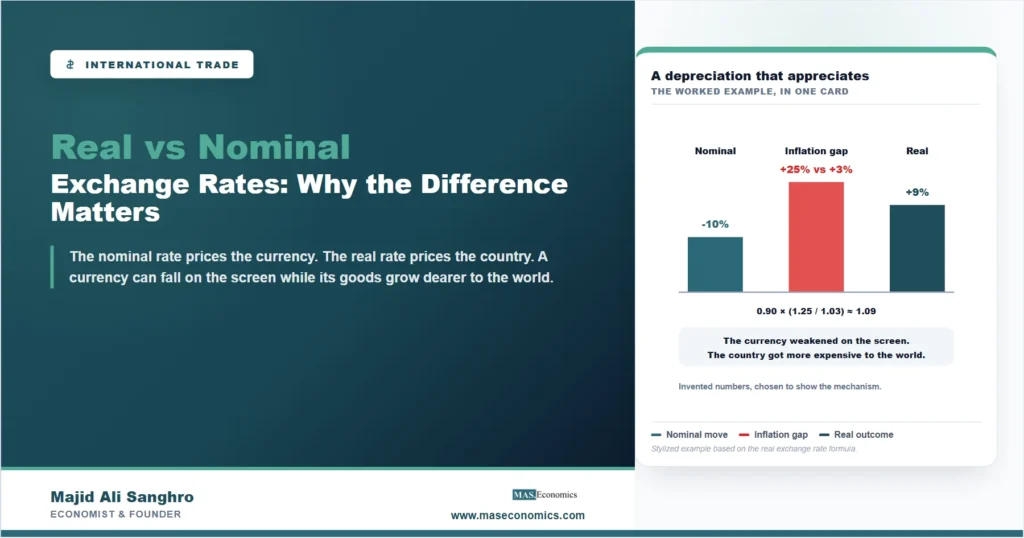
Start with the intuition before the formula. Suppose a haircut costs 1,000 rupees in Karachi and 20 dollars in New York, with the nominal rate at 280 rupees per dollar. The Karachi haircut costs about 3.60 dollars, roughly a fifth of the American price: in real terms, Pakistani services are cheap, whatever the screen says about the rupee. Now let a year pass in which the rupee slides to 300 per dollar, a nominal depreciation, while Pakistani prices rise 25 percent and American prices rise 3 percent. The haircut now costs 1,250 rupees, which at 300 per dollar is about 4.17 dollars against the American 20.60. Pakistani services became more expensive relative to American ones even as the currency weakened, because domestic inflation outran the depreciation. That relative-price movement is a real appreciation hiding inside a nominal depreciation, and it is the exporters’ whole problem.
The formula simply generalizes the haircut. Writing the nominal rate as the foreign-currency price of home currency, the real exchange rate is
where the two \(P\) terms are national price levels. A rise in the real rate means home goods have become dearer relative to foreign goods, a real appreciation; a fall is a real depreciation. The nominal rate enters once, but the price levels enter every day, which is why high-inflation countries can depreciate continuously on the screen while gaining nothing in competitiveness on the ground. The theory of where the real rate should settle in the long run, with identical baskets costing the same everywhere, is purchasing power parity, and the speed at which nominal movements leak into domestic prices, closing the gap from the other side, is the subject of our article on exchange rate pass-through.
Why the Real Rate Is the One That Bites
Trade responds to the real rate because trade is a comparison of costs. An exporter wins orders when producing at home and selling abroad beats the foreign buyer’s alternatives, and that calculation involves home wages and prices converted at the nominal rate against foreign prices, which is exactly what the real rate summarizes in one number. A sustained real depreciation makes a country’s labor and goods genuinely cheaper to the world, the condition under which export industries expand; a real appreciation prices them out quietly, however patriotic the nominal chart looks. This is why the high-inflation economy on the depreciation treadmill, running nominal devaluations that its own inflation eats within months, never gains the competitiveness it keeps paying the inflationary price for, and why its trade deficit refuses to respond to the falling currency. The broader machinery connecting currencies to trade flows is mapped in our article on exchange rates in global trade.
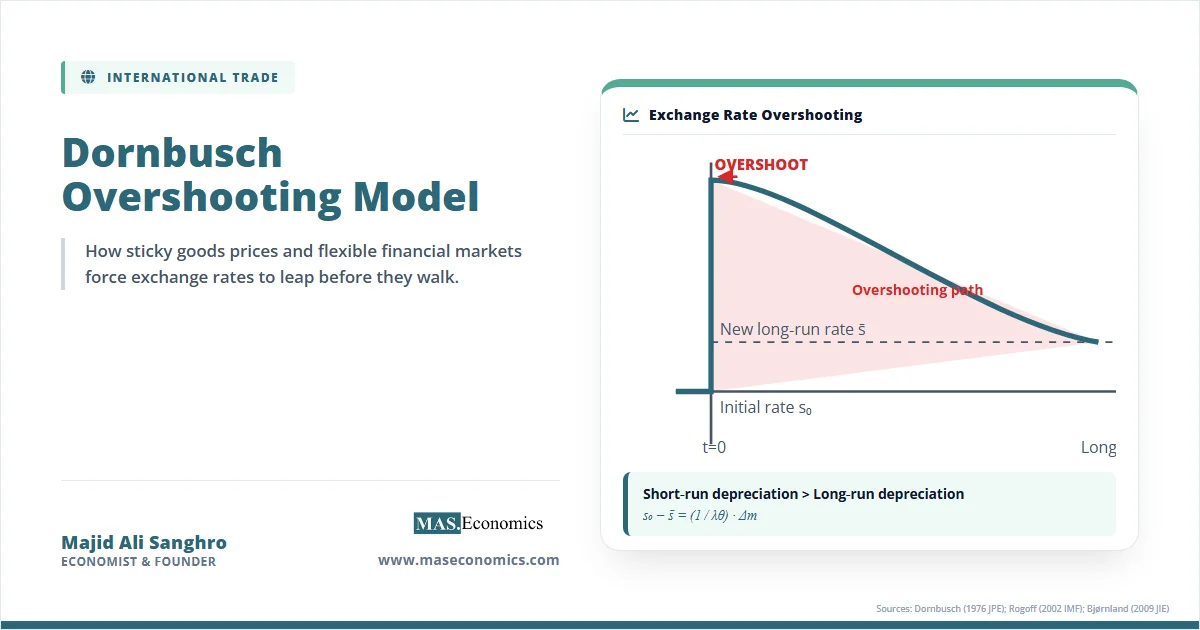
The short run adds a complication worth knowing: the two rates are volatile in different ways. Nominal rates are asset prices, repricing by the second with news and interest rates, while national price levels crawl, adjusting over months and years. The consequence, formalized in the Dornbusch overshooting model, is that in the short run the real rate simply inherits the nominal rate’s jumpiness, because prices have not had time to answer; over longer horizons the price levels catch up and purchasing power parity reasserts itself as a loose anchor. Real exchange rates therefore swing wide in the short run and mean-revert slowly, which is precisely the pattern that makes them both painful and informative.
Reading It in the Wild
The version used in practice adds one more layer. Countries trade with many partners, so analysts track the real effective exchange rate, a trade-weighted average of bilateral real rates against all significant partners; the Bank for International Settlements publishes effective exchange rate indices for dozens of economies, and the IMF maintains its own. An effective index above its long-run average is the standard first diagnosis of an overvalued currency, the condition that precedes many balance of payments crises, while an index held persistently low is the classic signature of a country leaning on exports. Two reading habits keep the concept honest. First, an index is only as good as its price measure, and consumer prices, producer prices, and unit labor costs can tell different stories about the same country. Second, never diagnose competitiveness from a nominal chart: a currency pair’s screen history answers a different question, and as our note on reading the yuan’s chart backwards showed, even the direction of a nominal plot is a convention that catches readers out. The real rate is the one doing the economics; the nominal rate is how it is quoted.
MASEconomics Explains
3 economic concepts behind real vs nominal exchange rates
These concepts are explored in depth across our educational articles library.
Explore the MASEconomics BlogConclusion
The real vs nominal exchange rate distinction reduces to one sentence: the nominal rate prices the currency, the real rate prices the country. One is an asset price that moves by the second and fills the news; the other multiplies that price by the ratio of national price levels and thereby measures the only thing trade actually responds to, how dear one economy’s goods are in terms of another’s. The two can and do part company, most consequentially in high-inflation countries whose currencies weaken on screen while their goods grow dearer in the world, a real appreciation wearing a depreciation’s clothes.
The practical rules follow directly. Judge competitiveness only through the real rate, preferably the trade-weighted effective version, and check which price measure the index is built on. Expect real rates to inherit nominal volatility in the short run, since prices crawl while currencies jump, and to bend slowly toward purchasing power parity over long horizons. And treat any argument about a currency being strong or weak that never mentions the price levels as an argument about the wrong number: the screen quotes the rate, but the baskets settle the trade.
Frequently Asked Questions
What is the difference between the nominal and real exchange rate in simple terms?
The nominal rate is the market price of one currency in another, the number on the screen. The real rate adjusts that number for the price levels of the two countries, measuring how expensive one country’s goods are relative to the other’s. The nominal rate compares monies; the real rate compares what the monies buy.
Can a currency depreciate nominally but appreciate in real terms?
Yes, and it happens routinely in high-inflation economies. If the currency weakens 10 percent but domestic inflation exceeds foreign inflation by more than that, home goods still end up relatively dearer, which is a real appreciation. Exporters lose competitiveness even though the exchange rate chart shows a falling currency.
What is the real effective exchange rate (REER)?
It is a weighted average of a country’s real exchange rates against all its significant trading partners, with weights based on trade shares. Institutions such as the BIS and the IMF publish these indices, and analysts use deviations from long-run averages as a first gauge of whether a currency is overvalued or undervalued.
Which exchange rate matters for exporters?
The real rate. An exporter’s fortunes depend on home costs converted at the nominal rate against foreign prices, which is exactly what the real rate captures. A nominal depreciation helps only to the extent it is not eaten by domestic inflation, which is why sustained competitiveness gains require the real rate, not just the screen rate, to fall.
Does purchasing power parity actually hold?
Loosely and slowly. Real exchange rates deviate from parity for years, pushed by capital flows, interest rates, and sticky prices, but they tend to drift back over long horizons, making PPP a useful anchor rather than a day-to-day predictor. The standard reading is that parity disciplines the destination while saying little about the journey.
Thanks for reading! The screen quotes the currency; the baskets settle the trade. Happy learning with MASEconomics