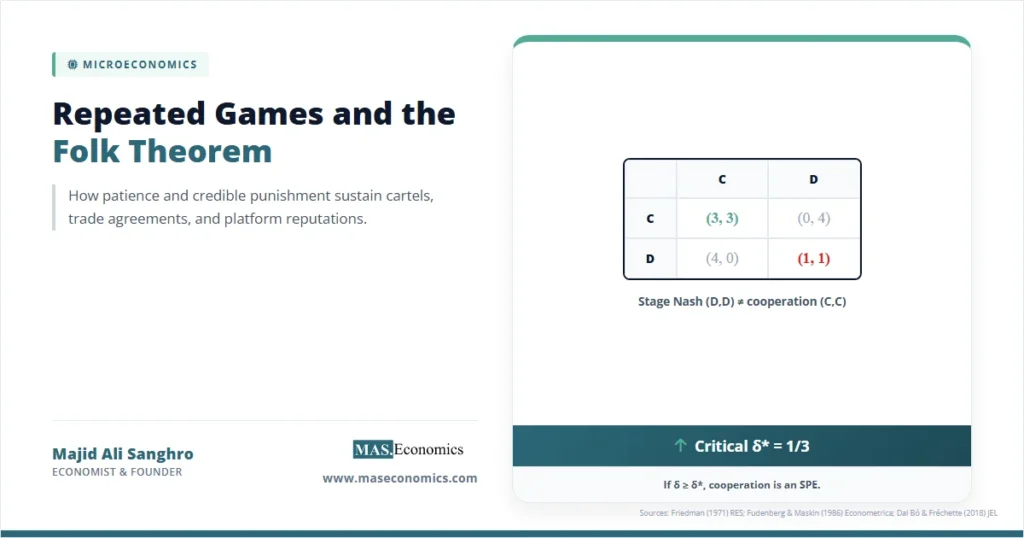
International cartels last about five years on average, according to Margaret Levenstein and Valerie Suslow’s survey of cartel evidence in the Journal of Economic Literature. The lysine cartel ran from 1992 to 1995. The vitamin cartel ran from 1989 to 1999. Yet in a one-shot prisoner’s dilemma with the same strategic structure, the Nash equilibrium is universal defection, not cooperation.
Repeated Games and Folk Theorem is the body of game theory that explains why cooperation can still emerge without enforceable contracts. When the same stage game is repeated indefinitely, and players care enough about future payoffs, credible punishment can make cooperation rational today.
The result is called “folk” because parts of it circulated informally among game theorists before formal publication. James Friedman’s 1971 supergames paper gave a rigorous Nash-reversion version. Drew Fudenberg and Eric Maskin later generalised the result in Econometrica. The result now sits behind modern theories of tacit collusion, trade reciprocity, reputation, and relational contracts.
Why Repetition Changes Strategy
A one-shot prisoner’s dilemma produces a bleak prediction. Each player has a private incentive to defect, regardless of what the other player does. Mutual defection is therefore the Nash equilibrium, even though both players would be better off under mutual cooperation. The stage game has a conflict between individual incentive and collective efficiency.
Repetition changes the calculation because a current action affects future behaviour. A player who defects today may earn a high current payoff, but loses the stream of cooperative payoffs that would otherwise have followed. The decision is no longer “cooperate or defect once.” It becomes a comparison between a one-period temptation and a future punishment.
The Folk Theorem turns that comparison into a general result. If players are sufficiently patient, many payoff outcomes that cannot be sustained in a single round can be sustained in an infinitely repeated game. The reason is simple. Patient players value the future enough that the threat of punishment tomorrow disciplines behaviour today.
This logic differs from the Coase theorem. Coasean bargaining relies on clear property rights and enforceable agreements. Repeated-game cooperation can emerge even when explicit contracts are absent, illegal, incomplete, or impossible to enforce. Cartels cannot write legal price-fixing contracts. Countries cannot always rely on a world government to enforce trade agreements. Online sellers cannot perfectly bind themselves to quality before delivery. In each case, future punishment can partly replace formal enforcement.
The logic also links directly to game theory mathematics. The key object is not only the one-shot equilibrium. It is the entire sequence of actions, histories, beliefs, and continuation payoffs. A strategy in a repeated game specifies what a player does after every possible history, including histories that never occur on the equilibrium path.
The Mathematics of Patience
Start with a finite simultaneous-move stage game:
Here \(N\) is the set of players, \(A_i\) is player \(i\)’s action set, \(A = \prod_i A_i\) is the set of action profiles, and \(u_i: A \to \mathbb{R}\) is player \(i\)’s stage payoff function. Let \(a^N\) denote a Nash action profile of the stage game.
The infinitely repeated game \(G^\infty(\delta)\) repeats \(G\) in periods \(t = 0, 1, 2, \dots\). A history before period \(t\) is:
A repeated-game strategy for player \(i\), written \(\sigma_i\), maps every history into an action. The repeated-game payoff is the average discounted payoff:
The discount factor \(\delta \in (0,1)\) measures patience. A low \(\delta\) means future payoffs matter little. A high \(\delta\) means future payoffs matter a great deal. The \((1-\delta)\) term normalises the infinite stream so that repeated-game payoffs can be compared with one-period payoffs.
The next key concept is the minmax payoff. In pure strategies, player \(i\)’s minmax payoff is:
This is the lowest payoff the other players can hold \(i\) to, assuming \(i\) responds optimally. In mixed strategies, the same definition uses mixed-action profiles. A payoff below the minmax cannot be sustained in equilibrium because player \(i\) can guarantee at least \(\underline{v}_i\) by choosing a best response to the punishment profile.
Let \(V\) be the convex hull of feasible stage-game payoff vectors. The feasible and individually rational set is:
Friedman’s version of the Folk Theorem states that if a feasible payoff vector \(v^*\) Pareto-dominates the stage-game Nash payoff \(u(a^N)\), then for sufficiently large \(\delta\), there exists a Subgame Perfect Equilibrium of \(G^\infty(\delta)\) with average discounted payoff \(v^*\). The equilibrium is supported by Nash-reversion trigger strategies: cooperate while no deviation has occurred, then revert forever to the stage-game Nash equilibrium after a deviation.
Fudenberg and Maskin’s version is broader. Under a full-dimensionality condition on \(V^*\), every feasible and individually rational payoff vector can be sustained as a Subgame Perfect Equilibrium payoff when players are sufficiently patient. The punishment need not be simple Nash reversion. It can use minmax punishments that target the deviator more directly.
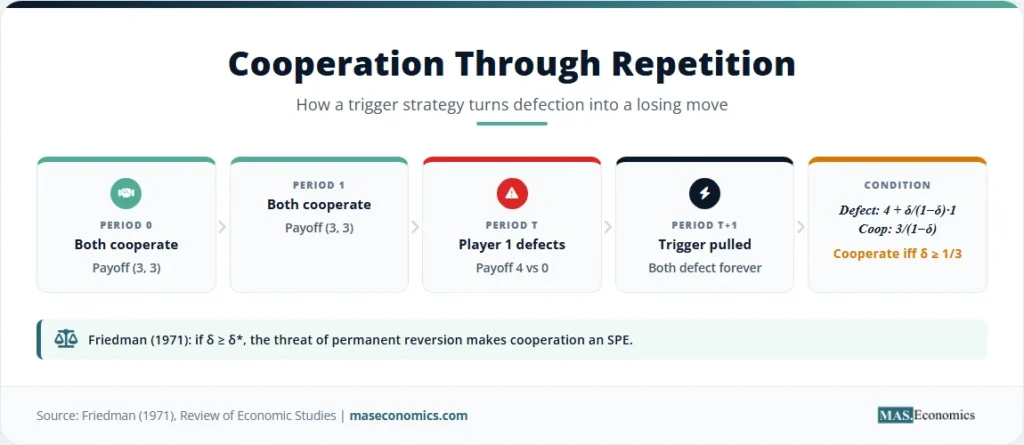
The canonical prisoner’s dilemma makes the critical discount factor visible. Suppose the stage-game payoffs are: mutual cooperation gives \(u_c = 3\), unilateral defection gives \(u_d = 4\), and mutual defection gives \(u_p = 1\). Under grim-trigger strategies, cooperation is sustainable if:
Substituting the payoffs gives:
When \(\delta \geq 1/3\), the future loss from permanent punishment outweighs the one-period gain from defection. Cooperation becomes a Subgame Perfect Equilibrium, even though defection remains the unique Nash equilibrium in the one-shot game.
| Symbol | Name | Definition |
|---|---|---|
| \(G\) | Stage game | One-shot simultaneous game repeated over time. |
| \(\delta\) | Discount factor | Patience parameter between zero and one. |
| \(h^t\) | History | Sequence of past action profiles before period \(t\). |
| \(\sigma_i\) | Strategy | Rule mapping histories into actions for player \(i\). |
| \(U_i(\sigma)\) | Repeated payoff | Average discounted payoff from a repeated-game strategy profile. |
| \(\underline{v}_i\) | Minmax payoff | Lowest payoff opponents can impose on player \(i\). |
| \(V^*\) | FIR set | Feasible and individually rational payoff set. |
| \(\delta^*\) | Critical discount | Minimum patience level required to sustain cooperation. |

|
||
When the Theorem Narrows
The Folk Theorem is powerful because it turns patience into enforcement. Its reach depends on demanding assumptions. The first is an infinite horizon, or at least an interaction with no commonly known final period. If the same prisoner’s dilemma is repeated a fixed finite number of times and the stage game has a unique Nash equilibrium, backward induction unravels cooperation. In the last period, defection is optimal. Knowing this, defection is optimal in the second-last period. The argument rolls backward to the first period.
The second assumption is common knowledge of patience. Players must know that future payoffs matter enough to others. If one firm believes a rival is about to exit the market, the threat of future punishment becomes weak. If one country believes another government has a short political horizon, retaliation may not discipline current policy.
The third assumption is observability. Friedman’s trigger strategy works cleanly under perfect monitoring, where deviations are observed. Real markets rarely offer that clarity. Price cuts may be hidden through rebates, bundled contracts, delivery terms, or quality changes. In repeated oligopoly, a fall in price may reflect cheating or a demand shock. Green and Porter’s imperfect price information model shows how collusion can involve temporary price wars even when no firm has actually cheated.
The fourth assumption is technical. The Fudenberg-Maskin theorem uses a full-dimensionality condition on the feasible payoff set. This condition prevents the payoff space from collapsing into a lower-dimensional object where punishments cannot separately discipline different players. The fifth is common knowledge of rationality. The strategies supporting the equilibrium rely on players correctly anticipating responses after every history.
These assumptions do not make the theorem irrelevant. They define where it is strongest. The theory is most informative when interactions are repeated, identities are stable, deviations are at least partly observable, future payoffs matter, and credible punishments are available. When monitoring becomes noisy, Abreu, Pearce, and Stacchetti’s imperfect monitoring framework replaces simple grim triggers with recursive punishment phases. With private monitoring, the equilibrium structure becomes still more complex because each player may receive different signals about what happened.
The deeper limitation is multiplicity. The Folk Theorem says many outcomes can be equilibria. That breadth is a strength for explaining how cooperation is possible, but a weakness for prediction. It does not say which equilibrium will be selected without more detail on institutions, communication, norms, learning, or focal points.
Evidence from Cartels and Labs
Empirical work shows the repeated-game logic most clearly in three settings: cartels, trade agreements, and laboratory games. In each case, cooperation depends less on moral commitment than on future consequences.
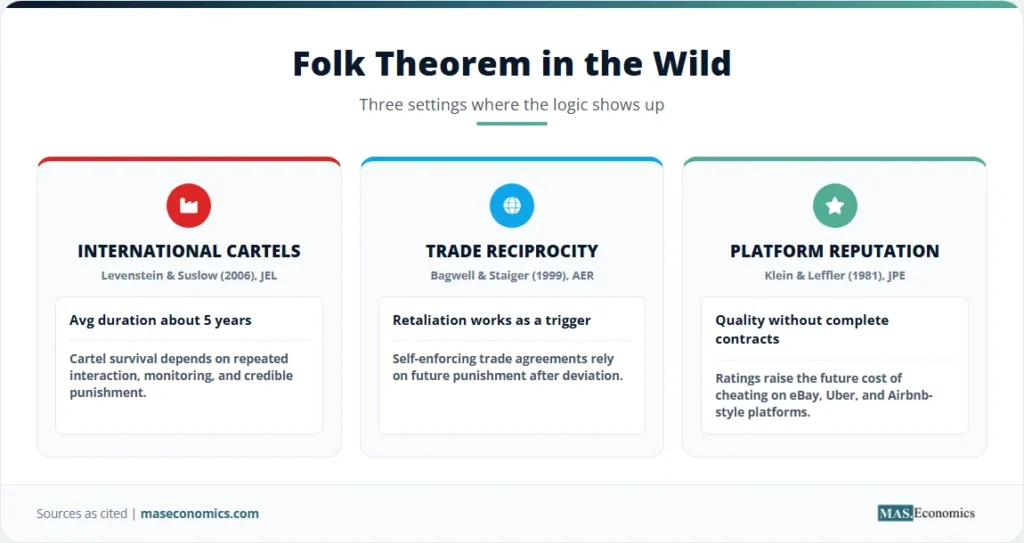
Cartel evidence is the closest industrial-organisation application. Levenstein and Suslow’s cartel survey shows that many cartels survive for years, but duration varies sharply. Some collapse quickly. Others persist long enough to shape prices and output across markets. This pattern fits repeated-game reasoning. Collusion is easier when firms monitor each other, demand is stable, market shares are observable, and punishment is credible. Collusion is harder when shocks create uncertainty about whether a rival cheated.
The lysine cartel and vitamin cartel illustrate the mechanism. Both depended on repeated interaction, market monitoring, quota discipline, and punishment threats. Both also show why explicit collusion is legally vulnerable. The same repeated-game incentives that sustain cooperation among firms can harm consumers, which is why antitrust law treats cartel agreements as serious violations.
Trade-policy reciprocity is the second field. Bagwell and Staiger’s economic theory of GATT treats reciprocal trade agreements as self-enforcing arrangements. Countries reduce tariffs because deviation can trigger retaliation. The World Trade Organization does not operate like a domestic court with police power. Its enforcement rests heavily on authorised retaliation, reputation, and repeated interaction. That makes trade agreements a close institutional cousin of the Folk Theorem.
The same logic appears in tariff escalation. When one country raises a tariff, another may respond not only to recover losses, but to preserve the credibility of future cooperation. The economics of tariff retaliation is therefore dynamic. A country may accept a short-run cost to maintain a long-run enforcement system.
Laboratory experiments provide direct evidence on the discount factor. Dal Bó and Fréchette’s Journal of Economic Literature survey finds that cooperation in indefinitely repeated prisoner’s dilemma experiments rises when cooperation is theoretically supportable. High continuation probabilities make future punishment more valuable. Low continuation probabilities make defection more attractive.
The chart shows the central mechanism. Once the discount factor rises well above the critical threshold in the canonical prisoner’s dilemma, cooperation becomes more common. The exact values vary across experimental designs, but the direction is stable: patience expands the practical scope for cooperation.
From Cartels to Reputation
The Folk Theorem matters because many economic institutions rely on self-enforcement. Formal contracts are often incomplete. Some actions are hard to verify in court. Some agreements are illegal. Some relationships cross borders where enforcement authority is weak. Repetition supplies an enforcement technology: future gains can discipline current behaviour.
In industrial organisation, the theory explains why repeated price competition can soften rivalry. A one-shot Bertrand pricing game often produces intense price cuts. Repeated interaction can support higher prices when firms observe deviations and can punish them. This is why competition authorities look for market features that make coordination easier: few firms, repeated contact, transparent prices, stable demand, and similar cost structures. The logic connects directly to Cournot oligopoly and repeated price-setting models.
Leniency programmes attack this logic. If the first cartel member to report receives immunity or reduced penalties, the payoff from defection rises. In the critical discount formula, a larger deviation payoff and a more dangerous punishment environment can destabilise cooperation. The design goal is not only to punish existing cartels. It is to make future cartel cooperation harder to sustain.
In international trade, repeated-game theory explains why reciprocity matters. Trade agreements are not only lists of tariff commitments. They are systems of expectations. A country that violates an agreement may gain today, but faces retaliation, lost credibility, and weaker bargaining power tomorrow. The result connects naturally to trade agreements, dispute settlement, and the economics of strategic interdependence.
In reputation models, the same logic supports quality without perfect contracts. Klein and Leffler’s contractual performance model shows how repeat purchases can discipline sellers. A firm may supply high quality today because cheating destroys future profits. The brand premium is not just marketing. It is a bond that the firm loses if it cheats.
Labour markets also contain repeated-game logic. Implicit contracts, gift-exchange wages, and relational employment arrangements depend on future interaction. A worker may exert effort beyond what a formal contract can verify because future employment, promotion, or reputation has value. A firm may pay above the spot-market wage because shirking, turnover, and distrust are costly. These mechanisms are not identical to the textbook prisoner’s dilemma, but they share the same structure: current behaviour is disciplined by future consequences.
Digital platforms make the mechanism explicit. On eBay, Uber, Airbnb, and similar marketplaces, ratings convert past behaviour into future payoff consequences. A seller who cheats may gain in one transaction but lose future demand. A driver, host, or buyer faces a reputational continuation value. Platform reputation systems are therefore institutional devices that raise the cost of defection and make cooperation more sustainable.
The same logic also appears in mechanism design and auction theory. Designers often try to align incentives so that truthful or cooperative behaviour is optimal. Repeated games take a different route. Instead of changing the one-shot mechanism, they use history and continuation payoffs to discipline behaviour.
The policy lesson is precise. Cooperation without contracts is possible when future surplus is large, monitoring is credible, punishment is targeted, and the relationship has no known final date. It is fragile when exit is easy, signals are noisy, short-run gains are large, or punishment lacks credibility. That is why repeated-game theory is useful for both explaining cooperation and identifying where cooperation may fail.
MASEconomics Explains
4 economic concepts behind repeated-game cooperation
These concepts are explored in depth across our educational articles library.
Explore the MASEconomics BlogConclusion
Repeated Games and Folk Theorem explains how cooperation can emerge without enforceable contracts when future payoffs are valuable enough. The mathematical core is the comparison between a one-period gain from defection and the discounted loss from future punishment. In the canonical prisoner’s dilemma, grim-trigger cooperation is sustainable when \(\delta \geq 1/3\). Friedman’s theorem shows how Nash-reversion can support cooperative outcomes. Fudenberg and Maskin’s theorem shows a broader result: under suitable conditions, every feasible and individually rational payoff can be sustained by sufficiently patient players.
The empirical record fits the mechanism. Cartels survive when monitoring and punishment are credible. Trade agreements rely on reciprocity and retaliation. Laboratory experiments show cooperation rising with the continuation probability. Reputation systems in digital platforms turn past conduct into future payoffs, making quality and trust possible even when contracts are incomplete.
Frequently Asked Questions
What is the Folk Theorem in repeated games?
The Folk Theorem is a class of results showing that many feasible and individually rational payoffs can be sustained as equilibria in repeated games. The central condition is patience: players must value future payoffs enough for punishment threats to deter current defection.
Why does repetition make cooperation possible?
Repetition links current actions to future consequences. A player who defects today may gain once, but loses future cooperative payoffs if others punish the deviation. When the future loss is large enough, cooperation becomes rational.
What is a trigger strategy?
A trigger strategy starts with cooperation and switches to punishment after a deviation. Grim trigger is the harshest form because one defection leads to permanent punishment. Softer trigger strategies allow punishment phases followed by a return to cooperation.
What is the critical discount factor?
The critical discount factor is the minimum level of patience required to sustain cooperation. In the canonical prisoner’s dilemma with cooperation payoff 3, deviation payoff 4, and punishment payoff 1, the threshold is \(\delta^* = 1/3\).
Does the Folk Theorem predict one outcome?
No. The Folk Theorem usually predicts a large set of possible equilibrium payoffs. It explains why cooperation can be sustained, but extra information about institutions, monitoring, communication, and norms is needed to predict which equilibrium will occur.
Thanks for reading! If you found this helpful, share it with friends and spread the knowledge. Happy learning with MASEconomics