Microeconomics Deadweight Loss: Welfare Cost of Market Distortions Deadweight loss is the welfare triangle that disappears when taxes, tariffs, monopolies, or price controls cut off mutually beneficial trade... May 24, 2026
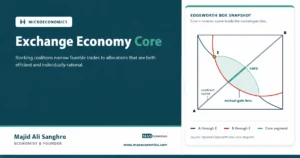
Microeconomics Core of an Exchange Economy: Blocking Coalitions core of an exchange economy analysis explains how blocking coalitions restrict feasible trades and why competitive markets shrink the stable... May 21, 2026
Microeconomics Contract Curve: Pareto Efficient Allocations contract curve analysis derives Pareto-efficient allocations in an Edgeworth box by equating two agents’ marginal rates of substitution at tangency... May 20, 2026
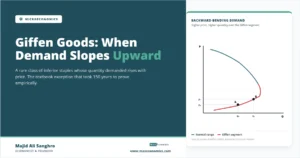
Microeconomics Giffen Goods: When Demand Curves Slope Upward Giffen goods are inferior staples whose demand rises with price because the income effect overwhelms substitution. Jensen and Miller's 2008... May 19, 2026
Microeconomics Marginal Rate of Substitution: Slope, Concavity, and Choice The marginal rate of substitution is the slope of the indifference curve at a point and the ratio of marginal... May 19, 2026
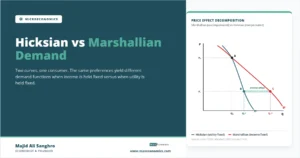
Microeconomics Hicksian vs Marshallian Demand: Two Curves, One Consumer Hicksian vs Marshallian demand is the central duality of consumer theory. One holds income constant for empirical work; the other... May 18, 2026
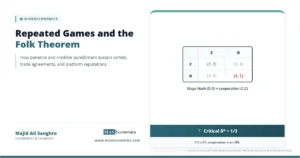
Microeconomics Repeated Games and Folk Theorem: How Cooperation Emerges Without Contracts Repeated Games and Folk Theorem explains how patience, punishment, and reputation sustain cooperation when formal contracts cannot enforce behaviour. May 12, 2026
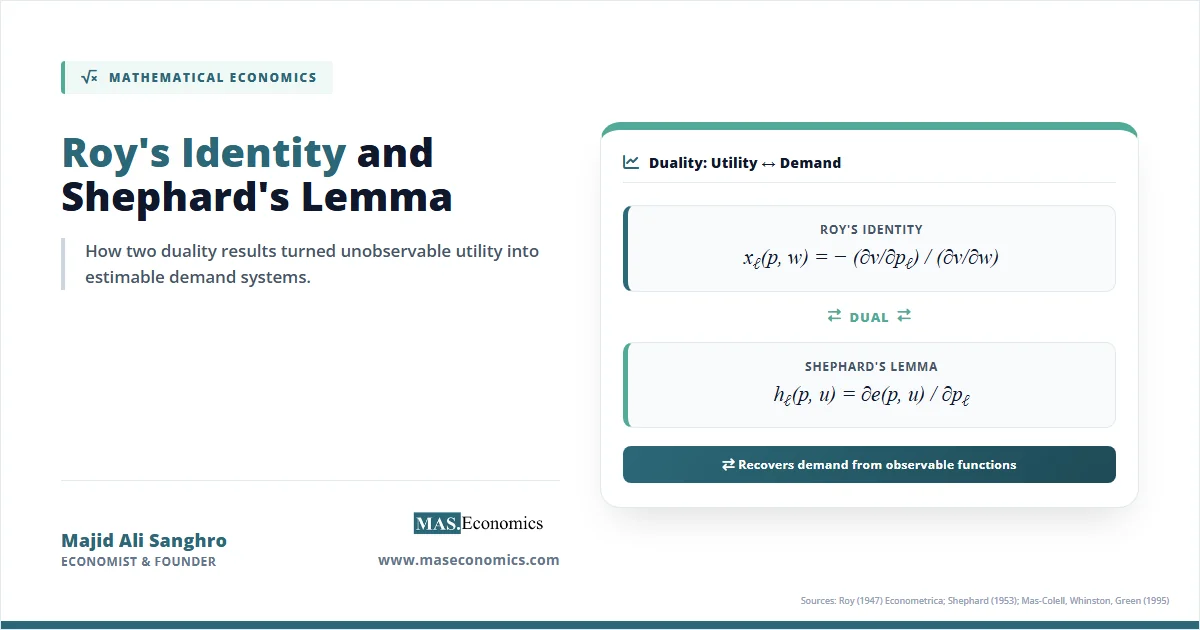
Mathematical Economics Roy’s Identity and Shephard’s Lemma: Recovering Demand from Utility and Cost Roy's Identity and Shephard's Lemma are the duality results that recover Marshallian and Hicksian demand from indirect utility and expenditure... May 10, 2026
Microeconomics Hotelling Rule: Pricing Non-Renewable Resources Over Time The Hotelling Rule states that the net price of an exhaustible resource must rise at the real interest rate, the... May 7, 2026
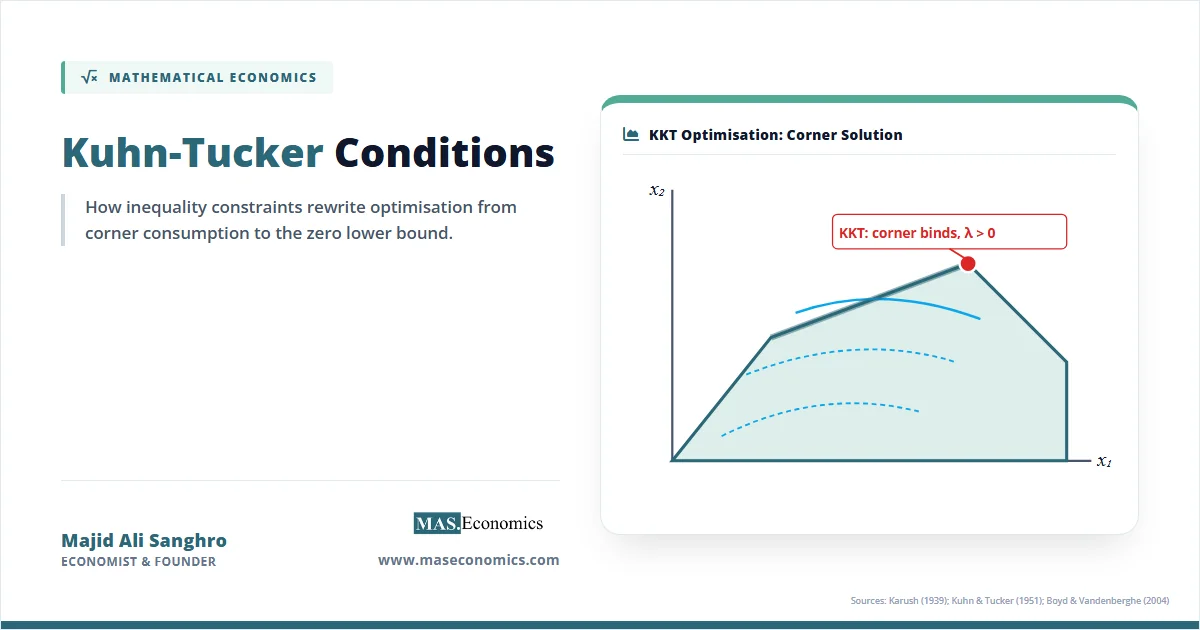
Mathematical Economics Kuhn-Tucker Conditions: Optimisation with Inequality Constraints The Kuhn-Tucker Conditions extend Lagrangian optimisation to inequality constraints through complementary slackness, the principle that supports modern microeconomics, finance, and... May 6, 2026