
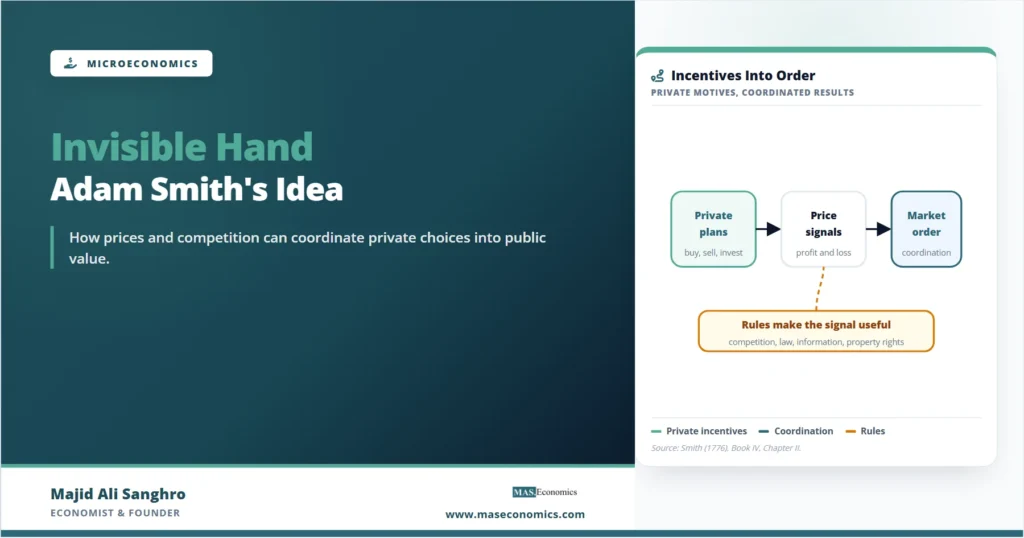
In 1776, Adam Smith published An Inquiry into the Nature and Causes of the Wealth of Nations, a book that became central to modern economic thought. One phrase from that work became more famous than almost any other: invisible hand. The idea is simple to state but easy to misuse.
The invisible hand describes a situation in which people pursuing their own interests can, under the right conditions, help produce social benefits they did not directly intend. A baker does not need to love every customer to sell bread. A shop owner does not need to plan national welfare to stock useful goods. A worker does not need to design the economy to specialize in a task that others value. Prices, competition, profit, loss, and exchange can coordinate separate plans.
That does not mean self-interest always produces good outcomes. Smith did not describe greed as a universal public good. The invisible hand works only when institutions, competition, information, property rights, and the rule of law give self-interested behavior a productive channel. Without those conditions, private incentives can create monopoly power, pollution, fraud, exploitation, or financial instability.
What Smith Actually Meant
The invisible hand is often presented as if Smith used it to summarize all free-market economics. The original use was narrower. In Book IV, Chapter II of The Wealth of Nations, Smith discussed merchants and capital owners who preferred to invest closer to home when profits were similar. They did so for their own security and convenience, not from public spirit. Yet that private choice could support domestic industry and employment.
Smith’s point was about unintended social effects. A person may pursue security, profit, or convenience. If the market rules are sound, that person may also help allocate capital, supply goods, employ workers, or expand output. The public benefit is not necessarily the motive. It is a by-product of decentralized coordination.
This is why the invisible hand is best understood as a mechanism, not a slogan. It does not say markets are moral by definition. It says that under certain conditions, decentralized exchange can coordinate decisions better than a central authority trying to direct every buyer, seller, worker, and investor.
Smith also wrote The Theory of Moral Sentiments, where he analyzed sympathy, moral judgment, and social approval. That matters because Smith was not describing human beings as purely selfish machines. He understood self-interest, but he also understood norms, justice, reputation, and moral restraint. A serious reading of the invisible hand keeps both books in view.

Prices Carry Information No One Person Fully Holds
The invisible hand begins with the information problem. No single person knows everything about consumer preferences, production costs, transport conditions, local shortages, available substitutes, worker skills, or future risks. A market price compresses some of that scattered information into a signal that buyers and sellers can act on.
If demand for a product rises, the price may increase. Buyers then have a reason to economize, search for substitutes, or signal that they value the good highly. Sellers have a reason to produce more, enter the market, or shift resources toward that product. The price does not need to explain every cause. It gives people a practical signal.
The MASEconomics guide to supply and demand explains this coordination process through curves, quantities, and equilibrium. The invisible hand is the broader idea behind that process: many separate decisions can become orderly because prices transmit incentives.
Prices are not perfect. They may fail to reflect pollution, unpaid care work, monopoly power, public goods, or unequal bargaining power. But when markets are competitive and information is reasonably available, prices help coordinate plans without requiring every participant to understand the entire economy.
Self-Interest Is Not the Same as Social Welfare
A common mistake is to treat the invisible hand as a claim that selfishness is always good. That is not careful economics. Self-interest can produce useful goods, innovation, cost savings, and specialization. It can also produce deception, market power, unsafe products, pollution, and underinvestment in public goods. The direction depends on incentives and constraints.
When a firm earns profit by lowering costs through better technology, consumers may benefit from lower prices and better goods. When a firm earns profit by hiding risk, blocking competitors, or shifting pollution costs onto others, private gain can reduce social welfare. The invisible hand is not a moral guarantee. It is a coordination mechanism that needs rules.
This is where welfare analysis and political economy connect directly. A positive statement can describe how self-interest affects market outcomes. A normative statement asks whether those outcomes are fair, efficient, acceptable, or worth changing through policy. The MASEconomics article on public choice theory explains why policy decisions also involve incentives.
Smith himself warned against concentrated producer interests. In The Wealth of Nations, he criticized monopolies, restraints on trade, and arrangements that protect particular producers at the expense of the wider public. The MASEconomics article on consumer tariff burden shows how trade policy can shift costs across buyers, firms, and foreign producers. A serious invisible-hand argument therefore does not mean “leave every market alone.” It asks whether the rules make private incentives serve public value.
Competition Is the Discipline Behind the Mechanism
Competition matters because it limits the ability of any one seller to ignore consumers. A firm that charges too much, reduces quality, or fails to innovate may lose business if buyers have alternatives. A worker may seek better employment if another firm offers higher wages. An investor may move capital away from an unproductive use if losses continue.
Without competition, the invisible hand becomes weaker. A monopoly can restrict output and raise price. A cartel can coordinate behavior that harms consumers. A dominant platform can shape access to markets. When entry is blocked, private interest may no longer push resources toward their most valued uses.
The US Department of Justice and Federal Trade Commission Merger Guidelines show how modern competition policy evaluates mergers that may reduce rivalry. That is not a rejection of markets. It is recognition that markets need competitive structure if price signals are to work well.
The MASEconomics article on market structures makes the same point in microeconomic terms. Perfect competition, monopoly, oligopoly, and monopolistic competition do not produce identical outcomes. The invisible hand is most persuasive when buyers and sellers face meaningful alternatives.
| Condition | Why it helps coordination | What can go wrong when missing |
|---|---|---|
| Competition | Pushes sellers to lower costs, improve quality, and serve buyers. | Monopoly power, cartels, high prices, and restricted output. |
| Clear property rights | Gives people responsibility for assets, contracts, and returns. | Overuse, conflict, theft, and weak investment incentives. |
| Reliable information | Lets prices and choices reflect real quality, risk, and scarcity. | Fraud, adverse selection, hidden risk, and poor choices. |
| Low external costs | Keeps private decisions close to social costs and benefits. | Pollution, congestion, health harms, and unpaid social costs. |
| Rule of law | Enforces contracts and limits coercion, corruption, and predation. | Unreliable exchange, rent seeking, weak trust, and instability. |
|
|
||
Specialization Makes the Invisible Hand Visible
One reason the invisible hand seems mysterious is that modern production is deeply specialized. A simple product may involve designers, suppliers, transport workers, software systems, credit, retail space, insurance, energy, and customer service. No single buyer directs that full chain. Yet the product appears on a shelf because many people respond to prices, contracts, and profit opportunities.
Smith placed great emphasis on the division of labor. Specialization raises productivity because people can focus on narrower tasks, improve skill, save time, and use tools more effectively. But specialization also requires coordination. A worker who makes one part of a product must exchange for many goods and services that others produce.
The MASEconomics article on costs of production helps explain the production side. Labor, capital, land, and entrepreneurial effort must be combined before output appears. The invisible hand describes how markets can guide those inputs toward uses that buyers value, without a single planner assigning every input.
This process also depends on scarcity. Resources have alternative uses. Labor can work in one sector rather than another. Capital can fund one project rather than another. Land can support housing, farming, retail, or conservation. This is why invisible-hand reasoning is always about allocation, not abundance.
Where the Invisible Hand Fails
The invisible hand is strongest when private benefits and social benefits are closely aligned. It is weakest when private decision-makers can keep gains while shifting costs to others. Economists call this an externality. Pollution is the standard example: a firm may profit by producing cheaply while nearby households bear health or environmental costs.
Public goods also create problems. A public good is difficult to exclude people from using and one person’s use does not greatly reduce another’s use. National defense, some forms of basic research, and clean public information often fit this logic. Markets may underprovide them because private sellers cannot easily capture the full social benefit.
Information problems create another limit. If sellers know more than buyers about product quality, risk, or hidden defects, exchange may become distorted. Insurance markets, used-car markets, financial products, and medical services can all face information gaps. In those cases, prices alone may not communicate enough information for efficient coordination.
Macroeconomic instability is a further complication. Individual decisions to cut spending, reduce lending, or hold liquidity may be rational during uncertainty. If many people do the same thing at once, the economy can experience falling demand, rising unemployment, and recession pressure. The MASEconomics introduction to macroeconomics explains why choices that look sensible at the individual level may create broader aggregate effects.
What the Invisible Hand Teaches About Policy
The policy lesson is not that government should never act. It is that policy should respect the coordinating role of prices and incentives. When policy blocks price signals without solving the underlying scarcity, shortages and surpluses can appear. When policy protects incumbents from competition, consumers may pay more and innovation may slow.
At the same time, policy can improve markets when it corrects failures. Competition law can limit collusion and anti-competitive mergers. Disclosure rules can reduce information gaps. Pollution taxes or regulations can force private decisions to account for social costs. Public investment can support goods that markets underprovide.
The earlier discussion of industry structure shows that markets are not just places where buyers and sellers meet. They are institutional arrangements. Rules define who can trade, what counts as a valid contract, how disputes are settled, and what behavior is prohibited.
That is the most useful modern reading of the invisible hand. Markets can coordinate dispersed knowledge and self-interest, but they do so through institutions. Better policy does not ignore the invisible hand. It asks where the hand is working, where it is blocked, and where it is pushing private gain away from social value.
How to Read the Phrase Today
When you see the phrase invisible hand, ask three questions. First, what private incentive is being described? Second, what market signal carries information to buyers, sellers, workers, or investors? Third, what institutional condition makes the private incentive socially useful rather than socially harmful?
For example, a producer who lowers costs through innovation may create a private profit and a public benefit. Consumers may receive lower prices or better products. Competitors may imitate the innovation. Resources may shift toward more productive uses. In that case, invisible-hand logic is plausible.
But a producer who lowers costs by dumping waste into a river is different. The private cost falls, but the social cost rises. The price signal is incomplete because it excludes damage borne by others. In that case, invisible-hand language would hide the real economic problem instead of explaining it.
The phrase is powerful when used carefully. It reminds readers that order can emerge without a central order-giver. It becomes misleading when used as a blanket defense of every private decision. The difference is not ideological decoration. It is the difference between economic analysis and a slogan.
MASEconomics Explains
4 economic concepts behind the invisible hand
These concepts are explored in depth across our educational articles library.
Explore the MASEconomics BlogConclusion
The invisible hand is Adam Smith’s famous metaphor for the way private incentives can produce unintended social coordination under the right market conditions. It explains why prices, competition, specialization, profit, and loss can organize economic activity without a central planner directing every choice.
The idea is powerful because it shows how order can emerge from decentralized exchange. It is also limited because self-interest does not automatically equal social welfare. The invisible hand works best when competition is real, information is usable, property rights are clear, contracts are enforced, and external costs are addressed.
Frequently Asked Questions
What does the invisible hand mean in economics?
The invisible hand means that people pursuing their own interests can sometimes create broader social benefits they did not intend. In markets, prices, competition, profit, and loss can coordinate separate choices.
Who created the idea of the invisible hand?
The phrase is associated with Adam Smith, especially his 1776 book The Wealth of Nations. Smith used it to describe an unintended public benefit that can arise from private economic choices.
Does the invisible hand mean markets are always efficient?
No. The invisible hand works only under certain conditions. Monopoly power, externalities, public goods, fraud, and information gaps can prevent private incentives from producing efficient social outcomes.
Why are prices important to the invisible hand?
Prices carry information about scarcity, demand, costs, and opportunities. They guide buyers and sellers without requiring one person to know every detail of the economy.
What is an example of the invisible hand?
A firm may introduce a better product to earn profit. If consumers benefit, competitors improve, and resources move toward more valued uses, private gain has helped produce a social benefit.
Thanks for reading! If you found this helpful, share it with friends and spread the knowledge. Happy learning with MASEconomics