Japan’s population fell by about 550,000 people in a single year, the fourteenth consecutive year of decline, while its government carried debt worth more than twice the size of the entire economy. Those two facts, a shrinking nation and a mountain of public debt, define the modern Japan economy more than any growth rate does. For three decades Japan was the world’s cautionary tale of deflation and stagnation, the economy that could not generate inflation no matter how hard it tried. In 2026, that long story is finally turning, but not in the way anyone hoped: inflation has returned, the Bank of Japan is slowly raising interest rates for the first time in a generation, and the yen sits near multi-decade lows, all while the demographic clock keeps ticking.
Japan is the world’s fourth-largest economy, a high-income, technologically advanced society of about 124 million people built on manufacturing excellence, a powerful export sector, and enormous pools of domestic savings. Its companies dominate global markets in autos, machinery, robotics, and electronic components. Yet the same country combines that industrial strength with the developed world’s most severe aging crisis and its heaviest debt load. The tension between a productive, wealthy economy and an unsustainable demographic and fiscal trajectory is the thread that runs through everything that follows.
Lost Decades and Deflation Trap
To understand Japan in 2026, start with the asset bubble that burst at the start of the 1990s. Stock and property prices collapsed, banks were left with bad loans, and households and firms spent years repairing their balance sheets rather than spending and investing. The result was a prolonged period of near-zero growth and falling prices that became known as the lost decades. Deflation, once it set in, proved extraordinarily hard to escape, because falling prices encourage households to delay purchases and raise the real burden of debt, which depresses demand further.
The Bank of Japan spent those decades pushing interest rates to zero and below and pioneering the unconventional tools, large-scale asset purchases and yield curve control, that other central banks would later adopt. The full story of those experiments is the subject of our profile of the Bank of Japan. For years, the lesson of Japan was that conventional monetary policy can lose its power when rates are stuck at zero, and expectations turn deflationary, the condition described in liquidity trap economics. That trap shaped Japanese policy thinking, and the rest of the world’s, for a generation.
Return of Inflation
The deflationary era has now broken. Inflation returned to Japan, pushed first by global supply disruptions and a weak yen that raised import costs, and then sustained by something Japan had lacked for decades: rising wages. Annual spring wage negotiations have delivered solid pay increases, and the Bank of Japan has watched closely for evidence that wages and prices are now reinforcing each other in the moderate upward cycle it long wanted. By 2026, the central bank judged that mechanism strong enough to begin withdrawing its extraordinary support.
The energy shock from the Middle East conflict complicated the picture. The Bank of Japan raised its core inflation forecast for the fiscal year sharply, to 2.8 percent, while cutting its growth forecast to 0.5 percent, because higher crude prices squeeze a resource-poor importer’s corporate profits and household incomes at the same time. That combination of higher inflation and weaker growth is a mild version of the stagflation we examine in when inflation and recession hit together, and it is the immediate backdrop to the central bank’s caution. The way an energy shock transmits into a major economy is traced in our analysis of the 2026 Iran oil shock.
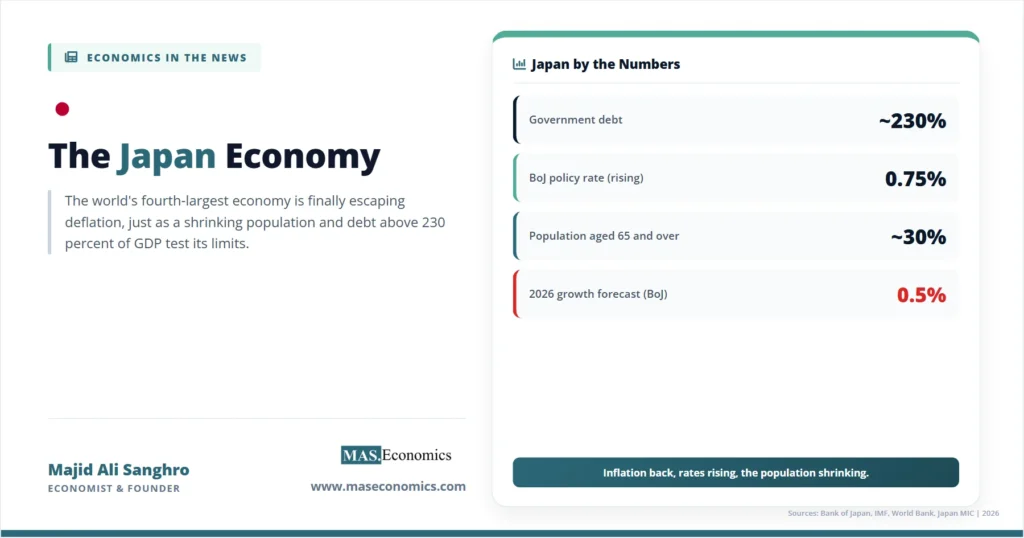
| Indicator | Value | Source and period |
|---|---|---|
| Economy size (global rank) | 4th largest | IMF, 2026 |
| Population | ~123.8 million | Japan MIC, Oct 2024 |
| BoJ growth forecast (FY2026) | 0.5% | Bank of Japan, April 2026 |
| BoJ core inflation forecast | 2.8% | Bank of Japan, April 2026 |
| Policy interest rate | 0.75% | Bank of Japan, April 2026 |
| Gross government debt | ~230% of GDP | IMF, 2025–2026 |
| Population aged 65 and over | ~30% | World Bank, 2025 |
|
Sources: IMF; Bank of Japan, Outlook Report (April 2026); Japan Ministry of Internal Affairs and Communications; World Bank.

|
||
Bank of Japan’s Exit
For the first time in a generation, the Bank of Japan is raising interest rates rather than cutting them. It lifted its policy rate in stages to 0.75 percent and signaled that further gradual increases would follow as inflation settles durably around its 2 percent target. The April 2026 decision to hold revealed an institution divided: a split vote with several members pushing for an immediate move to 1 percent, arguing that the energy shock had tilted price risks to the upside. The International Monetary Fund, in its 2026 review, endorsed the gradual withdrawal of stimulus and the move toward a neutral rate.
The exit is delicate for a reason unique to Japan’s scale of debt. After decades of bond buying, the central bank holds an enormous share of government debt, and raising rates increases the government’s interest costs on a debt pile larger than any other developed economy carries. The Bank must normalize policy without triggering a disorderly rise in bond yields that would strain the public finances. This is monetary policy executed on a knife-edge, using the full range of monetary policy tools while watching the bond market for signs of stress. The principles of how a central bank manages this balance are covered in our overview of central banking and monetary policy.
Weak Yen’s Dual Impact
The Japanese yen has weakened to levels not seen in decades, trading near 159 to the US dollar in 2026 and tracked closely for any move toward the 162 mark that markets treat as a line in the sand. The cause is fundamental: even as the Bank of Japan raises rates, the gap between Japanese and US interest rates remains wide, and capital flows toward higher-yielding dollar assets. As long as that gap persists, downward pressure on the yen continues.
A weak yen has two faces. It flatters Japanese exporters, whose foreign earnings translate into more yen and whose products become cheaper abroad, and it has fueled a record inbound tourism boom. But it raises the cost of the energy, food, and raw materials that a resource-poor Japan must import, squeezing household real incomes and importing inflation precisely when the central bank is trying to manage it. The currency’s behavior illustrates how exchange rates respond to interest-rate differentials and fundamentals over time, the territory of purchasing power parity, and the yen’s persistent weakness against its long-run value is one of the defining puzzles of the current Japanese economy.
Demographic Decline
No advanced economy is aging faster or shrinking sooner than Japan. The population has fallen for fourteen straight years and now stands near 123.8 million, dropping by more than half a million annually. Those aged 65 and over make up around 30 percent of the population, a share projected to approach 37 percent by 2045, while the working-age population shrinks and the number of children stays near record lows. This is not a forecast of decline; it is decline already underway.
The economic consequences run in every direction. A shrinking workforce caps how fast the economy can grow regardless of policy. An aging society spends more on pensions and healthcare, widening the fiscal deficit and driving the debt higher. Demographics also press on prices and demand in ways we examine in how aging populations impact price levels, and they reshape entire sectors of the economy, the shift toward elder care and age-related services that we explore in the silver economy. Japan is the country where these forces have advanced furthest, which makes it the world’s preview of a challenge that Europe, China, and eventually most of the developed world will face.
The Debt Question
Japan’s gross government debt, at roughly 230 percent of GDP, is the highest in the developed world, and it has been for years without triggering the crisis that such a number would imply almost anywhere else. The reason is that the debt is overwhelmingly held domestically, financed by Japan’s vast pool of household and institutional savings and by the central bank, rather than by foreign creditors who might flee. Japan borrows from itself, in its own currency, at interest rates it largely controls, which has made the debt sustainable in a way that headline comparisons miss.
That tolerance is now being tested. As the Bank of Japan raises rates, the cost of servicing the debt rises, and the expansionary fiscal stance of the Takaichi administration has pushed long-term government bond yields higher and revived market concern about fiscal soundness. The IMF has urged a credible plan to keep debt on a downward path, warning that interest costs and aging-related spending will eventually push the ratio back up. Whether Japan’s unique financing structure can absorb a higher-rate environment is the central fiscal question, and it connects directly to the framework we set out in debt sustainability and the broader analysis in whether the world’s biggest economies can keep borrowing.
Outlook for 2026
Japan enters the rest of 2026 in a genuinely transitional state. The deflation that defined it for thirty years has given way to moderate inflation, the central bank is normalizing policy after a generation of emergency settings, and wage growth is finally feeding domestic demand. Those are the developments Japanese policymakers spent decades trying to engineer. Set against them are the energy shock squeezing a resource-poor importer, a yen weak enough to import inflation, and the relentless demographic and fiscal arithmetic that no amount of monetary policy can reverse.
The near-term path depends on whether the Bank of Japan can keep raising rates toward neutral without destabilizing the bond market, and on whether wage growth proves durable enough to keep the new inflation from fading back toward zero once the energy shock passes. The structural challenge is harder and slower: an economy that must generate prosperity from a workforce that shrinks every year. Japan remains wealthy, technologically formidable, and socially stable, and it retains the deep savings and industrial base that have carried it through every shock so far. The question for the years ahead is whether those strengths are enough to manage a demographic and fiscal transition that no large economy has come through before.
Conclusion
The Japan economy in 2026 is a study in transition, an advanced industrial power finally escaping deflation while confronting the limits set by demographics and debt. Inflation has returned, and the Bank of Japan is raising rates for the first time in a generation, both long-sought outcomes, yet they arrive alongside a weak yen that imports price pressure, an energy shock that squeezes a resource-poor importer, and a population that shrinks by half a million people a year. The country’s gross debt above 230 percent of GDP remains sustainable only because Japan borrows from its own savers in its own currency, an arrangement now tested by rising rates and expansionary fiscal policy.
What makes Japan matter beyond its borders is that it is living through challenges the rest of the developed world is only beginning to face. Its escape from deflation will be studied by every central bank that fears the same trap, and its struggle to sustain growth and public finances with a shrinking, aging population is the future that Europe and China are moving toward. Japan’s strengths- its savings, its industrial base, and its social stability- are real and durable. Whether they are sufficient to carry a wealthy economy through a demographic decline without precedent is the defining question of the Japanese economy, and 2026 is the year the country began to find out.
Thanks for reading! If you found this helpful, share it with friends and spread the knowledge. Happy learning with MASEconomics