A day contains 24 hours, and no fortune in history has ever bought a twenty-fifth. Time is the one resource shared equally by everyone and held in abundance by no one. Scarcity, the condition in which the resources available fall short of the uses people would put them to, begins there and runs through every other resource an economy touches. It is the reason economics exists as a field: Lionel Robbins, writing in 1932, defined the subject as the study of human behavior as a relationship between ends and scarce means that have alternative uses.
The point holds even for the largest quantities. The world economy produces around 100 trillion dollars of output a year, according to World Bank national accounts data, and it is still not enough to give everyone everything they would want at a price they would like to pay. About 2.5 percent of the planet’s water is fresh, the US Geological Survey reports, and only a sliver of that is accessible in rivers, lakes, and shallow groundwater. Wants, meanwhile, do not stop expanding.
Scarcity is not the same as poverty. A billionaire still has only so many hours, so much attention, and one life to spend them on. The gap between limited means and competing uses is permanent, and it is what forces every person and every society to choose.
The Gap Between Wants and Means
An economy has a finite stock of resources, traditionally grouped into four categories: land, including natural resources; labor, the hours and skills of workers; capital, the tools and machines used to produce; and entrepreneurship, the willingness to organize the other three and bear risk. At any moment the supply of each is limited. There are only so many workers, so many machines, so many hectares of usable land.
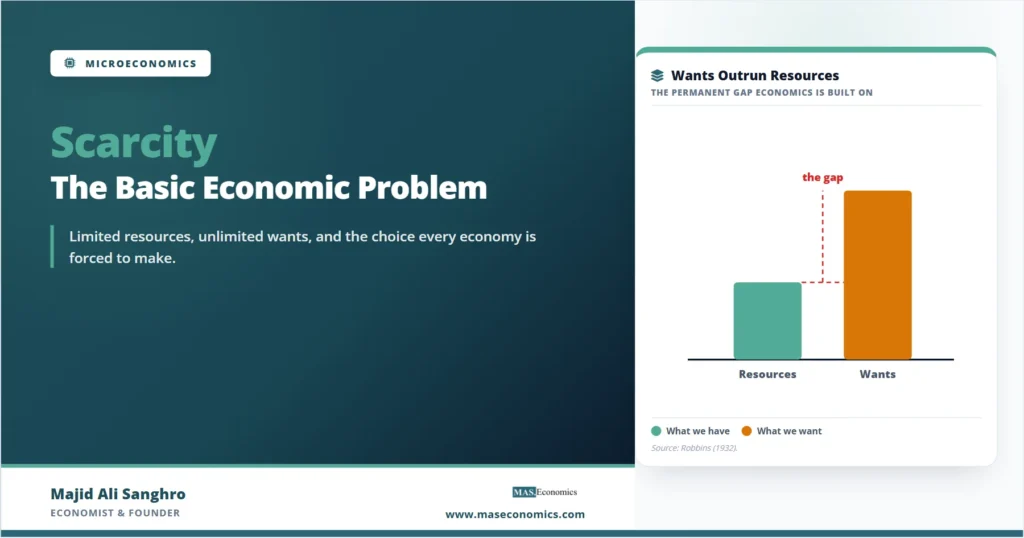
Human wants face no such limit. Satisfy one, and another appears, often a more elaborate version of the first. This is the mismatch the diagram below captures: a bounded pool of resources on one side, an open-ended set of wants on the other, and a gap between them that no level of production has ever closed.
Two distinctions sharpen the idea. Scarcity is not rarity. A signed first edition is rare, but air is scarce in the economic sense only where clean air must be paid for or fought over. What matters is whether using a resource for one purpose means giving it up for another. And scarcity is usually relative rather than absolute: the issue is rarely that a resource has run out completely, but that there is not enough of it to meet every want at once.

The Three Questions Scarcity Forces
Because resources are limited, no economy can produce everything, so every economy has to answer the same three questions. What should be produced, and in what quantities? How should it be produced, meaning with which combination of labor, machines, and materials? And for whom is it produced, meaning who ends up with the output? These questions sit underneath the whole field, and a reader meeting them for the first time will find them again in any introduction to economics.
Different systems answer them differently. A market economy lets prices and private decisions settle the questions, a command economy assigns the answers through central planning, and most real economies mix the two. The debate over which method allocates scarce resources best is a large part of what separates the schools of thought in economics. Whatever the system, the act of choosing one use means surrendering another, and the value of that surrendered alternative is the opportunity cost of the choice. Scarcity makes choice unavoidable, and choice makes opportunity cost unavoidable.
Healthcare shows the three questions at work. A hospital with a fixed budget and a fixed number of staff must decide what to provide, whether that is more surgeries or more preventive care; how to provide it, with more nurses or more equipment; and for whom, since not every patient can be treated at once. None of these choices disappears if the budget grows, because a larger budget simply moves the same questions to a higher level of spending. Scarcity sets the terms of the problem, and it leaves the answers to be argued out.
Scarcity Is Not the Same as a Shortage
The two words are often used as if they mean the same thing, and they do not. Scarcity is the permanent background condition: wants exceed the resources available to meet them, always and everywhere. A shortage is a temporary market situation in which the quantity demanded of a specific good exceeds the quantity supplied at the going price. The difference matters because the cures are different.
A shortage can be fixed. When the price of a good sits below the level that balances supply and demand, buyers want more than sellers will provide, and the gap shows up as empty shelves or waiting lists. Let the price rise, and the shortage clears as demand cools and supply expands. That mechanism is the heart of how supply and demand set prices. Scarcity, by contrast, has no such cure. No price change makes the underlying resources unlimited; a higher price only decides who gets the scarce supply, not whether the scarcity exists.
The Forms Scarcity Takes
Scarcity is not a single thing. It shows up differently across the resources an economy relies on, and naming those forms makes the idea concrete. The table below sets out the main ones, with an example of each and the reason it is limited.
| Resource | Example of the limit | Why it is scarce |
|---|---|---|
| Natural resources | Fresh water, oil, arable land | The physical stock is fixed or replenishes slowly |
| Labor | Skilled nurses, engineers | Only so many trained workers exist at any time |
| Capital | Machines, factories, infrastructure | Building more requires giving up output today |
| Time | Hours in a day, a single career | It cannot be stored, bought back, or expanded |
| Entrepreneurship | People able to organize and bear risk | The talent and willingness are unevenly spread |
|
|
||
Each row is the same problem wearing different clothes. In every case, a resource can serve one purpose only by being withheld from another, which is exactly the condition that makes a choice necessary and gives that choice a cost.
The scarcity of skilled labor is not an abstraction. The World Health Organization projects a global shortfall of around 10 million health workers by 2030, concentrated in low- and middle-income countries. Training a nurse or a doctor takes years, so supply cannot expand quickly to meet rising demand, and the gap has to be managed through wages, immigration policy, and how existing staff are deployed.
How Prices Ration What Is Scarce
Once scarcity forces a choice, something has to decide who gets the limited supply. In a market economy that job falls to prices. A price acts as a rationing device: it rises until the quantity people are willing to buy matches the quantity available, steering scarce goods toward the uses where they are valued most. This is why the same loaf, the same hour of labor, and the same barrel of oil all carry a price at all. The price is scarcity made visible.
Prices are not the only way to ration. Societies also use queues, lotteries, eligibility rules, and direct rationing, especially during wars or emergencies when allowing prices to rise freely is judged unfair. Each method has costs of its own. Economies also push against scarcity rather than just dividing it up. Specialization and trade let countries concentrate on what they produce at lower relative cost and exchange for the rest, a gain explained by comparative advantage. Better technology lets the same resources produce more, lowering the real cost of production over time. The aim of all of this, getting the most value from limited means, is the central concern of welfare economics and Pareto efficiency. When prices fail to steer resources well, the result is a market failure, a sign that scarce resources are being allocated poorly.
History gives a clear example of non-price rationing. During the Second World War, governments in the United States and Britain rationed food, fuel, and rubber with coupons rather than letting prices climb, on the view that scarce essentials should be shared by need rather than by ability to pay. The coupons did not create more sugar or gasoline; they only changed how the fixed supply was divided. That is the recurring lesson of rationing: the method decides who gets the goods, while the scarcity itself stays in place.
Why the Gap Does Not Close With Growth
A reasonable hope is that economic growth will eventually solve scarcity by producing so much that wants are finally met. Growth does raise what an economy can produce, sometimes dramatically, yet the gap stays open. Part of the reason is on the resource side. The world’s population passed 8 billion in 2022, according to the United Nations, and the amount of arable land available per person has fallen by roughly half since the 1960s, World Bank data show. More people draw on the same finite base.
The larger reason is on the wants side. As incomes rise, wants expand and change rather than stop. New goods create new desires, and many of the things people compete for, such as the best location, the top school place, or status itself, are limited by their nature: not everyone can own the rarest item or live in the most desirable spot. Growth shifts what an economy can do, a change shown clearly by the production possibilities frontier, but it moves the wants along with the means. Scarcity is not a stage an economy passes through on its way to abundance; it is the condition that economic activity is organized around.
Where the Idea Reaches Its Limits
The assumption that wants are unlimited is a useful simplification, not a law of nature. Some economists argue that basic needs are finite and that treating wants as boundless builds a bias toward endless production into the foundations of the field. Ecological economists push the point further, noting that the natural resource base sets hard limits that the standard framing tends to understate. The model also says nothing on its own about distribution; it explains why choices must be made without saying who should bear the cost of them, which is a question of values as much as economics.
There is also a class of goods that strains the classic picture. A piece of software, a formula, or a digital file can be copied at almost no cost and used by one more person without leaving any less for anyone else. These non-rival goods are not scarce in the ordinary sense, even if access to them is sometimes restricted by law. None of this overturns the core idea. Land, labor, capital, time, and attention remain stubbornly limited, and the choices they force remain the starting point of economic analysis, whether the question is a household budget or the design of a national policy in a full course on macroeconomics.
MASEconomics Explains
Four economic concepts behind scarcity
These concepts are explored in depth across our educational articles library.
Explore the MASEconomics BlogConclusion
Scarcity is the condition that gives economics its subject matter: resources are limited, wants are not, and the gap between them never closes. From that single fact follow the three questions every economy must answer, the unavoidable presence of opportunity cost in every choice, and the need for some method, usually prices, to decide who receives what is in short supply.
The distinction between scarcity and a temporary shortage keeps the idea precise. A shortage clears when the price adjusts; scarcity does not, because no price makes finite resources infinite. Growth, trade, and technology ease the pressure and raise how much an economy can produce, yet they expand wants alongside means. Scarcity is not a problem economies eventually solve. It is the problem they are built to manage.
Frequently Asked Questions
What is scarcity in economics?
Scarcity is the condition in which the resources available are not enough to satisfy everyone’s wants. Because land, labor, capital, and time are all limited while wants are not, individuals and societies must choose how to use what they have, and every choice carries an opportunity cost.
What is the difference between scarcity and a shortage?
Scarcity is permanent: wants always exceed available resources. A shortage is temporary and specific, occurring when the quantity demanded of a good exceeds the quantity supplied at the current price. A shortage clears when the price rises, while scarcity cannot be removed by any price change.
Why is scarcity called the basic economic problem?
It is called the basic economic problem because it is the starting point from which all other economic questions follow. Limited resources and unlimited wants force every society to decide what to produce, how to produce it, and for whom, which is the core problem economics studies.
Can scarcity ever be eliminated?
No. Economic growth, trade, and new technology can raise how much an economy produces and ease specific shortages, but they also expand and change what people want. Some resources, such as time and prime location, are limited by their nature, so the gap between wants and means remains.
Does scarcity only affect poor countries?
No. Scarcity is not the same as poverty. Even the wealthiest individuals and richest nations face limits on time, attention, skilled labor, and natural resources. Higher income changes which trade-offs are made, but it does not remove the need to choose.
Thanks for reading! If you found this helpful, share it with friends and spread the knowledge. Happy learning with MASEconomics