In February 2026 the United States placed a 10 percent tax on nearly everything entering the country, under a legal authority that allows it to run for 150 days. It was the latest move in a trade conflict that has been rearranging world commerce since 2025, and it made a very old instrument the most discussed tax on earth. What is a tariff, then? A tariff is a tax that a government charges on goods as they cross its border, almost always on the way in. It is collected at the port, before the goods clear customs, and it is one of the oldest taxes governments have, because a border crossing is the easiest place in an economy to see trade happening and charge for it.
The definition takes one sentence. The three questions that follow it are where most public discussion goes wrong: who actually hands over the money, who ends up bearing the cost, and how much of an announced tariff is ever really paid. The past year produced unusually clear evidence on all three.
A Tax Collected at the Border, Paid First by the Importer
Start with the mechanics. When a shipment arrives, the importing firm, not the foreign seller, is legally responsible for the duty. An American retailer bringing in $100,000 of footwear under a 20 percent tariff pays $20,000 to US customs before the shoes can enter the country. The money goes to the importing country’s treasury, the same place income tax and sales tax go. In that narrow legal sense, a tariff on Chinese goods is paid by the American companies that import them, exactly as a tariff on American goods entering Europe is paid by European importers.
Tariffs come in two basic shapes. An ad valorem tariff is a percentage of the shipment’s value, like the 20 percent above, and it is the dominant form today. A specific tariff is a fixed charge per unit, so many cents per kilogram or per item, a form that survives mainly in agriculture. Beyond the flat versions sit more complicated structures, and a fuller tour of the toolkit is in our overview of trade policies.
Writing the check is not the same as bearing the cost, and the distinction is the single most important idea in understanding tariffs. The importer who paid $20,000 has three options: raise prices and pass the cost to customers, accept thinner profits, or squeeze the foreign supplier for a discount. Where the burden settles among those three is called incidence, it varies by product and by how easily buyers can switch, and it is the subject of its own article on who pays the tariff.
The Announced Rate and the Paid Rate Are Different Numbers
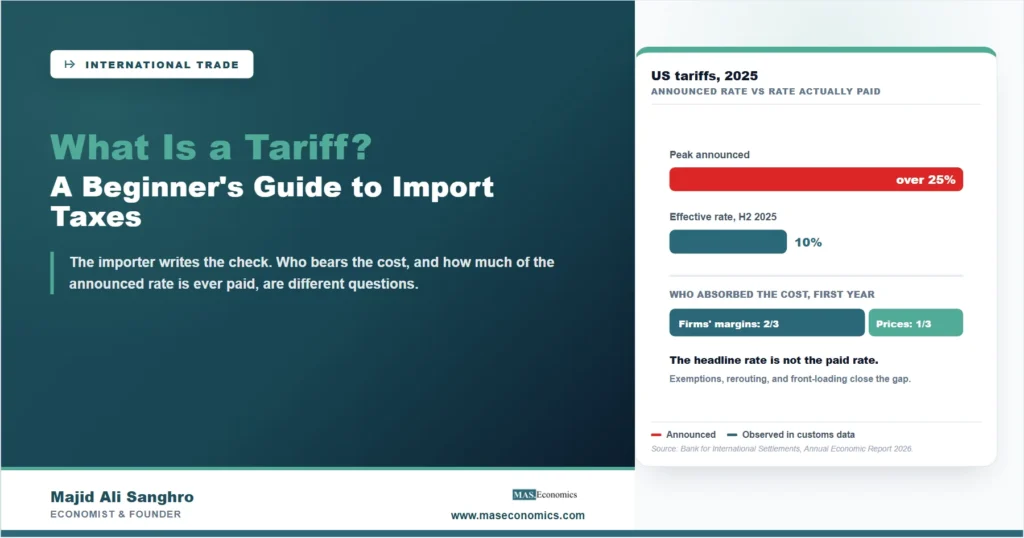
The most useful lesson of 2025 is one no textbook example teaches: the tariff rate in the headline is not the rate the economy pays. The Bank for International Settlements, in its Annual Economic Report 2026, reconstructed the average tariff actually observed in US customs data, meaning duties collected as a share of import value. At the peak of the 2025 announcements the headline figure exceeded 25 percent. The effective rate stabilized at 10 percent in the second half of 2025.
The gap has three causes, and each is a piece of economics in its own right. Exemptions and carve-outs multiply after every announcement, as sectors win exclusions. Trade reroutes: importers substitute toward countries facing lower rates, which mechanically lowers the average rate paid, and firms had been preparing that substitution for years. Chinese direct investment into Southeast Asian production facilities rose from $10 billion in 2017 to over $34 billion in 2024, so when the 2025 tariffs arrived, part of the supply chain had already moved to jurisdictions the tariffs touched more lightly. And importers front-load, racing shipments in before rates take effect, which delays the impact of the announced schedule.
The difference is not bookkeeping. The BIS estimates that using the effective rate rather than the announced one cuts the estimated loss to global output by about a third. Anyone modeling the world economy off the headline rate overstated the damage substantially, which is part of why merchandise trade volumes grew nearly 5 percent in the first half of 2025 despite record trade policy uncertainty. The full story of the conflict itself is in our account of the global tariff war of 2025–2026.
Who Actually Paid: The Evidence From One Year
Between the importer’s check and the shopper’s receipt sits the incidence question, and the 2025 episode produced a measured answer. The BIS estimates that the US firms most exposed to the tariffs absorbed about two thirds of the cost increases through lower profits, passing roughly one third on to consumers over the year to late 2025.
Two cautions keep that figure honest. First, it is an estimate built from firm costs and margins, not a line in customs accounts, and other studies of earlier episodes, including the 2018–2019 round, found pass-through to import prices that was nearly complete, with the burden landing inside the importing country one way or another. Second, the split is a snapshot of the first year. A firm can protect its customers from a cost shock for a while by accepting thinner margins, especially when it hopes the policy is temporary. It cannot do so indefinitely. If the tariffs persist, more of the burden migrates to prices, which is why the inflation effect of a tariff tends to arrive with a delay rather than on the day of the announcement.
What Tariffs Are For, and What They Cost
Governments reach for tariffs for three reasons, and evaluating any real tariff starts with asking which job it is supposed to be doing. The oldest is revenue: for most of history, customs duties funded states because ports were easy to police and account books were not, and the tax remains attractive today wherever administration is weak. The second is protection, sheltering a domestic industry by making the foreign alternative more expensive; how much shelter a given rate provides is less obvious than it looks, as our article on the effective rate of protection shows. The third is leverage, using access to the home market as a bargaining chip, which is the primary way the 2025–2026 measures have been used.
Against those three jobs stand the costs. A tariff raises prices for domestic buyers, including domestic firms that import parts and materials, so protection for one industry is a tax on the industries downstream of it. It invites retaliation. And it carries a consequence almost nobody intuits: taxing imports ends up taxing exports too, because it strengthens the currency and raises input costs for exporting firms, a result known as the Lerner symmetry theorem. A country cannot tax what it buys from the world without also, indirectly, taxing what it sells to the world.
One boundary is worth drawing before the conclusion. A tariff works through price: imports remain unlimited for anyone willing to pay the duty. Its sibling instruments work through quantity or through rules, restricting how much may enter or under what conditions, and they behave differently in ways that matter. Those tools, from quotas to standards, are covered in our article on non-tariff barriers.
MASEconomics Explains
3 economic concepts behind tariffs
These concepts are explored in depth across our educational articles library.
Conclusion
What is a tariff has a one-sentence answer: a tax on goods crossing a border, collected from the importer at the port. Everything interesting about tariffs lives in the three gaps that sentence hides. The gap between who pays the duty and who bears the cost, which in the first year of the 2025 tariffs meant firms absorbing about two thirds in lower profits. The gap between the announced rate and the paid rate, which ran from above 25 percent down to 10. And the gap between the industry a tariff protects and the economy that pays for the protection, through higher input costs, retaliation, and the quiet tax on exports.
None of this makes tariffs simply good or simply bad. It makes them a tax, with a tax’s trade-offs: capable of raising revenue, redirecting activity, and applying pressure, and incapable of doing any of it for free. Reading a tariff announcement the way an economist does means asking which of the three jobs it is meant to do, and then watching the customs data rather than the headline to see what actually happened.
Frequently Asked Questions
What is a tariff in simple terms?
A tariff is a tax on goods entering a country, collected by customs at the border before the goods can be sold. If a country sets a 10 percent tariff on imported bicycles, an importer bringing in $50,000 of bicycles pays $5,000 to the government. The importer then decides how much of that cost to pass on in prices.
Who actually pays a tariff?
Legally, the importing firm pays the duty to its own government; the exporting country’s government pays nothing. Economically, the cost is shared between the importer’s profits, the consumer’s prices, and sometimes the foreign supplier’s discounts. Estimates for the first year of the 2025 US tariffs put roughly two thirds of the cost in firms’ margins and one third in consumer prices, a split that can shift toward consumers the longer a tariff lasts.
Why was the paid US tariff rate so much lower than the announced one?
Three reasons: exemptions accumulated after each announcement, importers shifted purchases toward countries facing lower rates, and shipments were accelerated to arrive before rates took effect. The result was an effective average rate of about 10 percent in late 2025 against peak announcements above 25 percent, a gap large enough to change estimates of the tariffs’ global cost by about a third.
Do tariffs cause inflation?
A tariff raises the level of prices on affected goods once, rather than creating a repeating cycle of increases, and even that one-time rise can be delayed while importing firms absorb costs in their margins. Whether it shows up visibly in overall inflation depends on how broad the tariff is, how essential the goods are, and how long firms hold the line on prices.
What is the difference between a tariff and a quota?
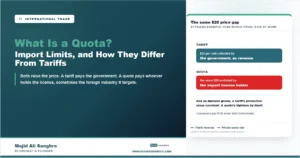
A tariff works through price: it taxes imports but lets any quantity in. A quota works through quantity: it caps how much may enter, and the price adjusts on its own. The two can produce similar prices, but with a tariff the revenue goes to the government, while with a quota the equivalent money typically goes to whoever holds the right to import under the cap.
Thanks for reading! The next tariff headline you see, look for the second number, the one collected at the ports, because that is the rate the economy actually lives under. Happy learning with MASEconomics