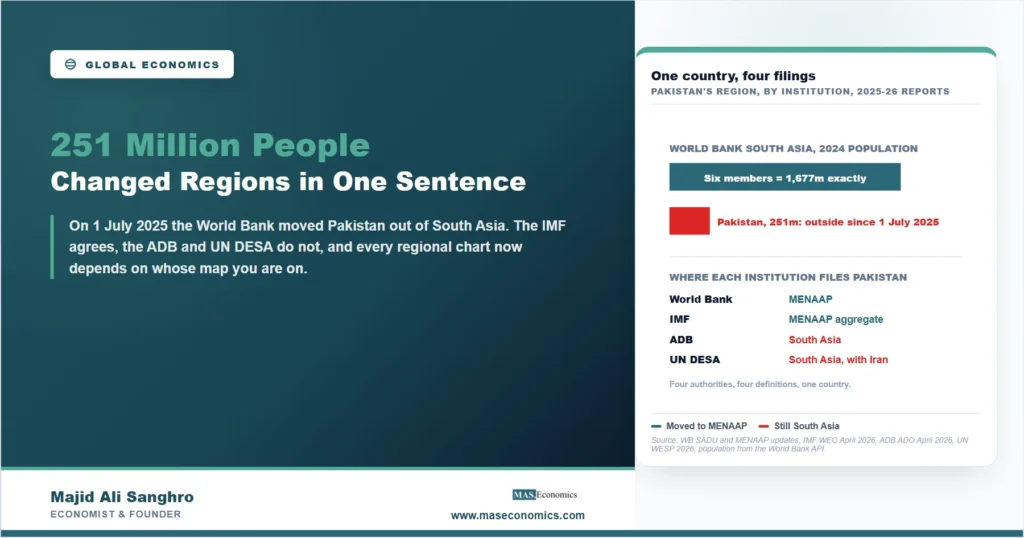
On July 1, 2025, a quarter of a billion people left South Asia. Not by moving: the World Bank reassigned Pakistan and Afghanistan from its South Asia region to a new grouping called MENAAP, the Middle East, North Africa, Afghanistan and Pakistan. The change ran through every World Bank regions product at once, the reports, the databases, the aggregates, and it means that any post-2025 World Bank figure labeled South Asia describes a region with no Pakistan in it, while nearly every chart, model and mental map built before 2025 assumes the opposite. Few reclassifications this large have ever attracted this little attention.
The proof is not a press release but the publications themselves. The Bank’s October 2025 South Asia Development Update states its coverage in one sentence: South Asia as used in this report includes Bangladesh, Bhutan, India, Maldives, Nepal, and Sri Lanka. The same month, the first MENAAP Economic Update appeared, a new flagship for the new region, produced by a renamed chief economist’s office. The data followed the documents, and the arithmetic is exact: the Bank’s South Asia population aggregate for 2024 stands at 1,677,384,532, which equals the sum of those six members to the person. Pakistan’s 251 million are not in it.
The Same Country, Filed Three Ways
| Institution | Publication | Pakistan’s region |
|---|---|---|
| World Bank | MENAAP Economic Update; South Asia Development Update, October 2025 | MENAAP; South Asia now lists six countries without it |
| IMF | World Economic Outlook, April 2026 | Carries a Middle East, North Africa, Afghanistan, and Pakistan aggregate |
| Asian Development Bank | Asian Development Outlook, April 2026 | South Asia, defined as Afghanistan, Bangladesh, Bhutan, India, Maldives, Nepal, Pakistan, Sri Lanka |
| UN DESA | World Economic Situation and Prospects 2026 | South Asia, in tables that also include Iran |

|
||
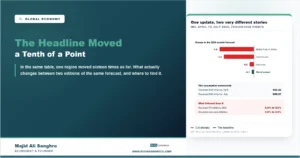
Read the table twice, because it is the article’s central exhibit. The two Washington institutions have moved Pakistan westward into a Middle East grouping. The Asian Development Bank keeps it in a South Asia that also retains Afghanistan. UN DESA keeps it in a South Asia that additionally contains Iran, a country the World Bank files in the Middle East and the ADB does not cover at all. Four authoritative sources, four region definitions, one country. None of them is wrong, because a region is not a fact about the earth. It is a filing decision, made for administrative convenience, and each institution’s filing reflects its own operational map.
Where Charts Quietly Break
The practical trap is the time series. A World Bank South Asia series that runs through 2025 either carries a silent 15 percent break in its population, and comparable breaks in GDP, trade and poverty, or has had its history recomputed for the new definition, in which case every pre-2025 number differs from what the same query returned two years ago. Both cases are invisible on the chart itself. Growth rates computed across the boundary, regional poverty counts, per capita figures, and any model trained on the old aggregates inherit the break. The same applies in mirror image to the Middle East series that quietly absorbed 294 million people. Anyone comparing a South Asia figure from a 2024 publication with one from 2026 is comparing regions that share five-sixths of their population and none of their definition.
The deeper lesson is the one this site keeps returning to: an aggregate is an answer to a question someone else chose. Regional groupings feel like geography, but they are administrative objects that institutions redraw when their operations change, and the redraw becomes everyone’s data problem. The World Bank’s move has operational logic, Pakistan’s economic entanglements with the Gulf, its remittance corridors and its program relationships sit westward, but the logic is the Bank’s, not the geography’s. This is the fifth case for the file our reader’s guide to conflicting economic statistics opened: two numbers labeled identically, measuring different things, both correct.
What It Means for the Country in Transit
For Pakistan itself, the filing change has real consequences in how the world’s data describes it. Its comparators change: benchmarking that once set it beside India and Bangladesh now sets it beside Egypt, Jordan and Morocco, economies with different structures, income levels and inflation histories, which mechanically changes how Pakistan ranks on almost everything. Its visibility changes: a reader following the South Asia literature no longer encounters Pakistan at all, while the MENAAP literature folds it into a region whose narrative is dominated by oil, conflict and the Gulf. And analysis of its monetary and fiscal circumstances, the territory we covered in the State Bank of Pakistan explained and monetary policy in a cash economy, now happens under a different regional umbrella depending on which institution’s report is open.
The general rule this case teaches costs one sentence to state and applies to every regional statistic anywhere: before using a regional aggregate, read the membership list, and before comparing two vintages of one, check that the list did not change in between. Institutions publish the lists, always, usually in a footnote nobody reads; the October 2025 South Asia Development Update needed exactly one sentence to redefine a region of 1.9 billion people into one of 1.7 billion. The sentence was public, accurate and almost universally unread, which is how a quarter of a billion people can change continents, statistically speaking, without making the news.
MASEconomics Explains
3 economic concepts behind the reclassification
These concepts are explored in depth across our educational articles library.
Conclusion
The World Bank regions map changed on July 1, 2025, when Pakistan and Afghanistan moved from South Asia to the new MENAAP grouping, and the change is documented beyond argument: the Bank’s own South Asia report now lists six countries, its new MENAAP flagship covers the arrivals, and its South Asia population aggregate of 1,677 million equals the six remaining members exactly, with Pakistan’s 251 million outside. The IMF’s tables carry the same grouping, while the Asian Development Bank and UN DESA kept Pakistan in South Asia, so the world’s four main statistical authorities now disagree about which region a quarter of a billion people inhabit.
Nobody in this story made an error, which is precisely what makes it useful. A region is a filing system, each institution files for its own operations, and the aggregates inherit the filing. The costs land on users: series that break silently in 2025, comparisons across vintages that no longer compare, and a country whose statistical neighbors changed overnight. The defense is a single habit, reading the membership list before the number, and this episode is the cheapest possible demonstration of why, because the redefinition of a 1.9-billion-person region was announced in one sentence of one report that almost nobody read.
Frequently Asked Questions
What exactly changed on July 1, 2025?
The World Bank moved Pakistan and Afghanistan from its South Asia region into a new grouping, MENAAP, the Middle East, North Africa, Afghanistan and Pakistan. The change applies across its reports and databases: the South Asia Development Update now covers six countries, and a new MENAAP Economic Update covers the enlarged western region.
How do we know the data really moved?
By arithmetic. The Bank’s South Asia population aggregate for 2024 is 1,677,384,532, which equals the sum of Bangladesh, Bhutan, India, Maldives, Nepal and Sri Lanka exactly, to the person. Adding Pakistan’s 251 million would give 1,929 million, so the aggregate demonstrably excludes it.
Do other institutions agree?
The IMF’s World Economic Outlook carries a matching Middle East, North Africa, Afghanistan and Pakistan aggregate. The Asian Development Bank still defines South Asia to include Pakistan and Afghanistan, and UN DESA’s South Asia includes Pakistan and Iran. Regional labels are institutional choices, and the institutions currently choose differently.
Why did the World Bank move Pakistan?
The Bank organizes regions around its operations, and Pakistan’s economic relationships, Gulf remittance corridors, program engagement and trade orientation, sit westward. The article treats the stated operational logic as the Bank’s own; the point is that any such logic produces an administrative region, not a geographic fact.
What should users of regional data do about it?
Read the membership list before using any regional aggregate, and check the list again when comparing different years or different institutions. Any World Bank South Asia or Middle East series spanning July 2025 should be checked for a break or a restated history before growth rates are computed across it.
Thanks for reading! A quarter of a billion people changed regions in one sentence of one report, and the sentence was footnote-sized. Happy learning with MASEconomics