Somewhere this year a minister will stand up and announce that the country is going to build its own large language model. The speech writes itself: strategic autonomy, national data, not being left behind. It is a popular plan: our piece on how only one poor country has a national AI strategy counts more than eighty of them worldwide. The World Bank’s 2026 World Development Report gives that plan an unusually blunt assessment, and it is worth quoting exactly because the phrasing is careful. Pursuing AI sovereignty by building fully independent capabilities, it says, is an alternative in principle but is unlikely to deliver the desired results in practice, and elsewhere the report puts it more flatly still: pursuing AI sovereignty is expensive and not always effective. The recommended route instead is to adopt what already exists, mostly open models, at a fraction of the cost. That is the headline verdict and it is the easy half of the argument. The harder half is that the door being recommended is closing slowly, on a measurable schedule, for reasons that have nothing to do with any government’s choices, and an honest case for adoption has to say so.
The Arithmetic of Building Every Layer
The case against building starts with what the stack actually contains, and with the value-chain logic that governs who captures what along it. Control over the key parts of the AI value chain, raw materials, advanced chips and data centers, sits with the leading powers, principally the United States and China, and that concentration is the dependency a sovereignty program is meant to escape. The trouble is that the program does not escape it. As the report puts it, simply having a local data center cannot avoid dependencies on chips from major foreign providers, so the most visible and expensive piece of a sovereign strategy leaves the binding constraint exactly where it was. Investing across all layers is described as extremely costly, and the large data center investments involved carry costs that land outside the AI budget entirely, higher electricity prices among them, which are paid by households who were never consulted about the model.
Then comes the argument an economist notices and a press release never mentions. If several countries each build their own sovereign AI systems, the report observes, they will be unable to benefit from the global demand that lowers costs across the whole chain, from model training through chip manufacturing to application development. AI is an industry with enormous fixed costs and very low marginal costs of serving one more user, which is the classic condition for falling average cost at scale. Fragmenting world demand into a dozen national systems does not distribute that advantage; it destroys it, and every participant ends up paying more per unit of capability than they would have paid inside the pooled market. Sovereignty in this setting is not merely expensive in the sense of a large bill. It is expensive in the deeper sense that the act of pursuing it raises the price of the thing being pursued, for everyone doing it. That cost structure, very high fixed costs against near-zero marginal cost, is the one our guide to platform economics works through, and the market it produces is examined in our piece on the two-tier AI world.
The Door That Is Closing Slowly
Adoption is the right recommendation and it rests on a condition that is quietly expiring. Open-weight models dramatically lowered the barrier for any country wanting to build AI capability without building AI infrastructure, and the report is direct that this window may not persist. The reason is not conspiracy but ordinary firm economics, and the report states the rule precisely: firms open their proprietary technology when doing so increases their earnings in markets adjacent to the technology by more than their losses in the market they are opening up. Openness, on that account, was never generosity. It was a commercial calculation about complements, and a calculation can change sign. It already has in at least one prominent case. Meta released several high-performing open models and has recently moved toward a proprietary approach, with its newly formed Meta Superintelligence Labs pausing work on Behemoth, its most powerful open model, and launching Muse Spark as a proprietary model instead.
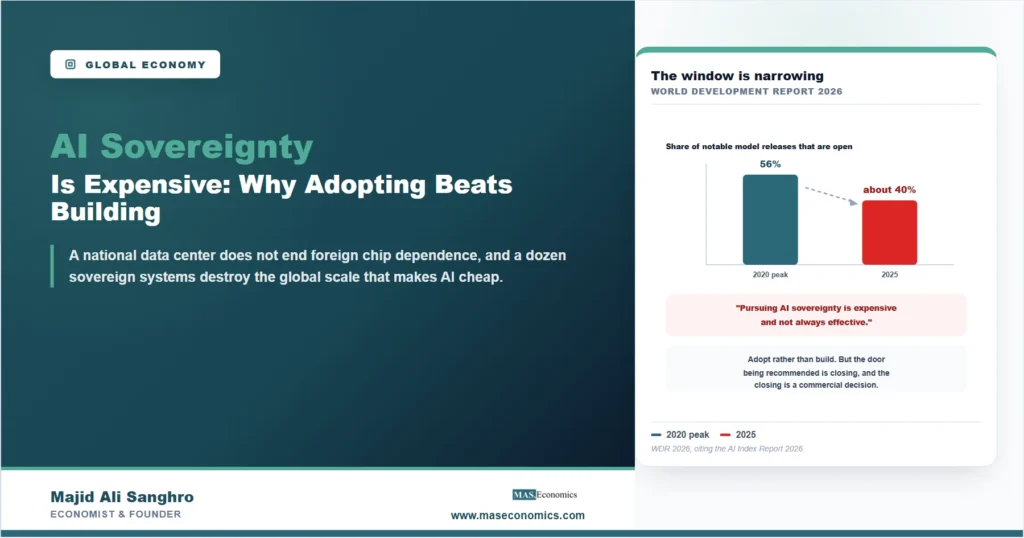
One firm is an anecdote; the aggregate is the evidence. The report cites the Artificial Intelligence Index Report 2026 finding that release patterns for notable AI models have continued to shift toward controlled access, with the proportion of newly released notable models that are open falling from a peak of 56 percent in 2020 to about 40 percent by 2025. That is the door, and it is measurably narrower than it was. The report is careful not to overclaim, and so is this article: models released under open licenses today stay open tomorrow, so nothing already available is being taken back. The problem is time-shaped rather than immediate. AI is advancing quickly enough that what a model can do today will differ substantially from what models can do in a few years, so a country standing on a 2025 open model is standing on an asset that depreciates fast, and the assumption that fresh open models keep arriving to replace it may not hold as training costs continue to rise. The report flags the risk as sharpest where the stakes update fastest, in fraud detection and cyberdefense, where an obsolete model is not merely less useful but actively outmatched by whatever the other side is running.
There is a second squeeze running alongside the first, and it comes from how the industry is organizing itself. Vertical integration across the AI stack can widen access and lower prices, and it can equally be used to restrict competition: an integrated provider can bundle products and services so as to foreclose rivals, either by refusing to sell to them or by selling at a higher price, which forces new entrants to enter at several levels of the stack at once rather than at one. Those are entry barriers in the textbook sense, and they carry the textbook consequence for market power: fewer competitors, and users locked into a small number of integrated providers with few alternatives to switch to. A country that adopts today is making a sound decision on today’s prices. It is also acquiring a supplier relationship whose future terms will be set by a market that is consolidating.
Diversification Is Not Sovereignty
What the report proposes instead deserves to be named correctly, because it is routinely misdescribed as a softer version of sovereignty when it is a different idea altogether. The advice is to source models, cloud services and other AI tools from several countries, choosing the most suitable technology available rather than the most domestic, and to combine open models with shared regional computing infrastructure. That is portfolio diversification. It does not attempt to remove dependence, which is not achievable at any price a developing economy can pay; it attempts to stop any single supplier or single jurisdiction from holding a decisive position, which is achievable and much cheaper. The distinction matters politically because the two strategies sound similar in a speech and behave very differently in a budget. Sovereignty spends heavily to reduce dependence and mostly fails, since the chips still come from abroad. Diversification spends little, accepts dependence as a condition, and manages its concentration.
The report is honest that diversification has its own bill, and the article would be dishonest to skip it. Because AI systems depend on their layers working together, buying across jurisdictions creates interoperability problems and exposes a country to conflicting regulations attached to technologies from different legal systems. That is a real cost, paid in engineering time and legal complexity rather than in capital expenditure, and it is the reason the shared regional compute idea appears in the recommendation: pooling infrastructure across neighboring countries restores some of the scale that fragmentation destroys, without requiring any one of them to build a full stack. None of this is unique to poor countries, which is worth saying plainly to readers in richer ones. European sovereign-AI programs face the same arithmetic, the same foreign chip dependence and the same forgone scale, and the open-model supply that every non-frontier economy is relying on is set in a handful of corporate boardrooms in two countries. The dependency runs to everyone outside those boardrooms. The report also notes that in the European Union, regions with more intense AI patenting tend to see a decline in the share of income going to workers as wages, salaries and benefits, which is a reminder that where the technology is built is a separate question from who captures what it earns, a gap our article on the digital divide follows into the labor market.
MASEconomics Explains
3 economic concepts behind the verdict
These concepts are explored in depth across our educational articles library.
Explore the MASEconomics BlogConclusion
The World Bank’s verdict on AI sovereignty is that it is expensive and not always effective, and that building fully independent capabilities is unlikely to deliver what governments want from it. The reasoning holds up under inspection. A national data center does not end dependence on foreign chips, the electricity costs land on households rather than on the AI budget, and, least discussed and most damaging, a world of separate sovereign systems forfeits the pooled global demand that drives down the cost of everything from training runs to chip fabrication. Countries pursuing sovereignty raise the price of the capability they are pursuing, for themselves and for each other. Adoption, mostly of open models, does the opposite at a small fraction of the cost.
The recommendation is right and the condition attached to it is the part worth carrying. The open window is narrowing on a measurable schedule: the share of notable model releases that are open fell from a peak of 56 percent in 2020 to roughly 40 percent by 2025, one major firm has already paused its most powerful open model and shipped its next one proprietary, and the industry’s vertical integration is raising entry barriers around the suppliers everyone is adopting from. Nothing already released is being withdrawn, so the risk is depreciation rather than confiscation: today’s open model still works and will simply matter less each year. The sane response is neither to build a stack nobody can afford nor to assume the current terms are permanent, but to adopt now, spread purchases across suppliers and jurisdictions, pool computing capacity regionally where neighbors make that possible, and treat the openness of the last five years as a commercial condition that was always subject to review.
Frequently Asked Questions
What is AI sovereignty?
The strategy of building fully independent national AI capabilities across the value chain, from chips and data centers to models and applications, so that a country does not depend on foreign providers. The World Bank’s 2026 World Development Report describes it as expensive and not always effective, and as unlikely in practice to deliver the results governments expect from it.
Why does building a national data center not solve the dependence problem?
Because the constraint sits a layer below. As the report puts it, simply having a local data center cannot avoid dependencies on chips from major foreign providers, which are concentrated in a small number of countries. The most visible and expensive element of a sovereignty program therefore leaves the actual bottleneck untouched, while adding costs such as higher electricity prices.
How does sovereign AI make the technology more expensive?
Through lost scale. AI carries very high fixed costs and very low costs of serving an additional user, so pooled global demand is what pushes average costs down across model training, chip manufacturing and application development. If several countries each build separate sovereign systems, that demand fragments and none of them benefits from the cost reductions the pooled market would have delivered.
Are open AI models going to remain available?
What is already released stays released, but new supply is uncertain. The share of newly released notable models that are open fell from a peak of 56 percent in 2020 to about 40 percent by 2025, and one major firm has paused its most powerful open model while launching its next as proprietary. Since firms open technology only when adjacent-market gains exceed the losses, the incentive can reverse.
What should a country do instead of building its own model?
Adopt rather than build, and diversify rather than pursue autarky. The report suggests sourcing models, cloud services and tools from several countries, choosing the most suitable technology available, and combining open models with shared regional computing infrastructure. The cost of that approach is interoperability difficulty and exposure to conflicting regulations across jurisdictions, which is far smaller than the cost of a full stack.
Thanks for reading! Openness was a commercial calculation rather than a gift, which is exactly why it can be withdrawn without anyone breaking a promise. Happy learning with MASEconomics