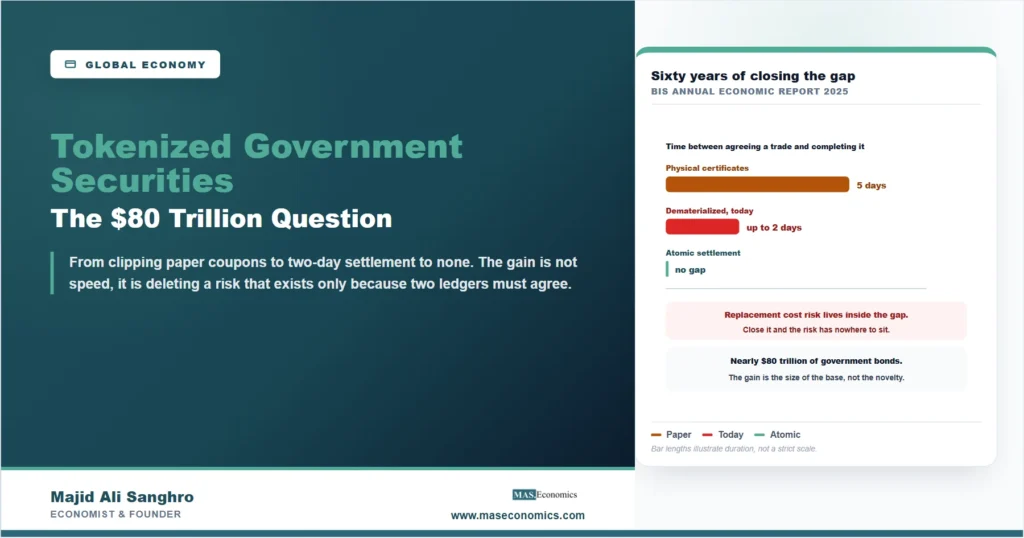
Sixty years ago, collecting the interest on a government bond meant taking a pair of scissors to it. The bond was a physical certificate, the interest payments were printed coupons attached to its edge, and you clipped one off and presented it. Transactions settled in five days. That system worked for decades and then buckled under its own volume, which produced the two great administrative inventions that made modern securities markets possible: immobilization, in which the certificates were locked in a central vault and electronic records created against them, and dematerialization, in which the paper was abolished entirely and the security became nothing but an accounting record backed by law. The Bank for International Settlements uses that history to set up a question about the next step. Tokenized government securities would put the money and the bond on one programmable ledger so that payment and ownership change in the same instant. With nearly $80 trillion of government bonds outstanding, the BIS observes, even modest efficiency gains would be significant. The interesting part is what the efficiency actually consists of, because it is not speed for its own sake.
The Gap Is the Risk
Consider what has to happen today when a bond changes hands. Buyers and sellers rely on brokers to initiate trades and on custodians to settle and hold the securities. Central securities depositories provide the accounts, the safekeeping and the asset servicing, sometimes directly and sometimes through those custodians. Around all of this sits a web of messaging instructions, identity verification and reconciliation with clearing agents. The BIS description is unglamorous and exact: trading and settlement are separate processes running on separate ledgers, and joining them up takes time. The settlement cycle can run up to two business days, and during that interval the parties are exposed to replacement cost risk, meaning the risk that the counterparty fails before completion and the trade has to be replaced at a worse price.
That risk is worth looking at directly, because it is the thing the technology is aimed at and it is entirely artificial. Nothing about the economics of lending to a government requires a two-day gap between agreeing a trade and completing it. The gap exists because the record of the money and the record of the security live in different places and have to be reconciled, and every hour of that reconciliation is an hour in which somebody can fail. A unified ledger holding tokenized money and tokenized securities together allows what the BIS calls contingent execution: the payment and the transfer of ownership happen atomically, as one indivisible event that either completes fully or does not occur. There is no interval, so there is no exposure in the interval. Framed that way, tokenization is not a faster version of the current system. It is the removal of a category of risk that exists only because of how the bookkeeping is arranged, which is a different and better claim than speed. The instrument itself is unchanged, and readers who want the underlying mechanics will find them in our guide to how governments and firms borrow and in our explainer on what bond markets signal.
Why the Scale Does the Work
The $80 trillion is doing something specific in the BIS argument and it is easy to misread. It is not a claim that tokenization creates $80 trillion of value. It is an observation about where small percentages become large numbers. Government bonds are the collateral layer of the financial system, the safe asset our guide to the future of money keeps returning to, underpinning the collateralized transactions that make liquidity management, risk management and monetary policy operations possible, so the same instrument is pledged, returned, re-pledged and margined continuously rather than simply bought and held. Each of those movements currently carries its own reconciliation. On a programmable ledger, the BIS notes, complex collateral operations could be automated so that participants issue instructions directly without account manager intervention, with continuous verification built in of whether a given piece of collateral meets a counterparty’s eligibility criteria, for example to satisfy a margin call. Atomic settlement of delivery against payment also reduces counterparty dependencies and speeds reconciliation and confirmation.
That is a description of administrative overhead rather than of finance, which is exactly why the number matters. A gain of a fraction of a percent on the operational cost of an $80 trillion collateral pool is worth more in absolute terms than a dramatic improvement somewhere small, and this is the ordinary economics of infrastructure: returns come from the size of the base, not from the novelty of the idea, the same logic our article on cross-border payment mechanisms applies to trade settlement. It is also why the case does not depend on anything speculative being true. No new financial product has to be invented and no existing one has to behave differently. The argument is that the world’s largest, dullest, most heavily used financial plumbing has a measurable amount of friction in it, and that removing some of the friction is worth doing because of how much passes through the pipe.
Why This Is Not the Crypto Argument
The word tokenization arrived in public debate attached to a very different proposition, so the distinction has to be made explicitly. The disintermediation story held that putting assets on a distributed ledger would let participants transact without banks and central banks in the middle. What the BIS is describing does the opposite. Its flagship experiment, Project Agorá, brings together tokenized central bank and commercial bank money across seven jurisdictions, involving seven central banks and 43 regulated financial institutions, and it is explicit that the project builds on the foundations of the existing financial system while innovating on the technology, maintaining the established roles of central banks and commercial banks and preserving the benefits of the two-tier monetary system. Central bank reserves and commercial bank deposits would be unchanged from today. This is an upgrade to the plumbing that deliberately leaves the institutional architecture in place, which is the reverse of what tokenization was originally supposed to mean, and it explains why the participants are the incumbents rather than their challengers. The economics of a shared venue, where value accrues to whoever hosts it, are set out in our piece on digital marketplaces. Our articles on CBDCs against stablecoins and on central banks in the digital age set out the competing visions this one is defined against.
The harder obstacle is also not the one people expect, and this is the part most worth carrying away. The binding constraint on cross-border unified ledgers is legal and governmental rather than computational. Data protection laws differ across jurisdictions, and the most stringent require that data be physically stored inside the country. The BIS says plainly that where that is the requirement, cryptographic techniques are unlikely to be sufficient to assuage concerns about data protection and location. No amount of clever encryption satisfies a law about geography. That is why the design question is posed as a continuum, from a single shared ledger at one end to separate ledgers connected by bridges at the other, and why the choice along it trades the ease of programmability that a centralized design offers against the separation between domains that governance requires. Project Agorá has finished its conceptual phase and is moving toward building a prototype, which is a realistic pace for something whose difficulty lies in reconciling seven legal systems rather than in writing software.
MASEconomics Explains
3 economic concepts behind the proposal
These concepts are explored in depth across our educational articles library.
Explore the MASEconomics BlogConclusion
Tokenized government securities are the next entry in a sixty-year sequence that has already run from physical certificates settling in five days, through immobilization in central vaults, to dematerialized records that exist only in law and settle in up to two business days. The proposed step puts tokenized money and tokenized securities on one programmable ledger so that payment and ownership move atomically, as a single event. The gain is not principally speed. It is the elimination of replacement cost risk, an exposure that exists solely because the record of the money and the record of the asset are kept separately and must be reconciled, and which therefore has nowhere to sit once they are not.
Two things keep the proposition sober. The scale argument is real but modest in its claim: with nearly $80 trillion of government bonds outstanding, serving as the collateral underneath liquidity management, risk management and monetary policy operations, even small reductions in operational friction are worth a great deal in absolute terms, and that is an argument about the size of the base rather than about the novelty of the technology. And the obstacle is legal rather than technical. Where data protection law requires information to be held inside a jurisdiction, the BIS is clear that cryptography is unlikely to satisfy the concern, so the architecture must trade programmability against separation, and Project Agorá is moving to a prototype across seven jurisdictions and 43 institutions at the pace that reconciling legal systems allows. What is being proposed is an upgrade to the least visible and most heavily used part of the financial system, one that deliberately keeps central banks and commercial banks where they are. It is the opposite of the revolution the word once promised, and considerably more likely to happen.
Frequently Asked Questions
What does tokenizing a government bond actually mean?
It means representing the security on a programmable ledger that also holds tokenized money, so both sides of a transaction sit in the same place. That allows payment and the transfer of ownership to execute as one indivisible event. The bond itself is unchanged; what changes is where the record lives and what the record can be instructed to do.
What problem does it solve?
The settlement gap. Trading and settlement currently run as separate processes across separate ledgers, and the cycle can take up to two business days, during which parties face replacement cost risk if a counterparty fails and the trade must be redone at a worse price. Atomic settlement removes the interval, so the exposure that lives inside it disappears rather than shrinking.
Why is the $80 trillion figure relevant?
Because it sets the size of the base. Government bonds outstanding total nearly $80 trillion and act as the collateral underpinning liquidity, risk management and monetary policy operations, so the same securities are pledged and re-pledged continuously. The BIS point is that even modest efficiency gains applied to a pool that large produce significant benefits, not that tokenization creates value on that scale.
Is this the same as cryptocurrency?
No, and in an important sense it is the opposite. Project Agorá combines tokenized central bank and commercial bank money across seven jurisdictions, with seven central banks and 43 regulated financial institutions, and explicitly builds on the existing financial system while maintaining the established roles of central and commercial banks and preserving the two-tier structure. Reserves and deposits stay as they are.
What is holding it up?
Law and governance rather than technology. Data protection rules differ by country and the strictest require data to be physically stored within the jurisdiction, where the BIS notes cryptographic techniques are unlikely to be sufficient to address the concern. Designs must therefore sit somewhere on a continuum between one shared ledger and separate ledgers joined by bridges, trading programmability against the separation that governance demands.
Thanks for reading! The risk being removed here exists only because two sets of books have to agree, which is a strange thing to have built a market on. Happy learning with MASEconomics