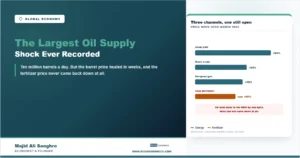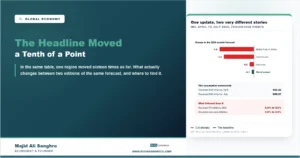
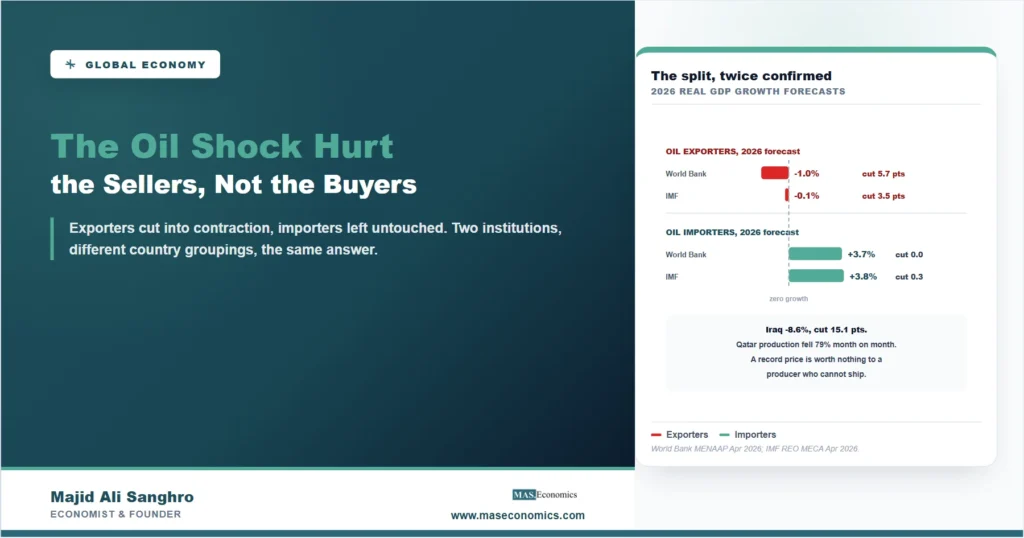
Everyone knows what an oil shock does. Prices go up, the countries that buy oil suffer, the countries that sell it collect, and the transfer runs from importer to exporter. That is what happened in 1973 and it is the shape most people still carry in their heads. It is also, in 2026, the opposite of what the forecasters found, and our narrative account of how the Hormuz crisis reshaped the global economy is the backdrop this article measures. The oil shock that followed the closure of the Strait of Hormuz left the region’s oil importers essentially untouched and put its oil exporters into outright contraction: the World Bank now projects developing oil exporters in the Middle East, North Africa, Afghanistan and Pakistan to shrink by 1.0 percent in 2026, a downgrade of 5.7 percentage points since January, while the same report leaves oil importers at 3.7 percent growth with a revision of exactly zero. The IMF, using a different country grouping and a different comparison date, reached the same conclusion independently: exporters at −0.1 percent, cut by 3.5 points, importers at 3.8 percent, cut by 0.3. Two institutions, two datasets, one counterintuitive answer. The reason is worth understanding, because it is not a quirk of this conflict but a general point about what a price is and what it is not.
What the Two Sets of Numbers Actually Say
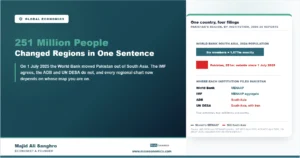
Start by being careful about the comparison, because the two forecasts are not measuring quite the same thing and the agreement is more impressive once that is clear. The World Bank’s aggregate covers developing oil exporters excluding Iran and compares against its own January 2026 forecast. The IMF’s aggregate covers MENAP oil exporters including Iran and compares against October 2025. Different members, different baselines, different models. They still land in the same place, and that is what makes the result hard to dismiss as an artefact of one institution’s assumptions. The country detail underneath shows where the damage sits. The World Bank has Iraq contracting 8.6 percent in 2026, a cut of 15.1 points since January, which is the single largest downgrade in its table; Kuwait at −6.4 percent, cut 9.0; Qatar at −5.7 percent, cut 11.0. The IMF is harsher still on Qatar, putting it at −8.6 percent with a downward revision of 14.7 points. Meanwhile the importers barely move. Egypt goes from 4.4 percent to 4.3, unchanged on the revision. Pakistan sits at 3.0 percent with a revision of zero since January. Morocco, Jordan and Tunisia all shift by two or three tenths of a point at most. A shock that made every front page did almost nothing to the growth forecasts of the countries that buy the commodity, and gutted the forecasts of the countries that sell it.
Why Selling the Thing That Got Expensive Did Not Help
The resolution is that a price rise only helps a seller who still has something to sell. What happened in March was not a demand boom that lifted the value of Gulf output; it was the physical severing of the route that output travels. Qatar halted LNG production entirely after strikes on the facilities at Ras Laffan where virtually all of its exports originate. Iraqi and Qatari crude production fell month on month by 67 and 79 percent respectively from February levels, reflecting near-total dependence on the strait. For Bahrain, Iraq, Kuwait and Qatar there are no alternatives at meaningful scale; Oman, Saudi Arabia and the United Arab Emirates can divert some volume through pipelines and ports outside the Gulf, which is exactly why Saudi Arabia is still forecast to grow 3.1 percent while its neighbors contract. Revenue is price multiplied by quantity, and when quantity falls by two thirds, a price rise of two thirds does not compensate; it barely holds the line, and it does nothing at all for the fiscal and employment structure built on top of the volume. This is the practical content of the terms of trade: a favorable movement in the ratio of export prices to import prices raises welfare only when the export volume survives to be sold at the better ratio.
The mirror image explains the importers. An oil importer facing higher prices takes a real income loss, and that loss is genuine: the IMF estimates that for the average emerging or developing oil importer in the region, a 10 percent rise in the average annual oil price costs about half a percentage point of output and adds about a full point to inflation, which is the cost-push channel working exactly as described. But the loss is spread thinly across an entire economy and it arrives as a squeeze on margins and household budgets rather than as the disappearance of a sector. Egypt and Pakistan were also entering the shock from a position of momentum, with the World Bank noting an industrial rebound and stronger confidence in Pakistan through the second half of 2025, so a headwind of a few tenths met a tailwind of a few tenths and the forecast barely moved. Concentration is the whole story. A diversified importer absorbs a cost increase; a hydrocarbon exporter that cannot ship loses the thing its budget, its currency and its labor market are all built on. Our profile of Pakistan’s stabilization cycle sets out what that kind of momentum looks like from the inside, and the general vulnerability of undiversified producers is the standing theme of our work on the geopolitics of oil.
What This Does Not Mean
Two qualifications keep the finding honest, and both matter more than the headline. The first is that a growth forecast is not a welfare measure. The importers were spared a downgrade, not spared the shock: they still pay more for fuel, still see current account deficits widen, still watch production costs feed through to consumers, and in some countries shortages had already produced blackouts and rationing. A number that does not move can conceal a population that is worse off, because growth measures the change in output and not the price paid for the inputs that produced it. The second qualification is that these are forecasts made in extraordinary conditions, and the World Bank says so with unusual bluntness: as of late March, the average gap between the highest and lowest 2026 growth forecasts for Gulf countries exceeded 12 percentage points. A 12-point spread is not a forecast, it is a range of scenarios wearing one. The right way to read the exporter numbers is as a direction and an order of magnitude, not as a point estimate, and the honest reason to trust the direction is precisely that two institutions with different memberships and different baselines produced it independently.
Held to those limits, the lesson travels well beyond one region and one war. Commodity wealth is not the same as commodity income, and commodity income depends on a logistics chain that a price chart cannot see. Any economy whose exports move through a single corridor is holding a concentrated risk that looks like an advantage right up until the corridor closes, and the advantage and the risk are the same asset. The countries in this table that did best were the ones with a second route or a second sector. That is a portfolio argument rather than a geopolitical one, and it applies to a landlocked exporter of anything, to a country whose earnings depend on one crop, and to a government whose budget balances on a single price.
MASEconomics Explains
3 economic concepts behind the result
These concepts are explored in depth across our educational articles library.
Explore the MASEconomics BlogConclusion
The 2026 oil shock inverted the pattern the phrase is supposed to describe. The World Bank cut its 2026 forecast for the region’s developing oil exporters by 5.7 percentage points to a contraction of 1.0 percent while leaving oil importers at 3.7 percent with no revision at all, and the IMF, working from a different country grouping and a different baseline, produced the same split at −0.1 and 3.8 percent. The mechanism is not mysterious once the shock is described accurately. This was not a demand event that raised the value of Gulf output; it was the closure of the route that output uses, and a producer that cannot ship gains nothing from a record price. Iraq and Qatar saw month-on-month production fall by 67 and 79 percent, and their forecasts fell with the volume rather than rising with the price.
Two limits belong with the finding. An unchanged growth forecast is not an unchanged standard of living, and the importers still absorbed higher fuel bills, wider deficits, and in places rationing, because output measures what was produced and not what it cost to produce. And the exporter numbers carry a forecast spread that exceeded 12 percentage points across Gulf economies in late March, which makes them a direction rather than a value. What survives both limits is the general point, and it is the one worth keeping: commodity wealth is not commodity income, the difference between them is a logistics chain, and an economy resting on one product through one corridor holds a risk that is indistinguishable from an advantage until the day it is not.
Frequently Asked Questions
Why did oil exporters do worse than oil importers in 2026?
Because the shock destroyed volume rather than creating demand. The closure of the Strait of Hormuz cut the route Gulf output travels, so producers could not ship at the higher price. Iraqi and Qatari crude production fell 67 and 79 percent month on month from February levels, and Qatar halted LNG production entirely after strikes on its export facilities.
Do the World Bank and the IMF agree on this?
Yes, and from different starting points. The World Bank projects developing oil exporters excluding Iran at −1.0 percent for 2026, revised down 5.7 points since January, against importers at 3.7 percent with a zero revision. The IMF, using a grouping that includes Iran and comparing with October 2025, projects exporters at −0.1 percent, revised down 3.5, and importers at 3.8 percent, revised down 0.3.
Which countries were hit hardest?
In the World Bank table, Iraq at −8.6 percent for 2026 is the largest downgrade at 15.1 points, followed by Kuwait at −6.4 percent and Qatar at −5.7 percent. The IMF puts Qatar lower still at −8.6 percent, a cut of 14.7 points. Saudi Arabia, which can divert some volume through routes outside the Gulf, is still forecast to grow 3.1 percent.
Does an unchanged forecast mean importers were unaffected?
No. Growth measures output, not the cost of producing it or the price households pay. Importers still faced higher fuel bills, wider current account deficits, production costs passed on to consumers, and in some countries blackouts and rationing. The IMF estimates a 10 percent rise in the annual oil price costs the average regional importer about half a point of output and adds about a point to inflation.
How reliable are these forecasts?
Reliable as to direction, weak as to level. The World Bank noted that as of late March 2026 the average gap between the highest and lowest 2026 growth forecasts for Gulf countries exceeded 12 percentage points, an extraordinary spread. The reason to trust the exporter-importer split despite that is that two institutions produced it independently, with different country groupings and different comparison dates.
Thanks for reading! A record price is worth nothing to a producer who cannot get the cargo out of the harbor, and that sentence is the whole of this shock. Happy learning with MASEconomics