The organizing hope of development economics is simple: poor countries, growing faster than rich ones, gradually close the gap. For most of this century the hope held. The World Bank’s June 2026 projections describe something else. Per capita income in emerging and developing economies, once China and India are set aside, will not regain its 2019 position relative to advanced economies until after 2028, which the Bank calls nearly a decade of lost income convergence. For the group of economies holding most of the world’s poor, catching up stopped in 2019 and has not restarted.
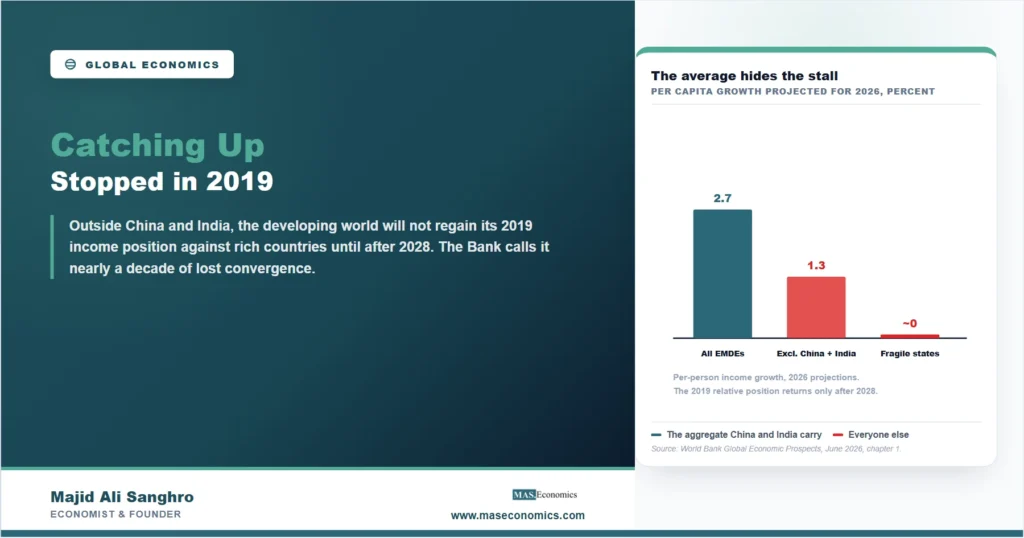
The qualifier in that sentence is doing enormous work, and most coverage drops it. Aggregate emerging-market growth still looks respectable, because China and India are large enough to carry the average on their own. Exclude them, and per capita income growth in the rest of the developing world falls to 1.3 percent in 2026. In fragile and conflict-affected states it falls to about zero. A reader who sees only the aggregate sees a developing world that is fine. The Bank’s own decomposition shows a developing world splitting in two.
Three Growth Rates, Three Different Worlds
The mechanics of the slowdown are not mysterious. The energy price shock from the Middle East war has hit commodity importers hardest, eroding household purchasing power exactly where incomes are thinnest, a shock whose global growth arithmetic we covered in the piece on what the institutions actually project. Fiscal space in vulnerable countries was spent during the pandemic and never rebuilt, so governments cannot cushion the blow, which is the country-level version of the closed margin we measured in the global fiscal gap. And the last external buffer is being withdrawn: net official development assistance fell 23 percent in real terms in 2025, the largest annual drop on record, with further declines expected.
What Zero Convergence Means in Lives
Growth rates are abstractions until they are attached to what they buy. The Bank’s report does the attachment itself, and the numbers deserve to be quoted plainly. The population facing severe food insecurity in developing economies excluding China rose by around 220 million between 2019 and 2025, and the report projects a further 35 to 70 million by the end of 2028 as war-driven food and fertilizer costs work through. On pre-conflict estimates, nearly 60 percent of people in low-income countries are projected to be living in extreme poverty by the end of 2026. In fragile states, per capita income is projected to remain more than 15 percent below its 2019 position relative to advanced economies even in 2028.
| Measure | Reading |
|---|---|
| Per capita growth, 2026, EMDEs excluding China and India | 1.3% |
| Per capita growth, 2026, fragile and conflict-affected states | About zero |
| Year the ex-China-and-India group regains its 2019 relative income position | After 2028 |
| Fragile states’ relative income position in 2028, against 2019 | More than 15% below |
| Rise in severe food insecurity, 2019-2025, EMDEs excluding China | About 220 million people |
| Net official development assistance, 2025 | -23% in real terms, the largest drop on record |

|
|
It is worth being precise about what “lost convergence” is not. It is not a recession: most of these economies are growing, and their absolute incomes are rising slowly. What has stopped is relative progress, the closing of the distance to rich-country living standards that gives development its direction. A country growing 1.3 percent per person while the advanced economies grow at a similar pace is running to stand still, and a fragile state at zero is watching the gap widen. The distinction matters because the usual dashboard, GDP growth by country, shows nothing wrong; the failure only appears in the ratio, which is why our primer on reading growth figures insists that the question determines the denominator.
Why the Aggregate Hides It
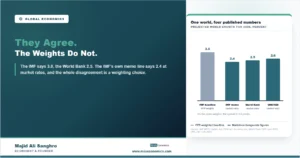
The EMDE average of 2.7 percent per capita growth is not wrong; it is answering a different question, the same trap in the same family as the median-versus-weighted split we dissected in the median country piece. China and India together hold about a third of the developing world’s people and a much larger share of its measured output growth, so any population- or GDP-weighted average of the developing world is substantially a statement about those two economies. Both are converging. The average therefore reports convergence, truthfully, for a group in which most member countries are not converging at all.
The practical reading habit follows: whenever a claim is made about “emerging markets” or “the developing world”, check whether it survives the removal of China and India. Claims about global poverty, convergence, the middle-income transition and export-led growth often do not, and the Bank’s own reports increasingly publish the ex-China-and-India line precisely because the aggregate has become unrepresentative. This piece belongs to the same reading discipline as our study of conflicting economic statistics: the aggregate and the typical member have parted company, and the interesting information is in the gap.
The wider consequences reach beyond the countries in the red bars. A developing world that stops converging is one in which the demand growth that exporters everywhere plan around does not materialize, in which migration pressure builds along the income gradients that stopped closing, and in which the trade-finance and capital-flow architecture we examined in the trade-credit piece carries more strain with fewer shock absorbers. Convergence was never only a moral project. It was the growth model of the world economy’s next half century, and the Bank’s projection says it is running almost a decade behind.
MASEconomics Explains
3 economic concepts behind lost convergence
These concepts are explored in depth across our educational articles library.
Conclusion
The World Bank’s projection that income convergence outside China and India will not regain its 2019 position until after 2028 turns a technical ratio into a historical marker: for most developing countries, the 2020s are on course to be a lost decade of catching up. The numbers underneath are 1.3 percent per-person growth in 2026 for the group, about zero in fragile states, 220 million more people in severe food insecurity since 2019, and the largest recorded fall in development assistance arriving exactly when the buffers were already spent.
The reading lesson travels further than the projection. The developing-world aggregate reports 2.7 percent and looks unremarkable, because two giant converging economies dominate it. Every user of that aggregate, in markets, in policy, in journalism, inherits the distortion unless they run the ex-China-and-India check the Bank now runs itself. The gap between the average and the typical country is where this decade’s development story is actually being written, and on the Bank’s own arithmetic it is a story of standing still.
Frequently Asked Questions
What does a decade of lost convergence mean?
Per capita income in emerging and developing economies excluding China and India, measured relative to advanced economies, is not projected to return to its 2019 position until after 2028. The gap that was supposed to close held roughly constant for nearly ten years, which is what “lost” means: relative progress, not absolute income, went missing.
Why exclude China and India from the average?
Because they are large enough to determine the aggregate on their own, and both are converging. Including them, developing-world per capita growth is 2.7 percent in 2026; excluding them it is 1.3. The aggregate truthfully reports the giants and misrepresents the typical member, so the Bank publishes both lines.
Is this just the war’s effect?
The war worsened it through energy and food prices, but the stall dates from 2019 and reflects the pandemic, depleted fiscal space and now falling aid, with net official development assistance down 23 percent in real terms in 2025 alone. The projected 2027-28 recovery, at 2.1 percent for the ex-China-and-India group, is not fast enough to make up the lost ground.
Who is most affected?
Fragile and conflict-affected states, where per-person income growth is projected at about zero for 2026 and the relative income position in 2028 remains more than 15 percent below 2019. Many are low-income countries, where the report projects nearly 60 percent of the population in extreme poverty by the end of 2026 on pre-conflict estimates.
Why does this matter to readers in rich countries?
Convergence is where much of the next generation of global demand, trade growth and investment returns was expected to come from, and income gaps that stop closing are historically associated with rising migration pressure. A developing world that runs to stand still changes the arithmetic for exporters, investors and policymakers everywhere.
Thanks for reading! The most important number in development this year is a ratio that simply stopped moving, and it took the Bank’s own footnote to make it visible. Happy learning with MASEconomics