A farmer notices discoloration spreading across the leaves of one section of a field. The problem is visual and spatial: which leaves, what shade, how far it has spread, what the soil there is like. The channels available to reach an advisory service are a text message and a recorded voice line, and neither can carry any of that. So the farmer receives the same seasonal bulletin everyone else receives, written for an average farmer in an average season, and the crop is lost or saved on guesswork. This is the gap that AI agricultural advisory services are supposed to close, and the World Bank’s 2026 World Development Report is unusually specific about the condition on which closing it depends. Adopting these services, it says, is possible only with good digital public infrastructure, including farmer and land registries, soil health databases and a unified digital identity system. An application that cannot identify who farmers are, what they grow, or where their land is located cannot deliver advice more meaningful than the generic bulletin it was meant to replace. The model is not the binding constraint. The address book is.
The Shortage That Hiring Cannot Fix
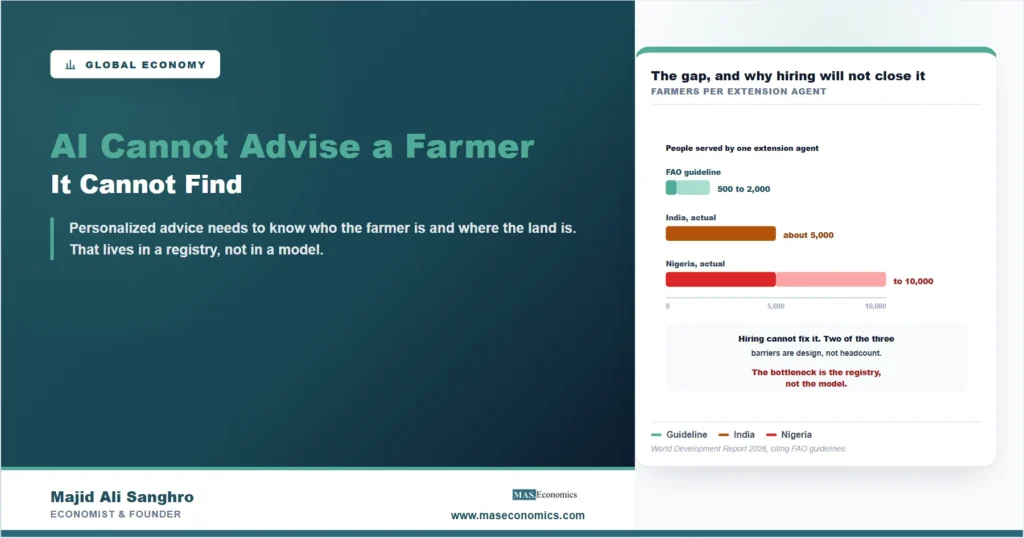
Start with the scale of the gap, because it explains why the technology is being reached for at all. The Food and Agriculture Organization’s planning guidelines specify one extension agent for every 500 to 2,000 rural inhabitants, varying with production systems and population density. The reality is not close. In Nigeria a single public extension agent may serve anywhere from 5,000 to 10,000 farmers. India runs one of the largest public extension systems in the world, with roughly 120,000 extension professionals, and its ratio of extension workers to farmers is about one to 5,000, far below its own national staffing guidelines of roughly one to 400 in hilly areas and between about one to 750 and one to 1,100 in irrigated and rainfed regions. A country can miss an international benchmark for many reasons. Missing your own staffing guideline by a factor of five is a different kind of statement, and it is the more revealing one.
The obvious response is to hire more agents, and the report’s most useful sentence is the one that closes off that route. Increasing the number of agents alone, it argues, cannot address the structural barriers that have defined extension systems for decades: understaffing, generic advice, and information that flows only one way. Those barriers require a different architecture entirely. This is worth pausing on, because it is an economic claim rather than an administrative one. If the service were merely under-resourced, more staff would fix it and the arithmetic would be a budget question. But two of the three named barriers are properties of the design, not of the headcount. Public extension advice is structurally generic, built for an average farmer in an average season; it is asymmetric, flowing from institution to farmer and rarely back; and it is reactive, following fixed seasonal calendars rather than real-time conditions that could anticipate a loss before it happens. Doubling the agents doubles the delivery of advice with all three properties intact. The constraint sits in the production function, not in the quantity of the input, which is why our guide to productivity matters more here than any staffing plan.
The Registry Is the Bottleneck, Not the Model
A different architecture is exactly what generative AI offers, and the report is careful about what it does and does not replace. It does not replace human extension agents. What it does is extend the reach of agronomic knowledge beyond what any human workforce could achieve, delivering advice that is personalized and specific to context to farmers who have never had access to a trained agronomist, which is a way of stretching scarce human capital rather than creating more of it. The words carrying the weight are personalized and specific to context, and they are also the words that identify the failure point. Personalized advice requires knowing who the person is. Context-specific advice requires knowing where the land is, what is planted on it, what the soil has been doing and what the season has been like there rather than nationally. None of that is in a language model. All of it is in a registry, and the registry is the part that does not exist in many of the countries where the need is greatest.
That is why the report’s precondition list reads like plumbing rather than like technology: farmer and land registries, soil health databases, a unified digital identity system. Strip those away and the most capable model available degrades to precisely the service it was brought in to replace, because with no way to distinguish one farmer from another it can only answer the average question with the average answer. The generic bulletin was never a failure of knowledge; agronomy knew the right answers. It was a failure of addressing, of getting the specific answer to the specific field. AI without the identity layer automates the delivery of the average and reproduces the original defect at higher speed and lower cost, which is a real saving and not the promised transformation. The general form of this is worth stating because it travels far beyond agriculture and far beyond poor countries. Any AI application promising personalization is only as good as the record of who the user is and what their situation is, which is why so many corporate AI pilots in rich economies stall at the point where the model works and the customer data does not. The bottleneck is almost never the model. It is the state of the records underneath it, a dependency our article on the digital economy traces through the commercial version of the same problem.
Where the infrastructure does exist, the returns are large enough to explain the enthusiasm. In the Indian state of Telangana, AI-generated weather forecasts produced savings of as much as $560 per small farmer, and the mechanism was behavioral rather than magical: the forecasts let smallholders respond to specific risks, with some increasing farm expenditure by as much as a third when conditions justified it and others avoiding spending that would have been wasted. Note what that requires. A forecast is only actionable if it is for the right place, which means the system knew where the farm was. The same report notes that farmers in Telangana had relied little on information from government and extension agents, which is the counterfactual that makes the number meaningful: the gain was measured against an information vacuum, not against a well-functioning service.
What Goes Wrong When the Ground Truth Is Missing
The failure modes are specific enough that the report lists what a pre-deployment adversarial test should probe for, and the list is a useful corrective to anyone imagining the downside is merely unhelpful advice. Red teaming, in which security professionals attack a model before release, is directed at risks including the generation of harmful advice on pesticides, incorrect fertilizer or pesticide dosage calculations, recommendations that ignore local crop calendars or regional pest pressures, and demographic bias in the quality of advice delivered to women farmers or marginalized communities. A dosage error is not a bad user experience. It is a poisoned field or a wasted season, paid for by a household with no buffer and eventually felt in food prices, and the last item on that list is the one that compounds quietly: a system trained on records that under-represent women farmers will serve them worse, and if the registry itself under-records them, the model has no way to know it is doing so.
The mitigations the report describes are equally unglamorous and worth knowing, because they explain why this is an institution-building problem rather than a procurement one. Human-in-the-loop validation integrates expert judgment into the model’s output for complex or high-risk queries, and the evidence is that validation by humans with the required expertise significantly improves output quality while farmer trust rises when advice is visibly grounded in verified, expert-curated sources. Trust gaps and limited digital literacy also mean human intermediaries remain essential complements rather than a transitional cost, illustrated by Rwanda’s Digital Ambassadors Program, which embeds community facilitators in rural communities to support uptake. The picture that emerges is not a technology replacing a workforce but a technology that needs a workforce, a registry and a validation process around it to function at all. That is a less exciting proposition than the one in most announcements, and it is the one supported by the evidence. It also sets the sequence for any government deciding where to spend: the identity and land records first, the advisory service second, because in the other order the money buys a faster way to send the same bulletin. The wider question of whether countries should build or adopt the underlying models is taken up in our piece on national AI strategies, and the efficiency case for the technology itself in AI in agricultural economics.
MASEconomics Explains
3 economic concepts behind the constraint
These concepts are explored in depth across our educational articles library.
Explore the MASEconomics BlogConclusion
AI agricultural advisory services address a gap that is real and badly measured in human terms. The Food and Agriculture Organization’s guideline is one extension agent per 500 to 2,000 rural inhabitants; India runs about one per 5,000 against its own national target of roughly one per 750 to 1,100, and a Nigerian agent may serve 5,000 to 10,000 farmers. But the report’s central finding is that hiring cannot close this, because two of the three structural barriers, generic advice and one-way information flow, are properties of the design rather than of the headcount. More agents deliver more of the same bulletin. The problem requires a different architecture, and generative AI supplies one that extends agronomic knowledge to farmers who have never had access to a trained agronomist.
The condition attached to that promise is the part worth carrying, and it is a plumbing condition rather than a technological one. Personalized, context-specific advice requires knowing who the farmer is, what they grow and where their land is, which lives in farmer and land registries, soil health databases and a unified identity system, not in any model. Without them the most capable system available can only answer the average question with the average answer, which is exactly the failure it was brought in to fix. Where the records do exist the returns are substantial, as in Telangana, where AI weather forecasts were worth as much as $560 per small farmer. Where they do not, the sequence matters more than the budget: build the records first. The general lesson outlasts the sector and the income bracket, because the same dependency stalls corporate AI projects in wealthy economies for the same reason. A model can only be as specific as the record of who it is talking to.
Frequently Asked Questions
What does AI agricultural advisory actually need to work?
Good digital public infrastructure, which the World Development Report 2026 specifies as farmer and land registries, soil health databases and a unified digital identity system. An application that cannot identify who farmers are, what they grow or where their land is located cannot give advice more meaningful than a generic bulletin, regardless of how capable the underlying model is.
How short-staffed are agricultural extension services?
The FAO planning guideline is one agent per 500 to 2,000 rural inhabitants depending on production systems and population density. In Nigeria one public extension agent may serve 5,000 to 10,000 farmers. India, with about 120,000 extension professionals, runs roughly one per 5,000 farmers, well short of its own national guidelines of about one per 400 in hilly areas and one per 750 to 1,100 in irrigated and rainfed regions.
Why not simply hire more extension agents?
Because only one of the three structural barriers is a staffing problem. Alongside understaffing, extension advice is structurally generic, designed for an average farmer in an average season, and asymmetric, flowing from the institution to farmers and rarely back. More agents deliver more advice with both of those properties unchanged, which is why the report concludes the barriers require a different architecture entirely.
What can go wrong with AI farm advice?
The report names the risks that pre-deployment adversarial testing should target: harmful advice on pesticides, incorrect fertilizer or pesticide dosage calculations, recommendations that ignore local crop calendars or regional pest pressures, and demographic bias in the quality of advice given to women farmers or marginalized communities. A dosage error costs a season, and a household with no financial buffer absorbs it.
Does AI replace human extension agents?
No. The report is explicit that generative AI does not replace them; it extends the reach of agronomic knowledge beyond what any human workforce could achieve. Human validation by people with the relevant expertise significantly improves output quality and raises farmer trust, and trust gaps and limited digital literacy mean human intermediaries remain essential complements, as in Rwanda’s Digital Ambassadors Program.
Thanks for reading! The generic bulletin was never a failure of agronomy, it was a failure of addressing, and a model with no address book repeats it faster. Happy learning with MASEconomics