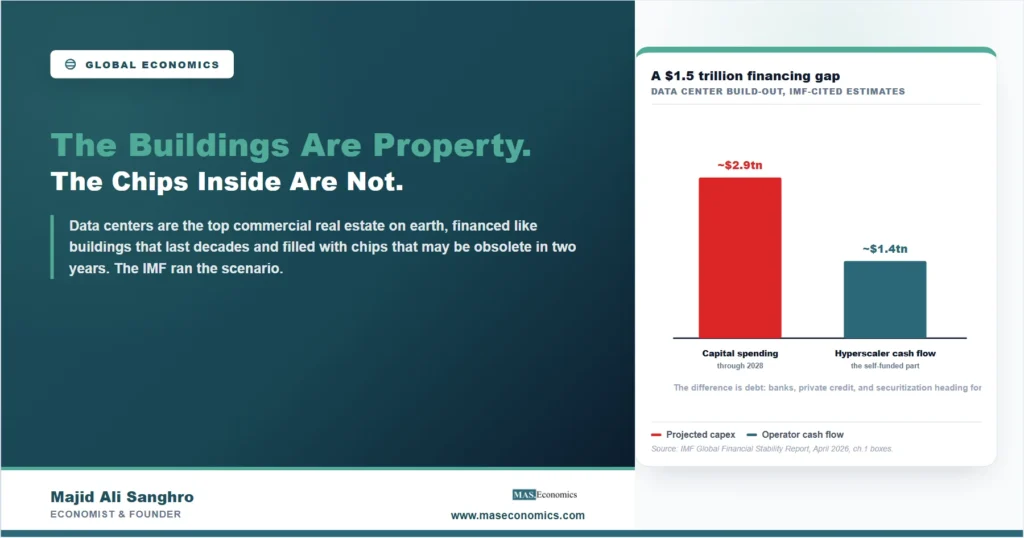
While offices empty and retail struggles, one kind of building has become the best-performing commercial property in the world. The IMF’s April 2026 Global Financial Stability Report ranks data centers as the top commercial real estate subsector, with leasing expected to reach an all-time high in 2026, and then devotes two boxes to the question that follows from success at this scale: who pays for it. The answer involves roughly $2.9 trillion of projected capital spending through 2028 against about $1.4 trillion of expected cash flow from the technology giants driving it, and a financing gap that the bond market, private credit and securitization are now being asked to fill.
That arithmetic is why a story about server buildings belongs in a financial stability report, and why it belongs to readers with no exposure to technology stocks. The gap is being bridged with debt, the debt is being sliced into securities, and the buildings backing it all carry a risk that ordinary property does not: the things inside them may be obsolete years before the loans mature.
The Money Arriving, and the Gap Behind It
The scale of the arrival is easy to underestimate. Investment inflows into AI and digital infrastructure exceeded an estimated $270 billion in 2025 alone, and the geography is wider than the American headlines suggest: France hosted $69 billion of activity, Korea $21 billion, and emerging markets including Brazil, Thailand, India and Malaysia secured multi-billion-dollar projects. Power, not land or money, is the binding constraint, with grid connection lead times now stretching from two to seven years, long enough that developers build speculatively and prelease capacity in power-constrained markets before ground is broken.
The financing structure is evolving in a familiar direction. Since 2018, $46 billion of data center debt has been securitized, 70 percent as asset-backed securities and 30 percent as commercial mortgage-backed securities, with record issuance in 2025 and an expected $150 billion by 2028. Banks bridge construction; private credit and bespoke structures expand behind them; real estate investment trusts partner with energy firms to secure power. Readers of financial history will recognize the pattern of a hot asset class acquiring its own securitization pipeline, and the mechanics of how such instruments parcel property income into bonds are the ones set out in our primer on how bonds work.
The Depreciation Question Nobody Can Answer Yet
The second IMF box asks the uncomfortable question about what all this debt is secured against. A conventional building earns for decades. A data center’s value is dominated by what it contains, and the hyperscalers’ own accounts imply an average useful life of about seven years for their property, plant and equipment. The report’s observation is that the GPUs and advanced chips that now make up a major share of AI infrastructure cost could become obsolete within two years, and nobody knows which number the future resembles, because the technology is too young for its true depreciation schedule to exist in any dataset.
The IMF staff therefore run the scenario instead of predicting it. If useful life turns out to be three years rather than seven, higher depreciation cuts the hyperscalers’ aggregate profit margin by more than nine percentage points, and under high capital intensity the margin is wiped out entirely by the reinvestment required. Debt outstanding, currently around $800 billion across the group, rises above $1 trillion as the financing gap widens, and a standard credit model puts the resulting widening in their credit default swap spreads at around 60 basis points, against current spreads of 20 to 160. The report is careful to file this as business risk rather than imminent financial instability, and the article repeats that classification: these are the world’s most cash-generative firms, and a margin compression is not a default. What the scenario shows is sensitivity, that the difference between seven years and three, a parameter nobody can currently measure, moves a trillion-dollar debt stock and the price of insuring it.
| Assumption | Implied outcome for the hyperscalers |
|---|---|
| Useful life of capital: ~7 years (current accounts) | Margins and debt as reported today, debt about $800 billion |
| Useful life: 3 years | Aggregate profit margin falls by more than 9 percentage points |
| 3 years, with high capital intensity | Aggregate margin wiped out by required reinvestment |
| 3 years, financed by borrowing | Debt rises above $1 trillion; modeled credit spreads widen ~60 basis points |

|
|
Where the Risk Actually Sits
Assembling the two boxes gives the structural picture. On one side, record demand, record leasing and tenants of exceptional credit quality. On the other, four vulnerabilities the report names: concentration of those tenants, a handful of hyperscalers anchor most of the leases, so one firm’s retrenchment moves the whole sector; obsolescence on the timeline just described; speculative development timed against power constraints; and the grid delays themselves. The combination is unusual: an asset class whose collateral can depreciate at technology speed is being financed with instruments designed for assets that depreciate at building speed, and sold onward to investors, insurers and credit funds who hold it as property exposure.
Whether the bet pays depends on a question outside finance entirely, whether AI revenues arrive fast enough to keep the buildings leased and the chips worth replacing, and markets are currently pricing a confident answer, the kind of confidence whose limits our piece on the efficient market hypothesis examines. The macroeconomic backdrop makes the wager consequential: the same AI investment surge now shows up in national accounts as a growth engine, in labor markets through the displacement we documented in AI job displacement, and in the productivity hopes we set out in output per hour and living standards. If the payoff disappoints, the adjustment arrives not only through equity prices but through a newly built credit channel, the ABS, the private credit and the bank construction loans, which is precisely why the IMF is mapping it before rather than after. For the ordinary observer, the tell to watch is not the leasing headlines but the depreciation footnotes: the quarter the hyperscalers shorten their stated useful lives is the quarter the seven-year assumption starts becoming the three-year scenario.
MASEconomics Explains
3 economic concepts behind the data center build-out
These concepts are explored in depth across our educational articles library.
Conclusion
Data centers are now the top-performing commercial real estate on earth, absorbing more than $270 billion of investment in 2025 and heading for record leasing in 2026, and the financing behind them has become the interesting part: roughly $2.9 trillion of projected spending through 2028 against $1.4 trillion of hyperscaler cash flow, with the difference met by debt, private credit and a securitization pipeline expected to triple to $150 billion. The IMF’s contribution is to price the question the boom defers: the buildings are financed like property, but their contents may depreciate like phones.
The scenario arithmetic is the takeaway. Shorten assumed useful life from seven years to three and the hyperscalers’ margins compress by nine points or vanish, their debt passes $1 trillion, and modeled credit spreads widen 60 basis points, a business risk today, a macrofinancial one if leverage keeps building on the optimistic assumption. Nothing in the report predicts that outcome, and this article does not either. What the analysis establishes is where to look: in an investment boom this large, the load-bearing number is not the leasing rate but the depreciation schedule, and it is the one number no one will know until the chips age.
Frequently Asked Questions
Why does the IMF treat data centers as a financial stability topic?
Because the build-out’s projected spending of roughly $2.9 trillion through 2028 exceeds the operators’ expected cash flows by about $1.5 trillion, and the gap is being financed through banks, corporate debt, private credit and securitization. Once that much credit exposure exists, the sector’s assumptions become everyone’s assumptions.
What is the obsolescence problem?
Hyperscaler accounts imply their capital lasts about seven years, but the advanced chips now dominating AI infrastructure cost could become obsolete within two. If true lives are closer to three years, depreciation compresses margins by over nine percentage points and the sector needs substantially more debt, which is the IMF’s modeled scenario rather than its forecast.
Is this concentrated in the United States?
The build-out began concentrated in North America but is spreading: of the estimated $270 billion-plus of 2025 inflows, France hosted $69 billion and Korea $21 billion, with Brazil, Thailand, India and Malaysia among emerging markets securing significant projects. Power availability, with grid waits of two to seven years, increasingly decides the map.
Who ends up holding the risk?
Construction banks during building; then bondholders, private credit funds and buyers of the asset-backed and mortgage-backed securities, $46 billion issued since 2018 and an expected $150 billion by 2028, plus investors in data center REITs. Many hold it as stable property exposure, which is exactly what the obsolescence question tests.
Is the IMF predicting a crash?
No. It classifies obsolescence as a business risk rather than an imminent stability threat, given the operators’ exceptional cash generation. Its point is sensitivity: an unmeasurable parameter, the true useful life of AI capital, moves a trillion-dollar debt stock, so the risk deserves monitoring while it is still a scenario.
Thanks for reading! Every building boom eventually meets its depreciation schedule; this is the first one where nobody knows what the schedule is. Happy learning with MASEconomics