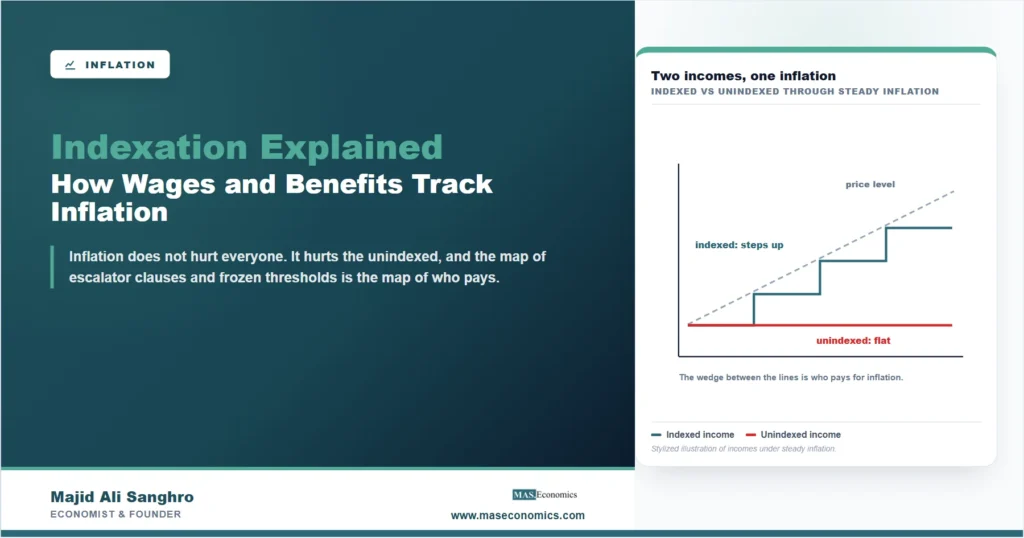
Inflation does not hurt everyone. It hurts the unindexed. Indexation is the practice of tying a payment, a wage, a pension, a benefit, a tax threshold, a bond coupon, to a price index, so that when the index rises the payment rises automatically with it. Wherever that link exists, inflation passes through harmlessly; wherever it does not, inflation quietly transfers purchasing power away from the person waiting on a fixed number. The map of what is indexed and what is not is therefore the real map of who pays for inflation, and it looks nothing like the impression given by headlines that treat rising prices as a uniform national weather event.
The machinery is worth understanding twice over: once from below, because a household’s exposure to inflation depends almost entirely on which side of the indexation line its income and obligations sit; and once from above, because economies that indexed everything discovered they had built a machine that made inflation self-perpetuating. Indexation protects individuals from inflation and, taken far enough, protects inflation from central banks. Both halves are true, and the tension between them shaped a half century of policy.
The Line That Decides Who Pays
Run down an ordinary household’s finances and the line is easy to trace. On one side: public pensions in most rich countries adjust annually by law, American Social Security through a cost-of-living adjustment computed from the consumer price index, and many countries uprate benefits the same way; inflation-linked government bonds adjust principal with the index; many rental contracts and some union wage agreements carry escalation clauses; and income tax brackets, in the United States and elsewhere, shift upward each year so that pure inflation does not push unchanged real incomes into higher tax rates.
On the other side sits most of economic life. The typical private wage is renegotiated occasionally, not indexed, so real pay erodes between raises and the raise must claw back ground already lost. Cash savings and conventional bonds pay fixed nominal amounts, which is how inflation silently taxes savers and rewards borrowers, the redistribution our article on how inflation erodes purchasing power works through. Fixed-rate mortgages shrink in real terms, a windfall for the indebted. Child benefits here, minimum wages there, fee thresholds and fine schedules everywhere: each jurisdiction indexes some and freezes others, and every freeze is a policy choice wearing the costume of neglect. A threshold left unindexed during an inflation is a stealth tax rise or benefit cut that no legislature ever has to vote on.
The index chosen matters as much as the indexing. A pension tied to a broad consumer index tracks the average household’s basket, not the pensioner’s, and older households spend more heavily on the categories, healthcare, heating, that often outrun the average. Britain’s long argument over which index should uprate benefits and rail fares, visible in every year’s UK inflation round, is an argument about exactly this: switching a payment from a faster index to a slower one is a permanent cut that compounds, delivered as a technical footnote.
The Machine That Feeds Itself
Scale the protection up and it changes character. If every wage, price, and contract in an economy adjusts automatically to past inflation, then any shock that raises prices once gets copied into wages, which raises costs, which raises prices again: the wage-price spiral, hard-wired. This is not a theoretical worry; it is the documented history of the economies that indexed most completely. Brazil in the 1970s and 1980s indexed wages, rents, taxes, and financial contracts so thoroughly that inflation became self-replicating, each month’s price rise mechanically reproducing itself through the escalator clauses, a dynamic our hyperinflation case studies place alongside the classic collapses. Ending it required not just tighter money but dismantling the indexation itself, which is why Brazil’s eventual stabilization built an entirely new unit of account before a new currency.
That history is why central banks watch indexation coverage the way engineers watch corrosion. A one-off shock, an oil spike, a currency fall, stays one-off only if it does not get written into forward contracts; the more of the economy that adjusts automatically backward, the more persistent every shock becomes, and the harder disinflation has to work. The rich world’s disinflation of the 1980s and 1990s was accompanied by a quiet retreat of formal indexation, especially in private wages, and its absence is one reason the post-pandemic inflation, for all its pain, decayed rather than spiraled: expectations stayed anchored partly because the mechanical anchors to past inflation had been removed, leaving the psychological ones our article on inflation expectations examines as the main battlefield.
The result is a deliberate asymmetry in modern policy design. Governments index the things that protect the vulnerable and the credibility of the state, pensions, benefits, tax brackets, and issue some inflation-linked debt as both insurance for savers and a signal of confidence; they discourage economy-wide automatic indexation of wages and prices, precisely because universal protection is collective vulnerability. Indexation, in other words, is treated as medicine: essential in targeted doses, dangerous in the water supply.
MASEconomics Explains
3 economic concepts behind indexation
These concepts are explored in depth across our educational articles library.
Explore the MASEconomics BlogConclusion
Indexation is the plumbing that decides where inflation’s burden actually lands. Payments tied to a price index, pensions, benefits, indexed tax brackets, linked bonds, ride through inflation approximately whole; everything fixed in nominal terms, most wages between raises, savings, thresholds a government quietly declines to uprate, absorbs the loss. Reading any inflation episode honestly means reading this map first, because the average burden the headline implies is an average of the protected and the exposed.
The same mechanism, universalized, stops protecting and starts propagating: economies that indexed everything turned every shock into permanent inflation and had to unbolt the machinery to stabilize. Modern practice therefore indexes selectively, shielding the vulnerable while leaving enough of the economy nominal for monetary policy to bite. The arrangement is unlovely and asymmetric, and it is the compromise a half century of inflation fighting settled on.
Frequently Asked Questions
What is indexation in simple terms?
Indexation ties a payment to a price index so it adjusts automatically with inflation. When the index rises, the wage, pension, benefit, tax threshold, or bond payment rises proportionally, preserving its purchasing power without anyone renegotiating it.
What is a cost-of-living adjustment (COLA)?
A COLA is the annual automatic increase applied to a payment based on measured inflation. American Social Security benefits receive one computed from the consumer price index, and many pension systems and some wage contracts around the world use the same design.
Are income tax brackets indexed to inflation?
In many countries, including the United States, the main brackets adjust annually for inflation, preventing bracket creep, the stealth tax rise that occurs when inflation pushes unchanged real incomes into higher rates. But governments sometimes freeze thresholds deliberately, which raises taxes each year without a vote, so the answer depends on the country and the moment.
Does indexation cause inflation?
Targeted indexation of pensions and benefits does not meaningfully drive inflation. Economy-wide automatic indexation of wages and prices can: it copies every price shock into wages and back into prices, making inflation self-perpetuating, as heavily indexed economies like Brazil experienced. That is why central banks accept selective indexation but resist universal escalators.
Who loses most from inflation without indexation?
Anyone whose income or savings is fixed in nominal terms: workers between pay raises, savers in cash and conventional bonds, and recipients of any benefit or threshold a government declines to uprate. Borrowers with fixed-rate debts gain the mirror image, since their obligations shrink in real terms.
Thanks for reading! Follow the escalator clauses and the frozen thresholds, and the question of who really pays for inflation answers itself. Happy learning with MASEconomics