A restaurant’s costs drift upward every week, yet its menu is reprinted a few times a year. That small observation carries one of the larger ideas in macroeconomics. Menu costs are the expenses a firm incurs when it changes a price: literally reprinting the menu, but also updating systems and catalogs, renegotiating with distributors, the management time spent deciding, and the least visible expense of all, the customers annoyed by a price that moves too often. Each of these is trivial next to a firm’s revenue. Summed across millions of firms and translated into behavior, they help explain why prices in a modern economy move in occasional steps rather than continuously, and why money, which theory once treated as a veil over the real economy, can move output and employment at all.
The distance between the small fact and the large consequence is the story of this article. It runs from a restaurant’s laminated card to the reason central bank policy works, and it ends at a live question: what happens to all of it in an economy where an algorithm can reprice ten thousand items in a second?
The Staircase and the Ramp
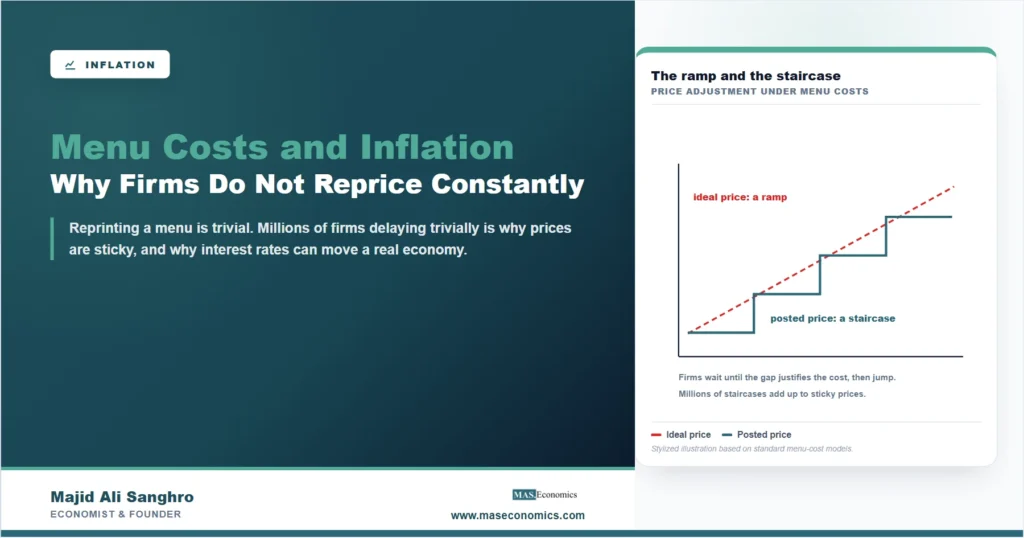
Consider a firm whose costs and competitors’ prices rise steadily. Its ideal price, the one it would charge if adjustment were free, rises like a smooth ramp. Its actual price cannot climb a ramp; every change costs something, so the firm waits until the gap between the ideal and the posted price is wide enough to justify the expense, then jumps. Prices trace a staircase around the ramp, and the steeper the ramp, the more frequent the steps.
The staircase explains features of everyday commerce that pure supply and demand does not. Prices cluster at round numbers and hold there for months. Firms facing identical costs reprice at different moments, so identical products briefly sell at different prices across town. And when firms do move, they move in meaningful jumps rather than pennies, because a jump big enough to justify the menu cost is, by construction, not small. None of this requires irrationality; it is the rational response of a firm weighing a known cost of acting against the drifting cost of standing still.
From Laminated Menus to Monetary Policy
The idea earned its place in macroeconomics through an argument about magnitudes that initially sounds impossible. If repricing costs are tiny, how can they matter for anything as large as a recession? The answer, worked out by New Keynesian economists in the 1980s, is that a firm’s private loss from delaying a price change is second-order small, roughly, the square of a small number, while the economy-wide consequence of many firms delaying is first-order large. Each firm sensibly ignores a sliver of profit; together their inertia makes the overall price level sticky.
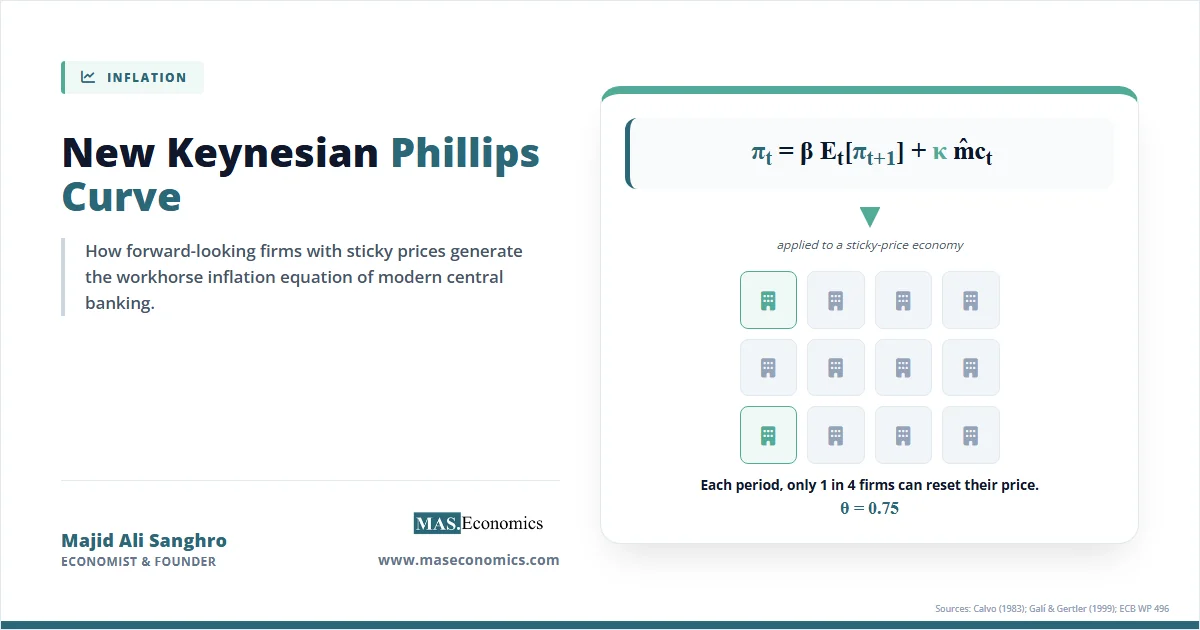
Sticky prices are the hinge on which practical monetary policy turns. If every price in the economy adjusted instantly, a change in money or interest rates would pass straight into the price level and touch nothing real, which is what classical theory concluded. Because prices actually move in staircases, a boost to spending meets prices that have not yet risen and becomes real output and employment for a while; a squeeze meets prices that have not yet fallen and becomes lost production instead of instant disinflation. The formal machinery connecting the staircases to inflation dynamics is the subject of our article on the New Keynesian Phillips curve, and the same stickiness underlies the short-run flexibility of production described in our explainer on aggregate supply. A central bank’s power over the real economy exists, in large part, because repricing is a chore.
Inflation itself changes the staircase, and this is where menu costs stop being a curiosity and start being a welfare argument. At low inflation, the ramp is nearly flat; firms reprice rarely, and relative prices stay informative. As inflation rises, the ramp steepens, firms must reprice more often, paying the menu cost more frequently, and between repricings their prices are more wrongly calibrated, so the price system transmits noisier information. In hyperinflations the staircase collapses into a blur: shops repricing daily or hourly, staff doing nothing but relabeling, the pattern documented across our hyperinflation case studies. Menu costs are one concrete answer to the question of why inflation is costly even when incomes keep pace, a mechanism that operates alongside the redistribution effects covered in how inflation erodes purchasing power.
The Algorithm Ate the Menu
The obvious modern objection is that repricing has become nearly free. An airline adjusts fares continuously; a large online retailer changes prices on individual items many times a day; electronic shelf labels let a supermarket reprice an aisle from a laptop. Where adjustment is genuinely costless, prices do behave as the frictionless theory always said they should, which is why airfares and ride-hailing rates move like weather while the corner restaurant still prints menus.
Yet the staircase has survived the technology better than expected, because the physical cost was never the whole cost. The decision still requires attention: someone must judge whether the change fits strategy, and management attention is scarce. And the customer-relations cost has, if anything, grown: buyers tolerate stable prices and punish visible volatility, as the public backlashes against surge pricing and dynamic supermarket labels keep demonstrating. Firms hold prices steady partly because fairness perceptions are an asset, and that implicit contract does not get cheaper with software. The composition of menu costs has shifted from printing to psychology; the stickiness they produce, measured in how long typical consumer prices survive between changes, has declined only gradually. For monetary policy the question is live and consequential: an economy of algorithmic staircases with shorter steps is one where policy’s real effects fade faster into pure inflation, and central banks are watching the repricing data for exactly that shift.
MASEconomics Explains
3 economic concepts behind menu costs
These concepts are explored in depth across our educational articles library.
Explore the MASEconomics BlogConclusion
Menu costs begin as an observation about laminated cards and end as a load-bearing wall of macroeconomics. Because changing a price costs something, firms let posted prices trail their ideal ones and adjust in occasional jumps; because millions of firms do this at once, the price level is sticky; and because the price level is sticky, changes in money and spending move real output before they move prices, which is the working premise of every central bank decision. The chain from trivial friction to monetary consequence is the canonical example of how small costs, aggregated, produce large economics.
The friction is evolving rather than vanishing. Software has made the mechanical part of repricing nearly free, and where it truly is free, prices now move continuously. But the decision costs and the customer’s dislike of volatile prices have proven durable, so the staircase persists with shortening steps, fastest wherever inflation is highest. Watching how quickly prices reprice has itself become a way of measuring what inflation is doing to an economy, which is a fitting fate for an idea that started with a menu.
Frequently Asked Questions
What are menu costs in economics?
Menu costs are the expenses a firm bears when changing a price: reprinting and relabeling, updating systems and catalogs, management time spent deciding, and the customer goodwill lost when prices move visibly and often. The name comes from the literal cost of reprinting a restaurant menu, but the concept covers every friction of repricing.
Why do menu costs matter for the whole economy?
Because they make prices sticky. Each firm rationally delays small adjustments, and the sum of those delays slows the entire price level. Sticky prices are why changes in money and interest rates affect output and employment in the short run rather than translating instantly into inflation, which is the foundation of practical monetary policy.
Do menu costs still exist with digital pricing?
The mechanical cost has nearly vanished, and prices set by algorithms, airfares, ride-hailing, large online retailers, now move almost continuously. But the decision costs and the customer backlash against volatile prices remain, so most consumer prices still change in occasional steps. The friction has shifted from printing costs to attention and fairness perceptions.
How does inflation affect how often firms change prices?
Higher inflation steepens the gap between a firm’s posted price and its ideal price, so the threshold that justifies paying the menu cost is reached sooner and repricing becomes more frequent. In hyperinflations this reaches its limit, with prices updated daily or hourly, which is itself one of the ways extreme inflation wastes an economy’s resources.
What is an example of a menu cost?
A restaurant reprinting menus is the classic case. Modern examples include a manufacturer updating price lists and notifying distributors, a retailer relabeling shelves, a software firm revising published subscription tiers, and, least visibly, the management meetings and customer-communication effort any deliberate price change requires.
Thanks for reading! A laminated card, a squared small number, and the reason interest rates can move an economy: few ideas travel so far on so little. Happy learning with MASEconomics