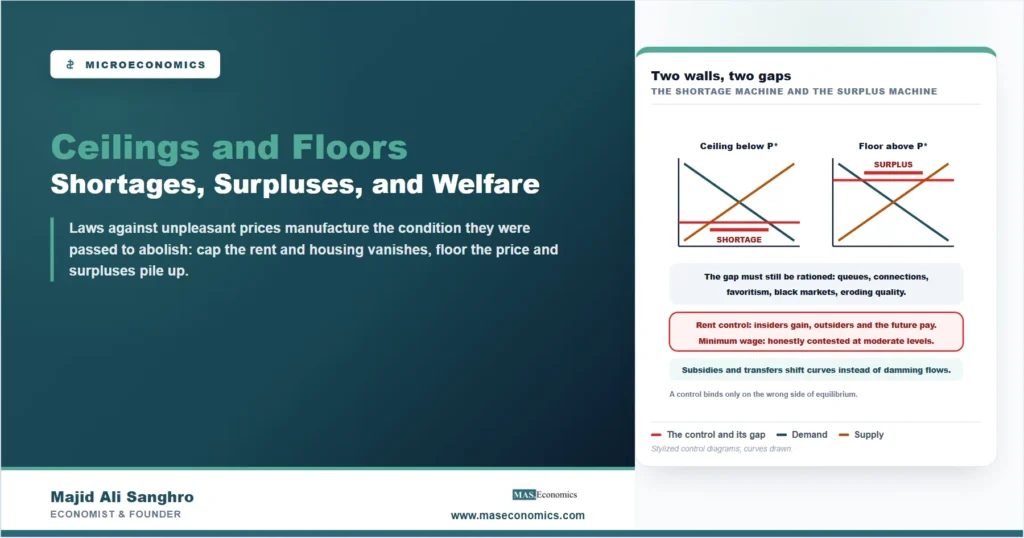
Few laws are more popular than laws against unpleasant prices. Rent is crushing, so cap the rent; wages are meagre, so raise the wage floor; bread is dear, so fix its price where the poor can pay it. Price ceilings and price floors are the two forms this impulse takes, a legal maximum below where the market would settle, and a legal minimum above it, and economics’ standing contribution to the debate is an uncomfortable regularity: each control tends to manufacture the very condition it was passed to abolish. A ceiling that makes housing affordable on paper makes it unavailable in practice; a floor that makes labor or crops valuable on paper leaves some of both unsold. The mechanism is nothing more than the market diagram read honestly, and yet the full story is richer than the slogan version, because the controls also redistribute, sometimes as intended, and because the empirical record, especially on minimum wages, has genuine surprises in it. Reading the controls well means holding the mechanism and the surprises at once.
The Mechanics: A Wedge Against the Flow
The setting is the ordinary market of our explainer on how prices emerge: a price that rises when buyers outnumber sellers and falls in the reverse, settling where quantities offered and demanded agree, the equilibrating process traced in our guide to price determination. A control is a wall built across that adjustment. A binding ceiling, fixed below equilibrium, does two things at once: it invites more buyers, since the good is now cheaper, and repels sellers, since supplying it now pays less. Quantity demanded rises, quantity supplied falls, and the gap between them is the shortage, not a temporary one that price would cure but a permanent one that the law forbids curing. A binding floor runs the film backwards: set above equilibrium, it draws in eager sellers and drives away buyers, and the gap is a surplus, unsold crops in the state’s warehouses or, when the price is a wage, workers who want jobs at the floor and do not find them. One clause matters before anything else: a control binds only on the wrong side of equilibrium. A ceiling above the market price, or a floor below it, is a wall built where the water never rises, and much confusion about controls that “did nothing” is about controls that never bound.
What the Gap Sets in Motion
The manufactured gap is the beginning of the story, not the end, because a shortage must be rationed somehow, and what replaces price is rarely kinder. Queues ration by time, favoring those whose hours are cheap; connections ration by relationship, favoring insiders; sellers ration by choosing tenants and customers, which opens the door to discrimination the price system was blind to; and black markets ration by price after all, now with illegality’s premium attached. Quality erodes along the untouched margin, since a landlord who cannot raise the rent can defer the maintenance, converting the controlled price into an uncontrolled deterioration. Rent control is the canonical exhibit because its ledger is so legible: sitting tenants with controlled leases gain genuinely, often for decades, while the costs land on outsiders, the young, the newly arrived, the mover, who face a thinner, shabbier stock and pay the uncontrolled sector’s inflated prices. The control redistributes, as intended, but between insiders and outsiders rather than simply from landlords to tenants, and it destroys value along the way: with fewer trades happening and homes drifting away from those who value them most, some of the gains from trade this market once created simply vanish, the deadweight logic this site’s welfare-triangle analysis makes precise. How large each effect is turns on the responsiveness of the two curves, which is the empirical work done by the price elasticities of demand and supply: cap a price in a market where supply barely responds and the shortage is small at first, which is exactly why controls look benign early and corrosive late, housing supply being far more elastic over decades than over months.
The Floor Debate, and the Honest Scorecard
The minimum wage is the floor the world argues about, and honesty requires reporting that the argument has real content on both sides. The textbook mechanism predicts that a binding wage floor prices some low-productivity workers out of employment, and at high enough levels it plainly does. But labor markets are not wheat markets: employers of low-wage labor often hold wage-setting power, since workers cannot switch jobs costlessly, and against such monopsony power a moderate floor can raise wages without reducing employment, even raising it in the theory’s cleanest case. The modern empirical literature, built on comparisons across borders and policy changes, has repeatedly found small or undetectable employment effects for moderate minimums, alongside clearer losses where floors are pushed high relative to local wages; the debate is genuinely about magnitudes and levels, not about whether the mechanism exists. The scorecard, then: floors transfer income to workers who keep their jobs and hours, cost something to those rationed out where the effect binds, and sit alongside the agricultural floors whose surpluses governments have historically had to buy, store, and dispose of, a fiscal exhibit of the diagram’s right-hand panel. Where the goal is supporting incomes rather than fixing prices, economics’ standing suggestion is to reach for instruments that do not fight the market’s rationing function: a subsidy to demand or supply, or direct transfers, shifts the curves rather than damming the flow between them, at the cost of appearing on a budget where controls hide their costs off the books, which is, not incidentally, a large part of the controls’ political charm. The algebra of these interventions is worked in our guide to supply and demand functions.
MASEconomics Explains
3 economic concepts behind price ceilings and floors
These concepts are explored in depth across our educational articles library.
Explore the MASEconomics BlogConclusion
Price ceilings and price floors are laws against the messenger: the price that was rationing a scarce good or eliciting a costly one is fixed by statute, and the imbalance it was managing reappears as a quantity, a shortage under a binding ceiling, a surplus above a binding floor. The gap then finds its own rationers, time, connections, favoritism, black markets, and its own hidden margins, quality erosion above all, while the intended redistribution arrives tangled with an unintended one, insiders gaining at outsiders’ expense, and a portion of the market’s gains from trade disappearing entirely.
The honest scorecard is not a slogan in either direction. Controls do transfer real income to identifiable people, moderate wage floors in monopsonistic labor markets can pass their test empirically, and the impulse behind every control, that some prices produce outcomes a society will not accept, is not an error but a value. What the mechanism teaches is the price of the instrument: controls fight the rationing function itself, so their costs arrive off-budget, delayed, and diffuse, which is precisely why they are politically cheap and economically expensive. Where the goal is genuinely helping the pressed, the interventions that shift curves rather than dam flows, subsidies and transfers, buy the same kindness with fewer manufactured gaps, and the diagram, read once, shows why.
Frequently Asked Questions
What are price ceilings and price floors?
Legal limits on prices: a ceiling is a maximum, set to keep a good affordable, rent control being the standard example; a floor is a minimum, set to keep a price rewarding, minimum wages and agricultural supports being the standard examples. Each binds only when set on the wrong side of the market’s equilibrium price.
Why does a price ceiling cause shortages?
Because it moves buyers and sellers in opposite directions: the artificially low price attracts more demand while making supply less worthwhile, and the law forbids the price rise that would reconcile them. The gap becomes a standing shortage, allocated by queues, connections, favoritism, or black markets instead of by price.
Does the minimum wage destroy jobs?
The honest answer is: it depends on the level and the market. Moderate floors have repeatedly shown small or undetectable employment effects in the empirical literature, consistent with employer wage-setting power that a floor can counteract, while floors set high relative to local wages show clearer job losses. The debate is about magnitudes, not about whether the mechanism exists.
Why do most economists oppose rent control?
Because its ledger is lopsided over time: sitting tenants gain, while the costs fall on outsiders and the future, through reduced construction and conversion, deferred maintenance, thinner turnover, and inflated prices in the uncontrolled sector. Housing supply responds weakly in months and strongly over decades, so the control looks benign early and corrosive late.
What are the alternatives to controlling prices?
Instruments that shift the curves instead of damming the price: housing subsidies or vouchers, wage subsidies and earned-income supplements, and direct transfers. They preserve the price system’s rationing role and put the cost on the visible budget, which is their economic virtue and their political weakness relative to controls, whose costs hide in shortages and quality.
Thanks for reading! A control is a law against the messenger, and the message returns as a queue. Happy learning with MASEconomics