Suppose every worker who lost a job could walk into an identical one the next morning at the same pay. Being fired would cost nothing, and a worker who could not be monitored every minute would have no reason to work rather than pretend to. Employers understand this, and the model of efficiency wages built by Shapiro and Stiglitz follows the understanding to its conclusion. To make a job worth keeping, the wage has to be higher than what the worker could get elsewhere. But if every employer pays that premium, nobody’s job is better than anyone else’s, and the premium buys nothing. What restores the threat is unemployment: when jobs are scarce, losing one means a spell without pay, and the wage premium works again. Unemployment, on this account, is not a failure of the labor market to clear. It is the device the market uses to make effort worth supplying.
The Wage That Makes Working Better Than Shirking
The model has workers who can either work, which is costly to them, or shirk, which is not. A firm cannot see effort directly; it catches a shirker only with some probability each period. A worker caught shirking is fired and joins the unemployed, from whom firms hire at a rate that depends on how many jobs are open relative to how many people are looking. Every worker weighs the same choice: the wage minus the cost of effort, kept with certainty, against the wage with no effort cost, kept until caught.
A worker will not shirk if the value of holding the job while working exceeds the value of holding it while shirking, and that inequality can be rearranged into a condition on the wage.
The right-hand side is the no-shirking wage. It starts from what the worker gets when unemployed, \(\bar{w}\), and adds a premium that rises with the cost of effort \(e\) and falls with the probability of being caught \(q\). The bracket contains the interest rate \(r\), the rate at which jobs end for reasons other than shirking \(b\), and the rate at which the unemployed find new jobs \(a\). That last term is the one the whole model turns on. When jobs are easy to find, a fired worker is back at work quickly, the punishment for shirking is brief, and the wage needed to prevent it is high. When jobs are hard to find, the punishment is a long spell of unemployment, and a smaller premium suffices.
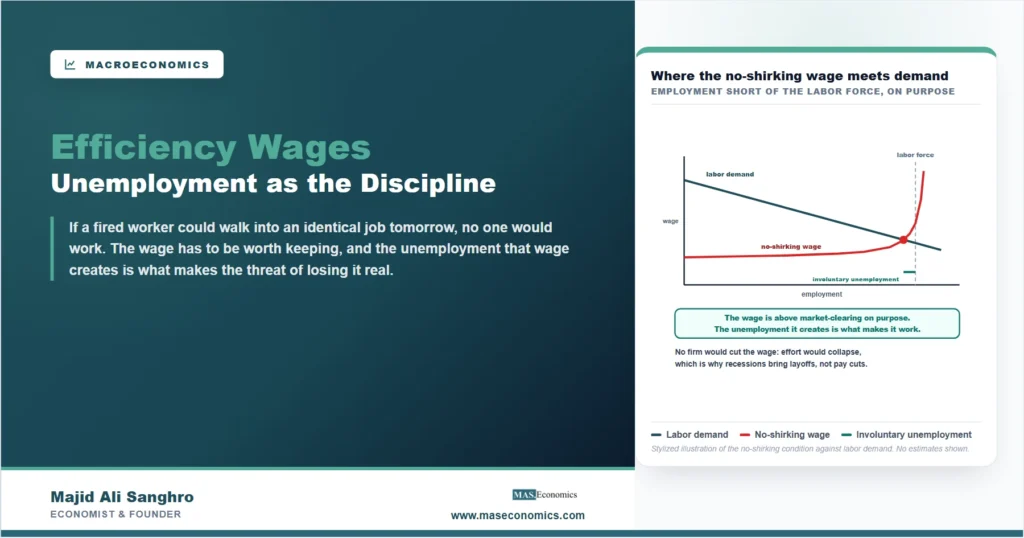
The job-finding rate is not a parameter. It is determined by how many people are unemployed relative to how many vacancies open up, so it falls as unemployment rises. That makes the no-shirking wage a decreasing function of unemployment, and it is the curve in the figure that rises steeply toward full employment: at full employment a fired worker is rehired immediately, the threat vanishes, and no finite wage prevents shirking.

Stylized illustration; the no-shirking curve is computed from the condition with the job-finding rate rising as employment approaches the labor force. No estimates are shown.
Why Every Firm Pays the Premium and Nobody Escapes the Unemployment
The equilibrium has a property that separates it from the ordinary story about wages above market-clearing. In the ordinary story a wage floor, from a union or a minimum wage law, creates unemployment that firms would happily remove by cutting pay, and are prevented from removing. Here no firm wants to cut. A firm that lowered its wage below the no-shirking level would find its workers shirking and would lose more in output than it saved in pay. The wage is a choice, made by profit-maximising firms with no constraint on them at all, and the unemployment it produces is the equilibrium of a market in which everyone is optimising.
That is what makes the unemployment involuntary in a precise sense. The unemployed would work at the going wage, and even at a lower one, and firms will not hire them, because a worker hired at a lower wage would shirk and a worker hired at the going wage would add to employment, raise the job-finding rate, and undermine the discipline on everyone already employed. Each firm, by paying the premium, contributes to the pool of unemployment that makes its own premium effective. No firm can escape it alone, and none would want to, since the pool is doing work for it. Our article on the natural rate hypothesis describes an equilibrium unemployment rate arising from search and matching frictions; this model gives a second reason for one, arising from the need to make effort worth supplying, and the two are not exclusive.
What Moves the Curve, and the Predictions That Follow
Because the no-shirking wage is built from named ingredients, the model says which changes should shift it and in which direction, and each prediction can be checked against something observable.
| Change | Effect on the no-shirking wage | What it predicts |
|---|---|---|
| Better monitoring (higher \(q\)) | Falls | Jobs that are easy to supervise pay less of a premium; supervision and pay are substitutes |
| Higher unemployment benefit (\(\bar{w}\)) | Rises | More generous benefits raise wages and equilibrium unemployment together |
| Higher job-finding rate (\(a\)) | Rises | In a boom the premium has to grow; wages rise as unemployment falls, tracing a wage curve |
| Higher separation rate (\(b\)) | Rises | Where jobs end often for other reasons, the threat of firing is diluted and pay must compensate |
| Higher effort cost (\(e\)) | Rises | Unpleasant or demanding work carries a larger premium above the outside option |
| Higher discount rate (\(r\)) | Rises | Workers who weigh the present heavily discount future punishment; the premium must be paid now |
|
|
||
The first row explains a pattern that a competitive model struggles with: the same worker paid differently for the same skill depending on how observable the work is. It also explains why firms invest in supervision, since a supervisor who raises the detection rate lets the firm lower the premium on every worker supervised. The third row produces a relationship between the wage and unemployment at the level of a region or an industry, in which lower unemployment goes with higher pay, a wage curve that has been found repeatedly in local labor market data and that a market-clearing model does not predict.
The second row is the one that reaches policy. If unemployment benefits raise the wage firms must pay to prevent shirking, they raise equilibrium unemployment through a channel that has nothing to do with the unemployed choosing leisure. The benefit makes the punishment for being fired less severe, so the premium must rise, so fewer people are employed. That is a different argument from the usual one about work incentives, and it applies even if every unemployed worker is searching hard.
One Name, Four Reasons to Pay Above the Market
Shirking is one reason a firm might pay more than it has to, and the phrase “efficiency wage” covers several others that share the structure, a wage above market-clearing that raises productivity enough to pay for itself, while differing in mechanism.
The oldest is nutrition. In an economy poor enough that wages determine how well workers eat, a higher wage buys a stronger worker, and a firm paying subsistence gets less output per rupee than one paying above it. That version explains why wages in the poorest labor markets can sit above what an excess supply of labor would suggest, and it is the one Leibenstein wrote first. A second is turnover: hiring and training are costly, workers paid above the market quit less, and the premium is cheaper than the churn it prevents. A third is selection: if better workers have better outside options, a higher wage attracts a better pool of applicants, and cutting the wage drives away exactly the workers the firm most wants to keep, a mechanism our article on adverse selection and moral hazard would recognise. The fourth is reciprocity: workers who feel fairly paid work harder than the contract requires, and a wage seen as generous is repaid with effort the firm could not have bought directly.
The mechanisms differ in what they predict. Only the shirking version requires unemployment to work, since only it relies on the threat of a spell without pay. The turnover and selection versions can operate at full employment, because they work through who leaves and who applies rather than through what happens to those who are fired. The nutrition version applies where wages are near subsistence and nowhere else. A wage above market-clearing is consistent with all four, and which one is operating in a given labor market is an empirical question the wage level alone does not settle.
Why Wages Do Not Fall in a Recession
The model’s most durable application is to a fact that has puzzled economists since the 1930s: when demand falls, firms lay workers off rather than cutting everyone’s pay, even though a pay cut would let them keep more people on. In a market-clearing model the wage should fall until the labor market clears. In this model it should not, because a firm that cut its wage would find effort collapsing, and the cost of that exceeds the saving. Layoffs preserve the discipline on the workers who remain; a wage cut destroys it for everyone. When managers are asked directly why they do not cut pay in downturns, the answers they give, that it would damage morale and effort and drive out the best workers, are the turnover, selection and reciprocity versions in the managers’ own words.
That rigidity is what connects the model to the macroeconomics of demand. A wage that does not fall when demand does means employment absorbs the shock instead, which is the mechanism behind the output-unemployment relationship in our article on Okun’s law and the reason the multiplier in our article on the Keynesian cross operates through quantities rather than prices. It also bears on the trade-off in our article on the Phillips curve: if the no-shirking wage rises as unemployment falls, then pushing unemployment below its equilibrium raises wages continuously, which is the same steepening near full employment that the figure shows.
What the Model Leaves Out, and Where It Is Tested
The model treats the firm as unable to write any contract better than a wage and a threat of dismissal. In practice firms can and do use other instruments: bonuses tied to output, promotion ladders that raise the cost of dismissal over a career, and the repeated dealing that our article on repeated games and the folk theorem shows can sustain effort without any premium at all. A performance bond, in which the worker posts a sum forfeited on dismissal, would remove the need for unemployment entirely, and the standard reply, that workers cannot post such bonds because they are liquidity-constrained and firms would have an incentive to fire them falsely to collect, is itself an argument about hidden action, the subject of our article on why firms exist.
The evidence is of two kinds. Inter-industry wage differences, in which the same worker earns systematically more in some industries than others after controlling for everything observable, are hard to explain without something like a premium that varies with how hard effort is to observe. And studies that follow workers across jobs find that those who move into high-wage industries quit less and are more productive, which is what the turnover and selection versions predict. What the evidence has not done is separate the four mechanisms cleanly, because they predict similar wage patterns and differ mainly in what happens to the fired, which is harder to observe.
MASEconomics Explains
3 concepts behind a wage that is high on purpose
These concepts are explored in depth across our educational articles library.
Conclusion
The theory of efficiency wages in the Shapiro-Stiglitz form inverts the usual reading of unemployment. It is not what remains when the labor market fails to clear but the condition under which effort can be extracted at all, and firms produce it by paying a wage they are free to cut and choose not to. The premium above the outside option is the price of discipline, it rises as jobs become easier to find, and it becomes unbounded at full employment, which is why full employment is not an equilibrium of the model and involuntary unemployment is.
The account earns its place through what it predicts rather than what it assumes. Supervision and pay are substitutes; benefits raise wages and unemployment through a channel that has nothing to do with the unemployed choosing leisure; wages and local unemployment move inversely; firms in a downturn lay off rather than cut pay. Each has been found in the data. The model shares the phrase “efficiency wage” with three other mechanisms, nutrition, turnover and reciprocity, that produce similar wage patterns by different routes, and the wage level alone cannot say which is at work. What all four agree on is that the wage a firm pays is a decision about productivity, not a price it takes, and that a labor market in which pay is set that way will not clear.
Frequently Asked Questions
What is an efficiency wage?
A wage set above the market-clearing level because paying more raises productivity by enough to cover the cost. The Shapiro-Stiglitz version has the premium prevent shirking when effort cannot be fully monitored; other versions have it reduce turnover, attract better applicants, or elicit reciprocal effort. In each case the firm chooses the higher wage freely, and the labor market does not clear as a result.
Why does the Shapiro-Stiglitz model need unemployment?
Because the threat of dismissal only works if dismissal costs something. If every fired worker could find an identical job at once, no wage premium would prevent shirking. Unemployment makes a spell without pay the consequence of being caught, and the higher unemployment is, the smaller the premium needed. The equilibrium sits where the premium firms pay and the unemployment it creates are consistent with each other.
Is the unemployment in the model involuntary?
Yes, in a precise sense. The unemployed would work at the going wage or below it, and firms will not hire them, because a worker taken on at a lower wage would shirk and one taken on at the going wage would raise the job-finding rate and weaken discipline on everyone already employed. No firm is constrained by a floor; each is choosing the wage that maximises its profit, and the unemployment follows from those choices.
What does the model predict about unemployment benefits?
That more generous benefits raise both wages and equilibrium unemployment, through a channel unrelated to whether the unemployed search. A higher benefit makes the punishment for being fired less severe, so the wage needed to prevent shirking rises, so firms employ fewer people. The prediction holds even if every unemployed worker is looking hard for work.
Why do firms lay workers off instead of cutting pay in a recession?
Because a pay cut would lower the wage below the level that keeps effort worth supplying, and the loss of output would exceed the saving. Layoffs preserve the discipline on the workers who remain. Managers asked directly give the same answer in other words: cutting pay would damage morale and drive out the best workers. The rigidity this produces is why demand shocks show up in employment rather than in wages.
How is the model tested?
Through the patterns it predicts: wage differences across industries for the same worker that track how observable effort is, lower quit rates and higher productivity among workers who move into high-wage industries, and an inverse relationship between local wages and local unemployment. These are found consistently. What the evidence cannot yet do is separate the shirking version from the turnover, selection and reciprocity versions, which predict similar wages by different routes.
Thanks for reading! The wage is high on purpose, and the queue outside the gate is part of the purpose. Happy learning with MASEconomics