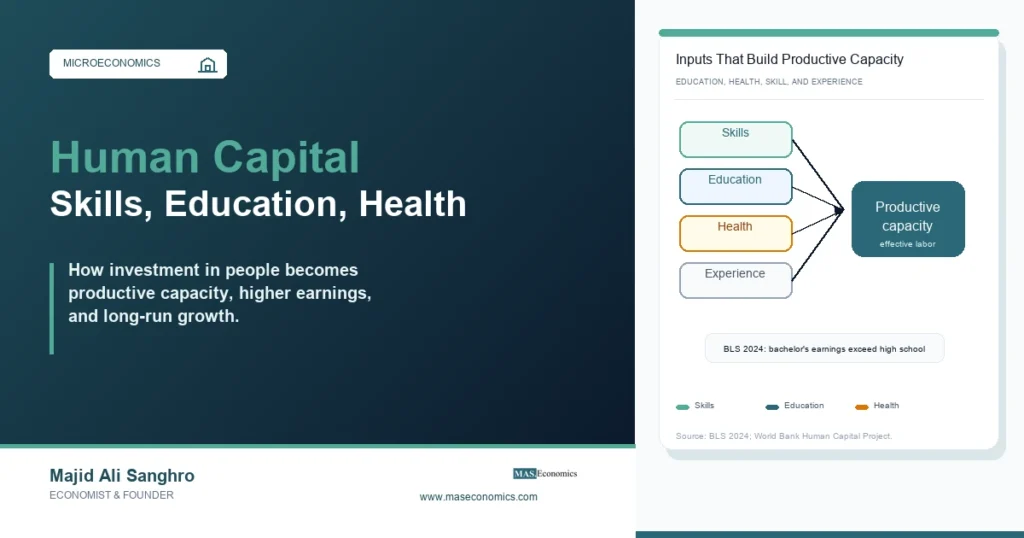
In 2024, US workers age 25 and over with a bachelor’s degree had median weekly earnings of $1,543, compared with $930 for workers whose highest credential was a high school diploma, according to the US Bureau of Labor Statistics. The same data show lower unemployment rates at higher education levels. Human capital is the economic value of the skills, education, health, knowledge, habits, and experience that make people more productive.
The phrase can sound cold because it places people inside the language of capital. The economic idea is narrower than the person. Human capital does not say that a worker is a machine or that human worth is measured by wages. It says that some investments in people raise productive capacity, just as some investments in equipment, software, transport, and research raise productive capacity.
What Human Capital Means
Human capital is the stock of productive abilities embodied in people. It includes literacy, numeracy, technical training, judgment, health, stamina, communication, problem-solving, work discipline, and experience. Some of it is produced in schools. Some is produced inside families, workplaces, health systems, apprenticeships, migration, and daily practice.
The concept became central to modern economics because it helped explain why two workers with the same number of hours can produce very different amounts of output. A worker with better training may use the same machine more effectively. A healthier worker may miss fewer days, learn faster, and sustain more complex tasks. A manager with more experience may coordinate a team with less waste. The number of people employed matters, but what those people can do matters as well.
Gary Becker’s work placed human capital at the center of microeconomic analysis. The Nobel Prize biography for Gary Becker notes that he applied economic analysis to investments in people’s competence, along with households, discrimination, crime, and other areas outside narrow market exchange. Becker’s contribution was not that education mattered, which was already obvious. It was that schooling, training, and health could be analyzed as investments with costs, risks, and expected returns.
That investment language connects human capital to opportunity cost. Time spent in education is time not spent working full-time. Tuition, books, transport, exam fees, and foregone wages are costs. The expected return is higher future income, more stable employment, better occupational choice, or stronger productivity. The calculation is never purely private because families, firms, and governments also pay part of the cost and receive part of the return.
Skills Are Built Over Time
Human capital accumulates through a lifecycle. Early childhood shapes health, language, attention, and readiness to learn. Schooling builds basic knowledge and credentials. Work experience turns general ability into practical skill. Adult training updates skills when technology, trade, regulation, or consumer demand changes. Health systems protect the stock of human capital by reducing preventable illness, disability, and early death.
This is why the World Bank Human Capital Project defines human capital around health and education. Its Human Capital Index was built to measure how much productive potential a child born today can expect to acquire under current health and education conditions. The measurement is not only about years in school. It also asks whether children survive, learn, grow in good health, and enter adulthood with the capacity to work productively.
Schooling without learning is a weak form of human capital. A country can raise enrollment and still fail to raise productive capacity if children do not acquire reading, mathematics, scientific reasoning, or social skills. Health without education also leaves potential unused. A workforce may be healthy but locked into low-productivity work if training systems, firms, and institutions do not create routes into better tasks.
| Stage | Main investment | Economic channel | Risk when neglected |
|---|---|---|---|
| Early childhood | Nutrition, health, language, safety | Learning readiness and cognitive development | Lower school readiness and weaker lifetime productivity |
| School years | Literacy, numeracy, science, credentials | Basic skills and access to further training | Low learning despite years of attendance |
| Entry into work | Apprenticeships, first jobs, mentoring | Conversion of knowledge into practical productivity | Skill mismatch and weak early earnings growth |
| Working life | Training, health care, job mobility | Adaptation to technology and changing demand | Obsolete skills and unstable employment |
| Older working age | Preventive health, flexible work, reskilling | Longer productive participation | Early labor-force exit and lost experience |

|
|||
The lifecycle view also explains why human capital policy is hard. The benefits often arrive years after the cost is paid. A childhood nutrition program may raise adult productivity decades later. A teacher-training reform may appear first in learning outcomes, then graduation rates, then labor market outcomes. A workplace training program may raise productivity only if firms also reorganize tasks so new skills are actually used.
Education Raises Productive Capacity
Education is the most visible form of human capital because it leaves records: years of schooling, credentials, test scores, degrees, and professional licenses. But education raises productivity through several channels. It teaches technical knowledge, improves general reasoning, builds communication skills, and gives workers access to occupations that require formal certification. It also helps workers learn new tasks later.
Jacob Mincer’s Schooling, Experience, and Earnings, published by the National Bureau of Economic Research in 1974, became a foundation for empirical labor economics. Mincer’s earnings framework relates wages to schooling and experience, often using the logarithm of earnings as the outcome. The simple version can be written as:
In this expression, \(w_i\) is earnings, \(S_i\) is schooling, \(X_i\) is labor market experience, and \(\rho\) is often interpreted as a return to schooling under suitable assumptions. The equation is not a complete theory of wages. It is a disciplined way to connect education and experience with observed earnings while leaving room for unobserved ability, family background, local labor demand, discrimination, occupation, and luck.
This is where human capital connects to the Spence signaling model. Education may raise productivity directly, but it may also signal ability, persistence, or conformity to employers. The two mechanisms can coexist. A medical degree teaches real skill and also certifies competence. A university degree may teach writing, statistics, and discipline, while also signaling that a worker passed a selection process.
Health Is Productive Capital
Health is human capital because poor health reduces the ability to learn, work, move, concentrate, and plan. Childhood stunting can reduce learning capacity. Chronic illness can reduce labor supply. Poor mental health can weaken school completion, workplace performance, and job retention. Unsafe working conditions can destroy human capital that took years to build.
The economic value of health does not mean health matters only because it raises output. Health is also a direct component of well-being. Economics separates the channels for clarity: health has consumption value because people value being healthy, and investment value because health raises productive capacity. A health system can therefore be justified on welfare grounds, productivity grounds, or both.
The MASEconomics article on healthcare economics explains why medical spending behaves differently from ordinary consumer markets. Information problems, insurance, uncertainty, and public health effects make health investment more complex than buying a machine. Yet the human capital logic remains: illness can reduce the stock of productive ability, while prevention, treatment, nutrition, and safe environments can protect it.
Health and education also reinforce each other. Healthy children attend school more regularly and learn more effectively. Educated adults often make better use of health information, preventive care, and labor market opportunities. These feedbacks are one reason the World Bank’s human capital measurement combines education and health rather than treating them as separate policy silos.
Wages Show Returns, Not Only Worth
Labor market data often show a wage premium for education. The BLS 2024 data are a clear example: median weekly earnings rise across most education levels, while unemployment rates tend to fall. These numbers are useful because they summarize observed labor market outcomes for large groups of workers.
These wage gaps should be interpreted carefully. They do not prove that every additional credential causes the full earnings difference. People differ in family resources, school quality, health, local labor markets, occupation, networks, discrimination, and ability. Some high-earning occupations require degrees because the degree teaches needed knowledge. Others use degrees partly as screening devices. The wage premium is an outcome that needs interpretation, not a simple moral ranking of people.
Human capital also affects unemployment risk. BLS reported a 2024 unemployment rate of 2.5 percent for bachelor’s degree holders and 4.2 percent for high school graduates, compared with 6.2 percent for workers without a high school diploma. More education does not eliminate job loss, but it often widens the set of tasks and industries a worker can enter. That flexibility matters when technology or trade changes demand for specific occupations.
The connection to unemployment is therefore direct. Human capital can reduce structural unemployment when workers have skills that match available jobs. It can also worsen mismatch if education systems produce credentials that firms do not value or if workers cannot afford retraining when demand shifts.
Human Capital and Economic Growth
At the economy-wide level, human capital raises output by improving labor productivity, innovation, management quality, and adoption of technology. A machine is more productive when workers know how to use it. A new idea spreads faster when people can read manuals, adapt processes, and solve problems. Public administration works better when the state has skilled employees who can manage budgets, data, health programs, courts, and infrastructure.
The link with growth theory is strong. The Solow-Swan growth model began with physical capital, labor, and technology. Later growth theory gave a larger role to ideas, learning, and human capability. The MASEconomics article on endogenous growth theory explains why knowledge and innovation can make long-run growth more than the accumulation of machines.
Human capital also changes how economies respond to technology. The World Bank’s World Development Report 2019 argued that technology is changing the skills employers seek, with demand rising for complex problem-solving, teamwork, and adaptability. This means the value of education is not fixed. It depends on whether schooling and training systems build skills that remain useful as production methods change.
The Cobb-Douglas production function is a useful bridge. A basic version writes output as a function of capital and labor. A richer version can adjust labor for human capital, treating effective labor as the number of workers multiplied by their average skill and health. In that setting, growth can come from more machines, more workers, better technology, or better human capability.
When Investment Fails to Pay
Not every investment in human capital pays off. A course may be low quality. A degree may be poorly matched to labor demand. A training program may teach outdated skills. A health intervention may fail because clean water, transport, nutrition, or trust in institutions is missing. Human capital is productive only when it can be formed, protected, and used.
The OECD’s Education at a Glance 2025 points to one key problem: educational opportunity remains unequal. Across OECD countries, young adults with tertiary-educated parents are far more likely to hold tertiary qualifications than young adults whose parents did not complete upper secondary education. That gap shows why human capital is not only a private choice. Family background, school funding, neighborhood conditions, health, and credit constraints shape who can invest.
Financing matters as well. The MASEconomics article on student loans economics explains why education finance can expand access but also create repayment risk. Borrowing to study is an investment when the program raises future earnings enough to cover the cost. It becomes a burden when credentials are weak, dropout risk is high, wages disappoint, or interest and repayment rules are poorly designed.
There is also a distributional issue. If high-income families can buy better schools, tutoring, health care, housing, networks, and unpaid internships, human capital investment can reinforce inequality. The MASEconomics guide to inequality shows why unequal starting points can shape later outcomes even when markets reward productivity. Human capital policy therefore sits at the intersection of efficiency and fairness.
MASEconomics Explains
4 economic concepts behind human capital
These concepts are explored in depth across our educational articles library.
Explore the MASEconomics BlogConclusion
Human capital is the productive capacity built into people through skills, education, health, experience, and habits. It explains why labor is not only a headcount and why countries, firms, and households invest so heavily in learning and health.
The concept is powerful because it links individual choices to wages, firm productivity, technological adaptation, and long-run growth. It is also incomplete when used alone. Returns depend on school quality, health systems, labor demand, family background, discrimination, finance, and institutions. Human capital raises economic potential when people can build it, protect it, and use it in productive work.
Frequently Asked Questions
What is human capital in economics?
Human capital is the productive value of people’s skills, education, health, knowledge, experience, and work habits. It helps explain why workers with different training and health can produce different amounts of output even when they work the same number of hours.
What are examples of human capital?
Examples include literacy, numeracy, technical training, professional credentials, work experience, physical health, mental health, communication skills, and problem-solving ability. These traits can raise productivity and affect wages, employment, and innovation.
Why is education considered human capital?
Education is considered human capital because it can increase knowledge, skills, and access to productive work. It may raise productivity directly, signal ability to employers, or both.
How does health affect human capital?
Health affects human capital by shaping a person’s ability to learn, work, concentrate, and remain active in the labor force. Poor health can reduce school attendance, job performance, and lifetime earnings, while good health can protect productive capacity.
How does human capital affect economic growth?
Human capital affects growth by raising labor productivity, supporting innovation, and helping firms adopt new technologies. Economies with stronger skills and health can often use physical capital and technology more effectively.
Thanks for reading! If you found this helpful, share it with friends and spread the knowledge. Happy learning with MASEconomics