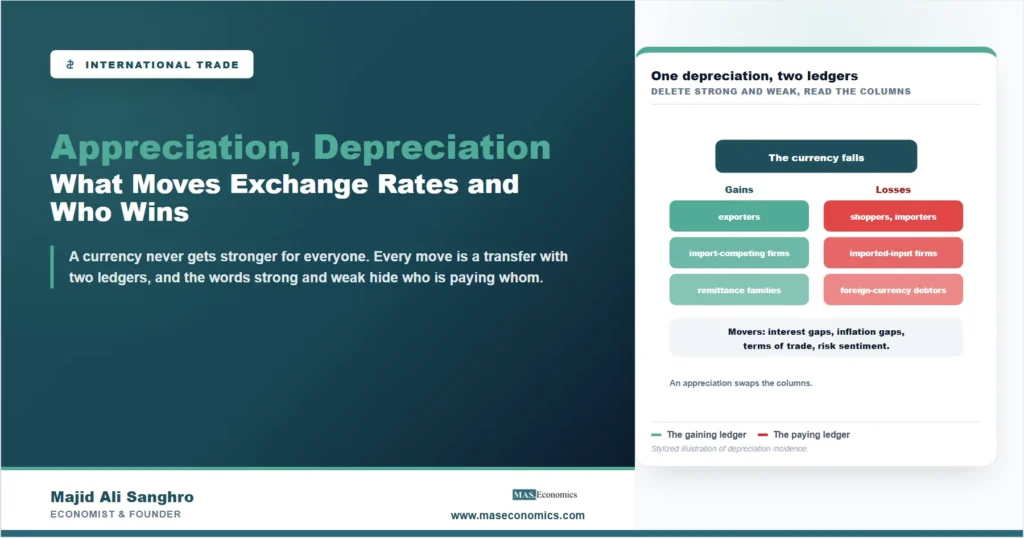
When a currency falls, the evening news calls it bad; when it rises, the same bulletin calls it strength. Both verdicts are wrong roughly half the time, because a currency’s move is never a national gain or loss, only a transfer. Currency appreciation and depreciation are the rise and fall of one money’s price in terms of another, and every move writes two ledgers at once: an appreciation makes a country’s shoppers, travelers, and foreign-debt payers richer while pricing its exporters out of world markets, and a depreciation runs the same ledger in reverse. The interesting questions are therefore never whether a move is good, but what pushed the price, who is on which side of it, and how long the effects last, and those three questions have precise answers that the strength-and-weakness vocabulary hides.
What Actually Moves the Price
An exchange rate is a price set in the deepest market on earth, and it moves for the reasons any asset price moves: the flows crossing it and the expectations behind them. Four forces do most of the work. Interest rate differentials come first in the short run: money migrates toward higher returns, so a central bank raising rates while others hold tends to pull its currency up, and the anticipation of that decision moves the price before the meeting ends. Inflation differentials do the slow work: a country whose prices rise faster than its partners’ must, over time, see its currency fall just to keep its goods sellable, the long-run gravity described by purchasing power parity. Trade and terms-of-trade shifts matter third: a commodity exporter’s currency rides its commodity’s price, and a country running a persistent trade deficit needs continuous foreign financing that can reprice suddenly. And risk sentiment overrides everything in a crisis, when capital runs to a handful of haven currencies regardless of fundamentals.
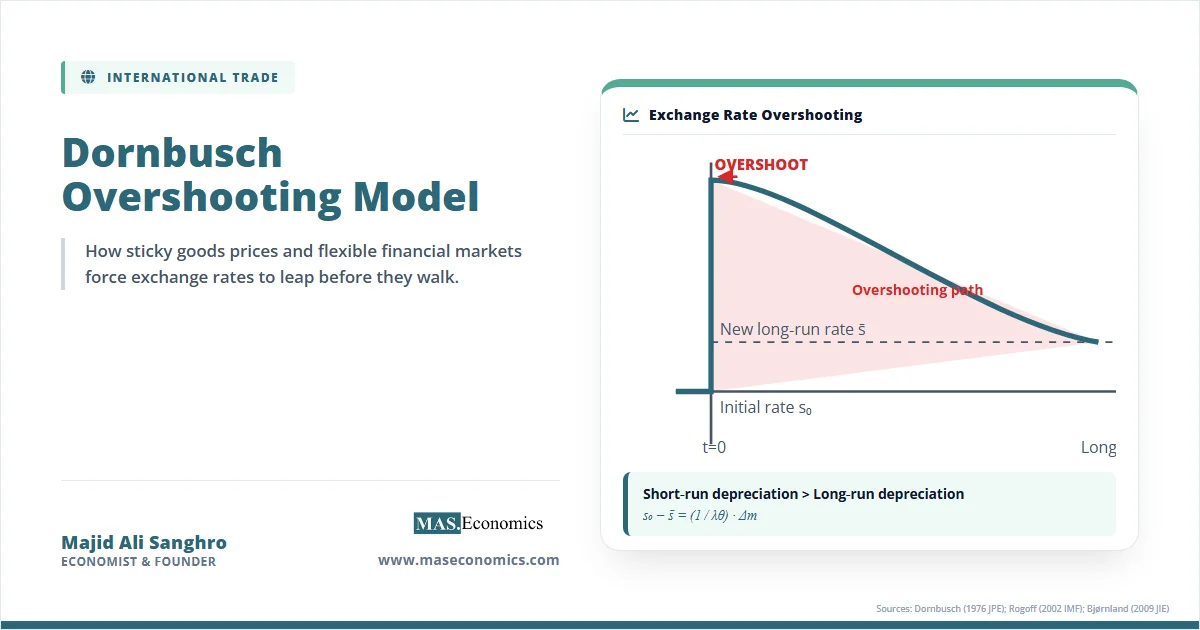
Two features of the mechanics catch newcomers out. First, currencies overshoot: because asset prices jump while goods prices crawl, a change in policy can push the exchange rate past its eventual resting point and back, the pattern formalized in the Dornbusch overshooting model, which is why day-to-day moves are noisier than any fundamental story justifies. Second, a floating currency is a policy choice with consequences: the freedom it grants domestic policy, and what pegging would surrender, is the territory of the Mundell trilemma, and how policy works when the rate floats is developed in our article on the floating-rate Mundell-Fleming case.
Who Wins, Who Pays, and Who Is Ruined
Walk the ledger for a depreciation, remembering that an appreciation simply swaps the columns. Exporters win: their costs are in home currency, their prices in foreign, so every unit sold abroad brings home more, which is why export lobbies everywhere quietly welcome what the newspapers mourn. Import-competing producers win the same way, as foreign rivals’ goods rise in price on the domestic shelf. Households receiving remittances win, their dollars and dirhams buying more at home, a first-order income event in economies from South Asia to Central America. On the other side, shoppers pay: fuel, medicine, machinery, and every import in the consumption basket cost more, and the depreciation feeds domestic inflation at a speed set by exchange rate pass-through, fast where imports loom large and expectations are loose, slower in big diversified economies. Producers dependent on imported inputs are squeezed between dearer components and competitive output markets.
And then there is the balance-sheet column, where currency moves stop being transfers and become ruin. A household, firm, or government that borrowed in foreign currency owes the same dollars against an income that just shrank in dollar terms; a large depreciation can double a debt burden in months without a single new loan being taken. This mismatch is the classic amplifier of emerging market crises, the reason a falling currency can bankrupt banks and utilities that never speculated on anything, and the reason central banks in dollar-indebted economies fear depreciation far beyond its inflation arithmetic. The wider machinery connecting these moves to trade volumes and growth is surveyed in our article on exchange rates in global trade.
The Verdict Depends on the Question
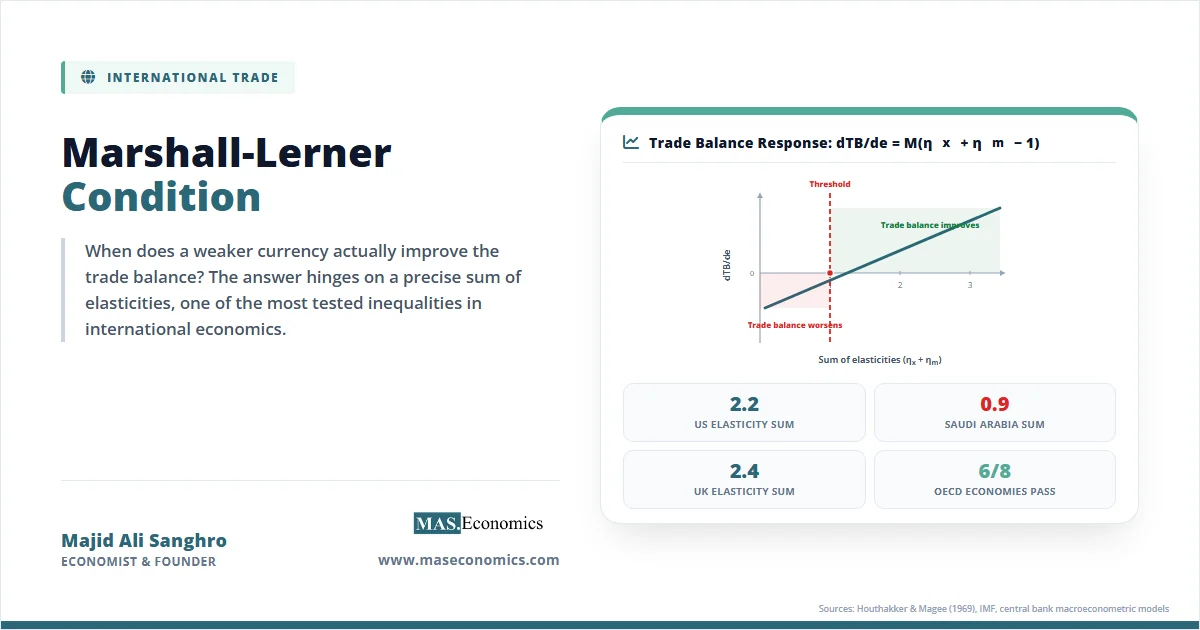
So is a depreciation good or bad? The only honest answer is: for whom, and against what alternative. A gradual real depreciation in an economy with competitive exporters, moderate pass-through, and little foreign debt is close to textbook stimulus, shifting demand toward home production. The same nominal move in a high-inflation, dollar-indebted economy delivers the costs, dearer essentials and heavier debt, while inflation eats the competitiveness gain within months; the distinction between the screen move and the one that matters runs through the difference between nominal and real exchange rates, which this site treats separately. Appreciations divide the same way: a strong currency is a raise for consumers and a tax on factories, celebrated in countries that import their lifestyle and resented in countries that export their living. There is a global layer too: because so much of world trade and debt is priced in dollars, the dollar’s own cycle redistributes across every other economy at once, tightening conditions worldwide when it rises, which is why an American interest rate decision can be the biggest currency event of the year in countries that had no vote in it.
MASEconomics Explains
3 economic concepts behind currency appreciation and depreciation
These concepts are explored in depth across our educational articles library.
Explore the MASEconomics BlogConclusion
Currency appreciation and depreciation are best understood by deleting the words strong and weak and asking the three questions that remain. What moved the price: interest differentials in the short run, inflation gaps in the long run, terms of trade and risk sentiment in between, with overshooting guaranteeing that the daily noise exceeds any fundamental story. Who is on each side: exporters, import-competers, and remittance families on one, shoppers, input-importers, and foreign-currency debtors on the other, with the debtors’ column capable of turning a price change into a solvency crisis. And how long will it last: only as long as the real move survives domestic inflation, which is the difference between a competitiveness gain and a treadmill.
The national-strength framing endures because each government hears loudest from whichever column is losing, and because a currency’s level flatters or wounds national pride in a way few prices do. The economics is calmer: every move is a transfer with an incidence, an origin, and a half-life, all three of which can be read. A reader who asks for the ledger instead of the verdict will understand more from one depreciation than the evening news conveys in a year of them.
Frequently Asked Questions
What is the difference between currency appreciation and depreciation?
Appreciation is a rise in a currency’s market price in terms of another currency; depreciation is a fall. Under a floating regime these happen continuously through supply and demand. The related terms revaluation and devaluation describe the same directions when a government changes an officially fixed rate by decision.
What causes a currency to appreciate or depreciate?
In the short run, mostly interest rate differentials and risk sentiment, which steer capital flows; in the long run, inflation differentials, since a high-inflation country’s currency must fall to keep its goods sellable; and in between, shifts in trade balances and the prices of a country’s main exports. Expectations move the rate before the facts arrive.
Who benefits from a weaker currency?
Exporters, whose foreign sales convert into more home currency; producers competing with imports, whose rivals become dearer; and households receiving remittances from abroad. The gains are real but conditional: they last only as long as domestic inflation does not eat the depreciation, and they are paid for by consumers and import-dependent firms.
Why are depreciations so dangerous for emerging economies?
Because of currency mismatch: governments, banks, and firms that borrowed in dollars owe unchanged dollars against incomes that shrank with the currency. A large depreciation can multiply debt burdens in months, turning a price movement into bankruptcies and banking stress, which is why dollar-indebted economies fear currency falls well beyond their effect on import prices.
Is a strong currency good for a country?
It is good for consumers, travelers, and anyone paying foreign debts, and costly for exporters and import-competing industries. Whether the trade-off favors a country depends on its structure: economies that import their consumption welcome strength, economies that export their living resent it, and the strength vocabulary itself obscures that both columns always exist.
Thanks for reading! A currency never gets stronger for everyone; it only changes who is paying whom. Happy learning with MASEconomics