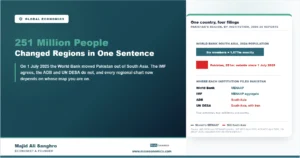
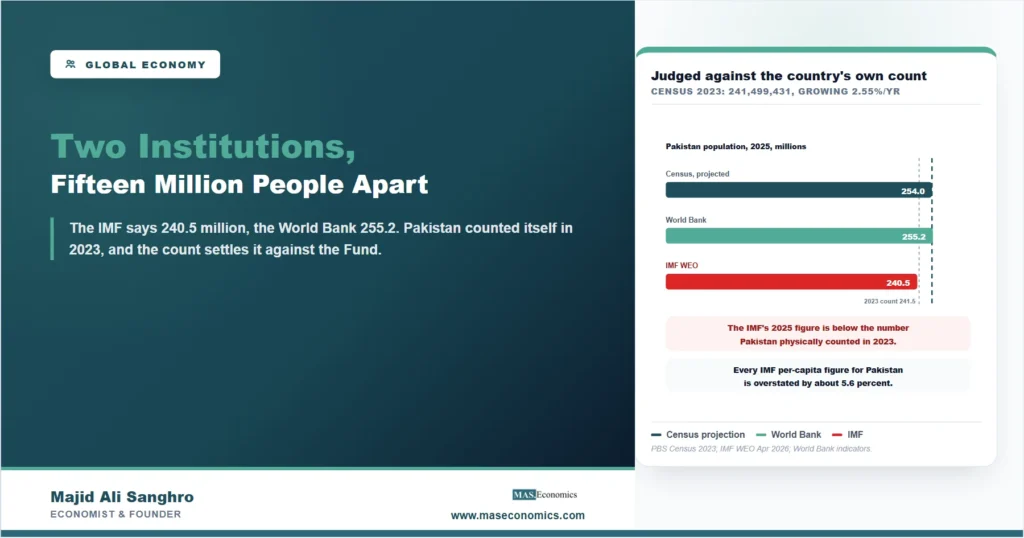
Ask the two most cited institutions in economics how many people live in Pakistan in 2025 and the answers differ by nearly fifteen million, roughly the population of Somalia. The IMF’s World Economic Outlook database puts the Pakistan population at 240.5 million. The World Bank’s indicators put it at 255.2 million. Both numbers sit in datasets that thousands of analysts, journalists and lenders treat as interchangeable, and they cannot both be right, because the gap is 6 percent of the country. What makes this case unusually clean is that it can be adjudicated: Pakistan counted itself in 2023, in a census that recorded 241,499,431 people and an intercensal growth rate of 2.55 percent a year. Project that count forward at its own rate and mid-2025 lands at about 254 million. The World Bank’s figure sits within half a percent of that. The IMF’s 2025 figure is lower than the number Pakistan physically counted two years earlier, which is not a rounding difference but an impossibility, and it quietly contaminates every per-person statistic the Fund publishes for the country. This is not a scandal. It is a denominator problem, and denominator problems are the most underrated errors in applied economics.
Adjudicating With the Census
The arithmetic that settles the dispute takes four lines. The 2023 census counted 241,499,431 people, against 207,684,626 in the 2017 census, and the census authority’s implied intercensal growth rate is 2.55 percent a year. The count is internally consistent: growing the 2017 figure at 2.55 percent for six years yields roughly 241.6 million, within about 57,000 people of what was actually counted, a discrepancy of two hundredths of a percent that validates the growth rate for projection. Carrying the 2023 count forward at the same 2.55 percent gives about 254.0 million by 2025. Against that benchmark, the World Bank’s 255.2 million is high by half a percent, comfortably inside any reasonable margin for a mid-year estimate. The IMF’s series fails twice: its 2023 figure of 231.45 million is about ten million below the count taken that year, and its 2025 figure of 240.5 million remains below the 2023 census count itself, meaning the Fund’s Pakistan has fewer people in 2025 than Pakistan enumerated in 2023. The likeliest explanation is unglamorous, a series built on projections from an older base that was never rebased to the new census, and that is precisely the point: nobody decided this number, it survived by not being checked against the primary source. Where an international series and a national primary source disagree about the nation, the count beats the projection, the same source-hierarchy rule our guide to conflicting economic statistics applies across its other cases.
What a Wrong Denominator Does Downstream
A population error never stays a population error, because population is the denominator of almost everything cited about a country. Divide the same GDP by the Fund’s 240.5 million instead of the census projection’s 254 million and income per head rises by 5.6 percent without a single Pakistani earning a rupee more: the WEO’s Pakistan GDP per capita of $5,992 at purchasing power parity becomes about $5,674 when recomputed on the census-consistent denominator. The same 5.6 percent inflation runs silently through every per-person series the database carries, and through everything analysts build on top: comparisons of growth and income with neighbors, poverty and consumption ratios, per-capita emissions, aid allocations benchmarked to income levels, and the middle-income thresholds that lending terms reference. The error is invisible in exactly the places people look, because the numerators are audited and argued over while the denominator arrives pre-installed from a trusted database. Our guide to measuring national income spends its energy, like most of the literature, on the numerator; this case is the reminder that the other half of the fraction can carry a six percent error while nobody is watching. And the direction matters for how the story reads: an inflated per-capita income makes Pakistan look modestly richer than it is, in the statistics of the institution whose program the country operates under, an irony noted here as measurement and nothing more, which is also how it bears on our profile of Pakistan’s economy.
The fair reading, and the article stands by it, is that this is a maintenance failure rather than a judgment call. International databases carry population series for two hundred countries, censuses arrive irregularly, and rebasing a series to a new count is a manual act that competes with everything else on a statistics team’s desk. Pakistan’s 2023 census itself moved the goalposts substantially, which is exactly when projection-based series go stale. The World Bank’s number is not evidence of superior wisdom, only of a series that absorbed the new count; the IMF’s is not evidence of anything except a projection that outlived its base. That is why the useful response is procedural, not accusatory: when a country conducts a census, every per-capita claim about it should be re-derived, and until the international series visibly rebase, the census and its growth rate are the denominator of record. For Pakistan that means using the count of 241.5 million for 2023, growing it at 2.55 percent, and treating any series inconsistent with the count as inconsistent with the ground truth, whatever letterhead it arrives on.
The Reader’s Rule: Check the Denominator’s Vintage
The portable lesson fits in a sentence: before trusting any per-capita statistic, ask when the population underneath it was last anchored to a count. The numerators of famous ratios, GDP, debt, emissions, are revised loudly and often; the denominators are revised quietly and rarely, and between censuses they are projections whose error grows with every year from the base. Fast-growing countries are where the stakes are highest, since a 2.55 percent growth rate compounds a small base error into a large level error within a decade, and they are also where censuses are hardest to run and longest delayed. The same discipline applies inside the datasets: a series whose value contradicts a physical count, as the Fund’s 2025 figure contradicts Pakistan’s 2023 enumeration, is not an alternative estimate but a flag, because counts and projections are not peers. None of this requires distrusting the institutions, whose transparency is what makes the check possible at all; it requires only remembering that a database is a warehouse, not a witness. The witness is the census, imperfect as counts are, and in this case the census speaks precisely enough to say which warehouse shelf is stale.
MASEconomics Explains
3 economic concepts behind the discrepancy
These concepts are explored in depth across our educational articles library.
Explore the MASEconomics BlogConclusion
The Pakistan population for 2025 is 240.5 million in the IMF’s database and 255.2 million in the World Bank’s, a gap of nearly fifteen million people that the country’s own 2023 census can adjudicate. The census counted 241,499,431 people, its 2.55 percent intercensal growth rate is validated by its own internal consistency to within 0.02 percent, and projecting the count forward puts mid-2025 at about 254 million. The World Bank sits within half a percent of that benchmark. The IMF’s figure sits below the number Pakistan physically counted two years earlier, which identifies it as a projection that was never rebased to the new census, and its consequence is mechanical: every per-capita figure the Fund publishes for Pakistan is overstated by about 5.6 percent, its $5,992 income per head at purchasing power parity falling to roughly $5,674 on a census-consistent denominator.
Read as measurement rather than scandal, the case yields two rules that travel anywhere. For producers of statistics: a census invalidates every projection built on the previous base, and rebasing is not optional maintenance. For consumers: check the denominator’s vintage before trusting any per-capita claim, prefer counts to projections wherever the two conflict, and treat a national census as outranking an international database about the nation it counted. The institutions’ transparency is what makes such checks possible, and the checks are the point, because a warehouse of numbers is only as current as its last delivery, and the most important number about a country, how many people share whatever it has, is precisely the one nobody thinks to verify.
Frequently Asked Questions
How large is the discrepancy in Pakistan’s population figures?
For 2025, the IMF’s World Economic Outlook database reports 240.5 million while the World Bank reports 255.2 million, a gap of nearly fifteen million people, about 6 percent of the country. Both figures circulate in datasets that analysts routinely treat as interchangeable, and the difference is far too large to be a definitional nuance.
Which figure is right?
The World Bank’s, to within about half a percent. Pakistan’s 2023 census counted 241,499,431 people with an intercensal growth rate of 2.55 percent a year, and projecting that count forward gives about 254 million for mid-2025. The IMF’s 2025 figure of 240.5 million is below the 2023 count itself, and its 2023 figure of 231.45 million is about ten million below what was enumerated that year.
How could the IMF’s number be below a physical count?
Most plausibly through stale projection: a series built by growing an older population base that was never rebased when the 2023 census arrived. That is a maintenance failure rather than a judgment, and it is common, because international databases carry two hundred countries and rebasing to each new census is manual work. It remains disqualifying, since a projection that contradicts an enumeration has expired.
What does the error do to other statistics?
It inflates every per-person figure by the same proportion. Dividing GDP by 240.5 million instead of the census-consistent 254 million overstates income per head by about 5.6 percent, turning the WEO’s $5,992 at purchasing power parity into roughly $5,674 when recomputed. The same distortion runs through per-capita comparisons, poverty ratios, emissions figures and any threshold benchmarked to income per head.
What should readers do with per-capita statistics generally?
Check the denominator’s vintage: ask when the population under the ratio was last anchored to an actual count. Between censuses all population figures are projections whose error compounds with distance from the base, fastest in fast-growing countries. Where a count and a projection conflict, the count wins, and a national census outranks an international database about the nation it enumerated.
Thanks for reading! Everyone audits the numerator, and the fifteen million people were hiding in the denominator the whole time. Happy learning with MASEconomics