
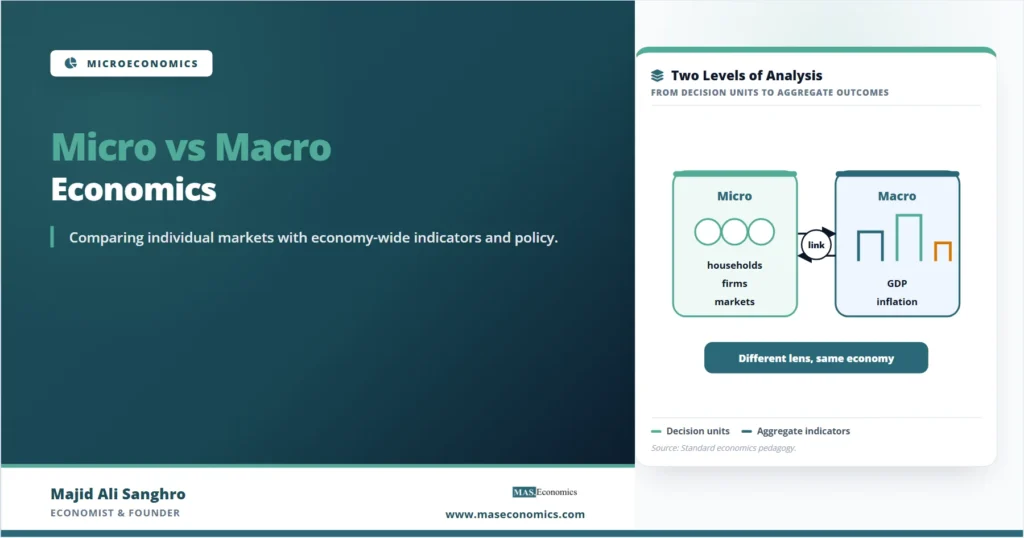
The same economy can be described through a grocery bill, a firm’s hiring plan, the unemployment rate, the inflation rate, or national GDP. Each view is useful, but each view answers a different question. That is why microeconomics vs macroeconomics is one of the first distinctions a new economics reader needs to understand.
Microeconomics studies decisions made by individual households, firms, workers, consumers, investors, and markets. Macroeconomics studies the economy as an aggregate system: total output, employment, inflation, growth, interest rates, public budgets, and business cycles. The two fields are separate for teaching and analysis, but they constantly interact in real economies.
The distinction matters because economic claims often move between the two levels. A firm may raise prices because its costs increased. If many firms raise prices at once, the result may appear in an inflation index. A household may reduce spending after an income shock. If many households do so together, GDP growth may weaken. Good economic reasoning knows which level is being analyzed before drawing a conclusion.
The Unit of Analysis Changes the Question
The simplest way to separate the two fields is to ask who or what is being studied. Microeconomics begins with individual decision-makers. It asks how a consumer responds to a price change, how a worker chooses between labor and leisure, how a firm chooses output, how a market price is formed, or how taxes and subsidies change incentives. It studies parts of the economy in detail.
Macroeconomics begins with totals. It asks why output grows, why recessions happen, why inflation rises, how unemployment changes, how central banks set interest rates, and how government budgets affect demand. It studies the whole economy or large sectors of it.
The same topic can have both sides. A gasoline price increase is microeconomic when the question is how one household changes driving behavior or how one refinery adjusts production. It becomes macroeconomic when the question is how higher energy prices affect measured inflation, real income, aggregate demand, or central bank policy.
This difference is not a ranking. Microeconomics is not smaller because it is less important, and macroeconomics is not broader because it is less precise. They are different lenses. One explains behavior inside markets; the other explains how markets and institutions combine into economy-wide outcomes.

Microeconomics Studies Choices Inside Markets
Microeconomics focuses on how scarce resources are allocated among competing uses when individuals and organizations face constraints. A consumer has a budget. A firm has costs. A worker has time. A landowner has an asset. A government has policy tools that change prices, incentives, and distribution. Microeconomic analysis studies how these decision-makers respond.
Demand and supply are the most familiar starting point. A market price coordinates buyers who want a good and sellers who can produce it. When price changes, quantity demanded and quantity supplied usually change in opposite directions. The MASEconomics article on supply and demand explains that price formation is not only a diagram. It is a way to organize incentives.
Microeconomics also studies production and cost. A firm chooses how much labor, capital, land, and entrepreneurship to combine. It compares marginal cost with marginal revenue, chooses output, and responds to competition. The article on costs of production explains why fixed costs, variable costs, and marginal costs matter for firm behavior.
Market structure is another core micro topic. Perfect competition, monopoly, oligopoly, and monopolistic competition produce different pricing power, output levels, and welfare effects. The MASEconomics guide to market structures shows why the number of firms and the ease of entry affect prices and consumer choice.
Microeconomic reasoning is also used in public policy. A tax can reduce the quantity traded. A subsidy can increase consumption or production. A price ceiling can create shortages. A tariff can change the burden shared by consumers, firms, and foreign producers. These are micro questions because they focus on incentives inside a specific market before adding them up across the economy.
Macroeconomics Studies the Economy as a System
Macroeconomics asks how the economy behaves in aggregate. Instead of one household’s budget, it examines total consumption. Instead of one firm’s output, it examines national production. Instead of one wage contract, it examines labor-market conditions across millions of workers. The unit of analysis becomes the whole economy, or a large part of it.
The US Bureau of Economic Analysis explains gross domestic product as a measure of the value of goods and services produced in the economy. GDP is a macroeconomic measure because it aggregates production across industries and sectors. A single restaurant’s sales are micro data; total output across the country is macro data.
Inflation is another macroeconomic concept. The US Bureau of Labor Statistics Consumer Price Index tracks price changes for a broad basket of consumer goods and services. A price increase for one product may be microeconomic. A sustained increase in the general price level is macroeconomic. The MASEconomics article Inflation Simply Explained develops that aggregate price-level idea.
Unemployment works the same way. The BLS Current Population Survey definitions specify who counts as employed, unemployed, or outside the labor force. One person’s job search is a micro event. The unemployment rate is a macro indicator because it summarizes labor-market conditions across the economy. The MASEconomics guide to unemployment types separates frictional, structural, and cyclical unemployment.
Macroeconomics also studies policy institutions. The Federal Reserve’s longer-run goals statement describes a mandate involving maximum employment, stable prices, and moderate long-term interest rates. Those are macro objectives because they concern economy-wide outcomes. The MASEconomics article on central banking and monetary policy explains how interest-rate decisions are used to influence those outcomes.
Where the Two Fields Meet
Microeconomics and macroeconomics are connected because aggregate outcomes are built from individual decisions. Total consumption is the sum of spending decisions made by households. Total investment is built from firms’ capital spending choices. The labor force is built from individual decisions to work, search, retire, study, or stay outside paid employment.
At the same time, macro conditions shape micro choices. Higher interest rates can make mortgages, business loans, and consumer credit more expensive. Higher unemployment can reduce workers’ bargaining power. Higher inflation can change how households budget and how firms set prices. A recession can change risk-taking, hiring, investment, and consumption in individual markets.
This two-way relationship is why economic analysis often needs both levels. A housing shortage may begin with micro factors such as zoning, construction costs, land scarcity, permitting rules, and local demand. But if housing becomes a major part of inflation, household debt, migration, and monetary policy, the issue also has macro consequences.
The opposite is also true. A macro shock can become a micro problem. A central bank rate increase is a macro policy action, but it reaches the economy through individual loan contracts, firm investment plans, asset prices, exchange rates, and household spending decisions. The MASEconomics article on economic indicators shows how those signals help readers connect individual behavior with aggregate conditions.
| Question | Microeconomic angle | Macroeconomic angle |
|---|---|---|
| Why did food prices rise? | Input costs, supply conditions, market power, demand shifts. | Contribution to CPI inflation and real household income. |
| Why is a firm hiring fewer workers? | Wages, productivity, demand for the firm’s output, technology. | Labor-market slack, unemployment, and aggregate demand. |
| Why did interest rates change? | Borrowing cost for households, firms, and asset buyers. | Monetary policy, inflation control, and the business cycle. |
| Why did output fall? | Firm-level production, costs, closures, and sector shocks. | GDP contraction, recession risk, and fiscal response. |
| Who bears a tax? | Incidence across buyers and sellers in a market. | Total revenue, demand effects, deficits, and distribution. |
|
|
||
Policy Debates Need the Right Level
Many policy mistakes begin by answering a macro question with only micro evidence, or answering a micro question with only macro evidence. A policy can improve one market while creating a larger macro cost. A policy can improve aggregate demand while creating distortions in specific markets. The level of analysis must match the policy question.
Consider rent control. The microeconomic question is how a rent ceiling changes the quantity of rental housing supplied, tenant search costs, landlord maintenance incentives, and allocation across renters. The macroeconomic question is different: whether housing costs are pushing measured inflation higher, whether shelter inflation affects monetary policy, and whether household budgets are being squeezed across the economy.
Fiscal policy gives another example. The microeconomic part asks how taxes and transfers change work incentives, saving, investment, and consumption for different groups. The macroeconomic part asks how the same policy changes aggregate demand, inflation pressure, public debt, interest rates, and long-run growth. The MASEconomics article on fiscal policy shows why government decisions often require both lenses.
Competition policy is mostly microeconomic because it studies market power, prices, output, entry, and consumer welfare inside industries. The US Department of Justice and Federal Trade Commission Merger Guidelines focus on how mergers may affect competition. Yet competition policy can still have macro implications if market concentration affects investment, productivity, wage-setting, or inflation dynamics across many sectors.
A Simple Flow From Micro Decisions to Macro Outcomes
Readers often learn the two fields separately, but the economy does not separate them neatly. A change begins somewhere specific, then spreads. A firm changes prices. Consumers adjust spending. Competitors respond. Workers bargain. Suppliers revise production. Banks adjust credit. If the change is large or widespread enough, it appears in macro statistics.
That process is why macroeconomics often needs microfoundations. A macro model may use assumptions about households, firms, labor markets, or expectations to explain aggregate outcomes. But micro detail alone is not enough either. Aggregation can create outcomes that no single decision-maker intended, including recessions, inflation spirals, financial stress, and sudden shifts in confidence.
The NBER Business Cycle Dating Committee describes recessions using broad measures of economic activity, including income, employment, consumption, sales, industrial production, GDP, and GDI. That is a macro classification. But each of those broad measures is built from underlying micro transactions, contracts, production decisions, and spending choices.
How Students Should Use the Distinction
The distinction between microeconomics and macroeconomics is most useful as a reading habit. When you see an economic claim, identify the level first. Is the claim about one market, one firm, one household, or one price? Or is it about total output, the price level, unemployment, interest rates, or national income?
Next, ask whether the claim is moving between levels. A sentence such as “higher wages are good for workers” may be microeconomic if it refers to workers in one firm or sector. It becomes macroeconomic if it claims that higher wages across the economy will raise consumption, inflation, employment, or productivity. The statement may be valid, but the evidence must match the level.
Finally, ask what is being held constant. Microeconomic analysis often isolates one market to see how incentives work. Macroeconomic analysis often allows broad feedback loops through income, spending, credit, expectations, and policy. A conclusion that is true in one setting may not automatically hold in the other.
The distinction also helps when reading headlines. A headline about falling profits in one industry is not automatically evidence of a national slowdown. A headline about strong GDP growth does not prove that every worker, firm, or region is improving. Micro data can reveal distribution and incentives that aggregate data hides. Macro data can reveal broad pressure that individual stories miss.
This habit prevents category mistakes. A reader should not use a single firm’s experience to explain a whole recession without additional evidence. A reader should also not use national GDP growth to assume every household or region is doing well. Microeconomics and macroeconomics answer different questions, and the strongest analysis knows when to switch lenses.
MASEconomics Explains
4 economic concepts behind microeconomics and macroeconomics
These concepts are explored in depth across our educational articles library.
Explore the MASEconomics BlogConclusion
Microeconomics vs macroeconomics is a distinction between two levels of economic analysis. Microeconomics studies individual choices, firms, workers, consumers, prices, and markets. Macroeconomics studies aggregate output, inflation, unemployment, growth, interest rates, and the business cycle.
The two fields are connected because individual choices add up to aggregate outcomes, and aggregate conditions shape individual choices. A careful reader does not treat them as rival subjects. The useful habit is to ask which level is being studied, which evidence fits that level, and how the two levels interact.
Frequently Asked Questions
What is the main difference between microeconomics and macroeconomics?
Microeconomics studies individual decision-makers and specific markets. Macroeconomics studies economy-wide outcomes such as GDP, inflation, unemployment, growth, and business cycles.
Is supply and demand microeconomics or macroeconomics?
Supply and demand is usually microeconomics when it explains prices and quantities in a specific market. It can connect to macroeconomics when many price changes affect inflation, aggregate demand, or national output.
Is inflation microeconomics or macroeconomics?
Inflation is macroeconomics because it describes a sustained increase in the general price level. Individual price changes are microeconomic, but broad price-level changes are macroeconomic.
Can the same issue be both microeconomic and macroeconomic?
Yes. Housing, energy, wages, taxes, and interest rates can all be studied at both levels. The micro side examines decisions inside specific markets, while the macro side examines aggregate effects on inflation, output, employment, or growth.
Which should students learn first, microeconomics or macroeconomics?
Many courses begin with microeconomics because prices, markets, and incentives provide useful foundations. Macroeconomics can also be learned first if the focus is GDP, inflation, unemployment, and policy. The best sequence depends on the course objective.
Thanks for reading! If you found this helpful, share it with friends and spread the knowledge. Happy learning with MASEconomics