
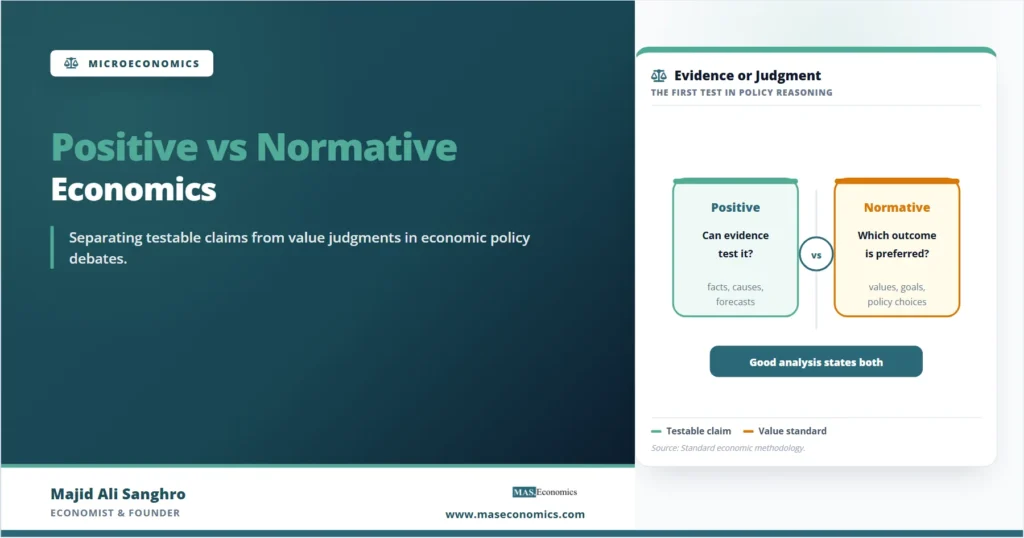
The same inflation release can support two very different sentences. The US Bureau of Labor Statistics may report that the Consumer Price Index rose by a measured percentage over twelve months. A commentator may then say the central bank should raise interest rates immediately. The first sentence is testable against data. The second sentence contains a policy judgment. That difference is the core of positive vs normative economics.
Positive economics describes what is, what was, or what is likely to happen under specified assumptions. Normative economics argues what ought to happen, which outcome is desirable, or which policy should be chosen. Both are part of economic reasoning, but they do different jobs. Confusing them makes public debate look more scientific than it is.
The distinction matters because economic language often mixes measurement, prediction, and values inside one paragraph. A clear reader separates the factual claim from the value judgment before deciding whether the argument is persuasive.
The Fact-Value Border
A positive statement can be tested. It may be true, false, incomplete, or uncertain, but evidence can bear on it. “The unemployment rate rose last month” is positive if the claim refers to a defined unemployment measure and a specific period. “Higher interest rates reduce mortgage demand, holding other conditions constant” is also positive because it describes a causal relationship that can be tested with data and theory.
A normative statement evaluates. It says something is good, bad, fair, unfair, too high, too low, acceptable, or unacceptable. “The unemployment rate is morally unacceptable” is normative. “The government should increase benefits” is normative. Evidence can inform that judgment, but evidence alone does not decide it. The word “should” is not the only signal. A sentence can be normative without using it if it relies on a value standard.
The border is not a wall between science and opinion. Economics needs both. Positive analysis estimates trade-offs. Normative analysis decides which trade-offs society is willing to accept. The danger comes when a normative conclusion is presented as if it follows mechanically from the data.

What Positive Economics Does
Positive economics tries to describe economic behavior without deciding whether the outcome is desirable. It asks questions such as how consumers respond to price changes, how unemployment is measured, how a tax changes market prices, or how a central bank’s interest-rate decision affects spending. The answer may be difficult, but the claim is still positive if it can be assessed against evidence.
Official statistics make this concrete. The US Bureau of Economic Analysis explains GDP as part of accounts that measure output, the income generated by that output, and how that income is used. That is positive measurement. It does not say whether GDP is the best possible measure of welfare, whether growth is distributed fairly, or whether the economy should prioritize output over leisure. Those questions require values beyond the accounting identity.
The same logic applies to labor markets. The BLS Current Population Survey definitions specify who counts as employed, unemployed, or outside the labor force. A statement about the unemployment rate can therefore be checked against the survey definition and the reported data. Whether a given unemployment rate is socially tolerable is a different question.
Positive economics also includes causal claims. A statement such as “a binding price ceiling creates a shortage” is not merely a description of a statistic. It is a prediction from supply-and-demand theory. Evidence can support or weaken it, depending on the market, enforcement, rationing rules, and the shape of demand and supply. The MASEconomics article on supply and demand explains the mechanism behind that prediction.
Good positive analysis avoids pretending that uncertainty is absent. Forecasts can be wrong. Data can be revised. Definitions can change. Models can omit important variables. A positive claim is not automatically true because it sounds technical. It is positive because evidence can discipline it.
What Normative Economics Adds
Normative economics enters when the analysis chooses an objective. Low inflation, full employment, equality, efficiency, poverty reduction, fiscal restraint, financial stability, environmental protection, and consumer welfare are all possible objectives. Economics can estimate the costs and trade-offs around them. It cannot prove, from data alone, which objective should dominate every other one.
The Federal Reserve’s longer-run goals statement is a useful example. It describes a statutory mandate involving maximum employment, stable prices, and moderate long-term interest rates. The target and mandate are policy objectives. Positive economics can ask how interest rates affect inflation and employment. Normative economics enters when the central bank decides how to balance those objectives under uncertainty.
Fiscal policy works the same way. A tax increase may reduce disposable income, change incentives, and raise revenue. Those are positive claims. Whether the tax is fair, whether the revenue should fund transfers, whether the burden should fall on high earners or broad consumption, and whether debt reduction should take priority are normative questions. The MASEconomics article on fiscal policy shows how policy objectives shape the interpretation of the same budget numbers.
Normative analysis is not a weakness. It is necessary because policy choices always rank values. A government cannot simultaneously minimize every tax, maximize every public service, reduce every deficit, protect every industry, and remove every market distortion. Scarcity forces trade-offs. Normative economics makes the chosen standard visible.
Statements That Look Mixed
Many economic statements contain both a positive and a normative part. “Raising the minimum wage will reduce employment, so the government should not raise it” has two claims. The first is positive: it predicts an employment effect. The second is normative: it says the employment cost should outweigh the possible wage gains for workers who keep their jobs. A reader should evaluate the two parts separately.
Another example is inflation policy. “Inflation is above target” is positive if it refers to a measured inflation series and a stated target. “The central bank should tighten policy” is normative because it chooses one policy response over alternatives. That judgment may be well supported, but it still depends on views about inflation costs, unemployment costs, credibility, distributional effects, and the time horizon.
The same distinction appears in recession debates. The NBER Business Cycle Dating Committee describes recessions using economy-wide indicators such as income, employment, consumption, sales, industrial production, GDP, and GDI. A statement that a recession occurred under that chronology is positive. A statement that fiscal stimulus should be larger during that recession is normative, even when it uses positive evidence about multipliers and unemployment.
| Statement | Type | Reason |
|---|---|---|
| The CPI rose over the last twelve months. | Positive | It can be checked against an official price index. |
| The inflation rate is too high. | Normative | It applies a standard about acceptable inflation. |
| A binding rent ceiling reduces the quantity of rental housing supplied. | Positive | It states a causal prediction that evidence can test. |
| The government should cap rents to protect tenants. | Normative | It chooses tenant protection over other trade-offs. |
| A recession involves a broad decline in economic activity. | Positive | It describes an empirical classification rule. |
| Recession policy should prioritize job protection over deficit reduction. | Normative | It ranks employment above a competing fiscal objective. |
|
|
||
The table shows why the distinction is practical. The positive statement tells the reader what claim can be investigated. The normative statement tells the reader what value standard is being applied. A full policy argument needs both, but it should not hide one inside the other.
How Data Still Needs Judgment
Positive economics is not free from judgment at every stage. Measurement choices matter. The CPI measures price changes for a defined basket and population. GDP measures market production using national accounting rules. Unemployment measures joblessness using a labor force definition. Poverty data, such as the World Bank poverty headcount ratio, depend on a poverty line, purchasing power parity adjustments, household surveys, and income or consumption concepts.
These choices do not make the data meaningless. They make definitions important. A positive statement should say which measure it uses and why that measure fits the claim. “Inflation rose” is less precise than “the CPI rose.” “Poverty fell” is less precise than naming the poverty line, country group, year, and data source. Positive economics becomes stronger when the measurement rule is explicit.
Judgment also enters model design. An economist choosing a model must decide which variables matter, which assumptions are acceptable, and which evidence should receive the most weight. A model of inflation may emphasize money growth, expectations, energy prices, slack, wage bargaining, or markups. The MASEconomics article on causes of inflation shows how different theories highlight different mechanisms.
Still, model judgment is not the same as normative judgment. A modeling choice asks which simplification best explains the facts. A normative choice asks which outcome is preferable. The two can interact, but they should not be collapsed into one category.
Why Economists Can Agree on Data and Still Disagree
Two economists can accept the same GDP estimate and still disagree about policy. One may read weak output growth as a reason for fiscal support. Another may worry that extra spending will worsen inflation or public debt. The disagreement is not necessarily about whether the GDP number is correct. It may be about which risk deserves priority. The MASEconomics guide to gross domestic product explains why GDP is a useful output measure, but it does not settle every welfare question attached to growth.
The same point applies to unemployment. Economists may agree that joblessness has increased, using the same labor-force data, while disagreeing over the proper response. One analyst may favor stronger unemployment insurance. Another may prefer training programs, wage subsidies, monetary easing, or a smaller policy response if inflation pressure is high. A reader who understands unemployment types can separate the labor-market diagnosis from the value judgment about redistribution, incentives, and public spending.
Monetary policy makes the distinction especially visible. Evidence about inflation, employment, credit, and expectations can narrow the debate, but it cannot remove the need to weigh price stability against output and labor-market conditions. That is why discussions of central banking and inflation often sound technical while still carrying value judgments about acceptable costs.
Policy Arguments Need Both Parts
A serious policy argument begins with positive analysis. It identifies the problem, measures its size, estimates causes, compares policy options, and describes likely effects. The article on economic indicators shows why this first step matters. Without measurement, policy debate becomes a contest of slogans.
But measurement alone cannot finish the argument. Suppose one policy reduces inflation faster but raises unemployment more sharply. Another policy protects employment but lets inflation fall slowly. Positive economics can estimate both paths. Normative economics decides how much short-run unemployment society is willing to accept for faster disinflation. That decision cannot be read directly from a chart.
Public choice also matters. Policy choices are made by voters, legislatures, central banks, agencies, courts, firms, and interest groups, each facing incentives. The MASEconomics article on public choice theory explains why political decisions do not always map cleanly onto textbook welfare objectives. Normative claims may say what should be done; positive political economy asks what institutions are likely to do.
How to Read Economic Claims
The cleanest method is to separate three layers. First, identify the measurable claim. What is being measured or predicted? Second, identify the causal mechanism. Which economic relationship is supposed to connect policy and outcome? Third, identify the value standard. Which objective is being prioritized?
Consider a sentence such as “The central bank should raise rates because inflation is above target.” The measurable claim is that inflation is above target. The causal mechanism is that higher interest rates can reduce inflation through spending, credit, asset prices, and expectations. The value standard is that bringing inflation down is worth the costs of tighter policy. The statement becomes clearer once those layers are separated.
The same method works for arguments about taxes, subsidies, trade, debt, unemployment insurance, rent control, minimum wages, and environmental policy. A reader does not have to reject normative claims. The task is to make them visible. Once the evidence and the values are both visible, disagreement becomes more precise.
MASEconomics Explains
4 economic concepts behind positive and normative analysis
These concepts are explored in depth across our educational articles library.
Explore the MASEconomics BlogConclusion
Positive vs normative economics is the difference between claims that can be tested and claims that require a value judgment. Positive economics measures, explains, and predicts. Normative economics evaluates, ranks objectives, and recommends action.
The distinction does not make one side serious and the other disposable. Good economics needs facts and values, but it must not confuse them. A policy argument is strongest when the evidence is stated clearly, the assumptions are visible, and the value judgment is named rather than hidden inside technical language.
Frequently Asked Questions
What is positive economics?
Positive economics studies what is, what was, or what is likely to happen. It uses definitions, data, theory, and evidence to describe or predict economic behavior without deciding whether the outcome is desirable.
What is normative economics?
Normative economics studies what ought to happen. It evaluates outcomes and policies using values such as fairness, efficiency, stability, freedom, or poverty reduction.
What is an example of positive economics?
“A rise in interest rates tends to reduce borrowing” is a positive economic statement. It makes a causal claim that can be tested with data, theory, and evidence.
What is an example of normative economics?
“The government should raise taxes on high-income households” is a normative economic statement. Evidence can inform the debate, but the word “should” reflects a value judgment about fairness, revenue, or redistribution.
Can a statement be both positive and normative?
A sentence can contain both parts. For example, “This policy will reduce inflation, so it should be adopted” includes a positive prediction and a normative recommendation. The two parts should be evaluated separately.
Thanks for reading! If you found this helpful, share it with friends and spread the knowledge. Happy learning with MASEconomics