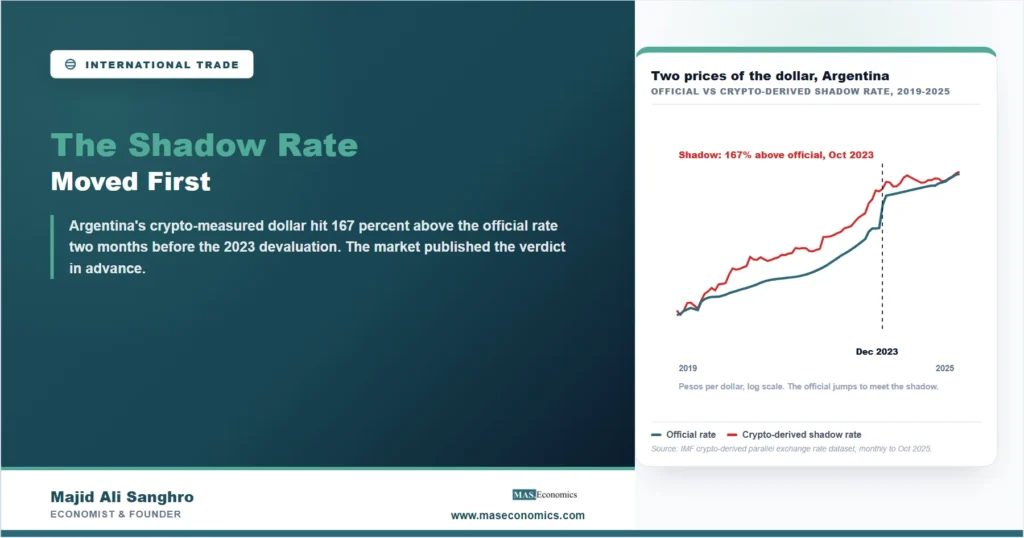
In October 2023, Argentina’s central bank would sell you a dollar for 350 pesos. On Argentina’s crypto exchanges, where bitcoin trades in pesos against its world price in dollars, the same dollar effectively cost 933 pesos. That gap, a parallel exchange rate premium of 167 percent, was the market’s published verdict on the official rate, available to anyone, two months before the December 2023 devaluation that moved the official dollar to 642 pesos. The devaluation shocked nobody who was watching the shadow price. The shadow price had moved years earlier.
This piece tells that story three times, in Argentina, Nigeria and Ukraine, using the IMF’s own crypto-derived exchange rate data. It also tells, honestly, the story of how we know the limits of the claim: the numbers here survived a battery of statistical checks that killed a more ambitious version of this argument, and the difference between what survived and what did not is itself worth a reader’s time.
Argentina: The Official Rate Chased the Shadow for Six Years
The mechanics behind the red line are simple enough to state in one sentence. When a government rations official dollars, people who need dollars buy bitcoin in pesos and sell it in dollars, so the bitcoin price on local exchanges, divided by its world price, reveals what a dollar is actually worth in pesos. IMF researchers assembled this into a monthly dataset covering dozens of countries, reviving a measurement that had effectively died with the parallel-rate yearbooks of the 1990s. The revival matters because the thing it measures had come back: the 2020s restriction wave put multiple large economies back on two exchange rates, the regime whose general economics we covered in how exchange controls work.
Read the chart’s December 2023 line closely, because it carries the article’s central fact. The official rate jumped 82 percent in one month, from 353 to 642 pesos per dollar. The shadow rate moved 7 percent, from 913 to 981. The devaluation that dominated headlines worldwide was, in the parallel market, a non-event: it moved the administered price toward the market’s price, which had long since incorporated the money growth and reserve loss behind the crisis, the fiscal mechanics we examined in Argentina’s recurrent defaults. By late 2025, with the exchange restrictions largely dismantled, the two lines nearly touch: a 6 percent premium, which is the market saying the official rate has become approximately true.
Nigeria and Ukraine Ran the Same Experiment
| Episode | Premium before the move | The official move | The shadow rate’s response | Premium after |
|---|---|---|---|---|
| Argentina, December 2023 devaluation | 167% (October 2023) | 353 to 642 pesos per dollar, +82% in a month | +7% in the same month | 53%, then falling |
| Nigeria, June 2023 naira float | 60 to 63% (March to May 2023) | 462 to 611, then 770 by July, +67% over two months | +9% over the same two months | 6.5% by July |
| Ukraine, July 2022 step devaluation | 18.5% (June 2022, rate pegged in wartime) | 29.25 to 36.57 hryvnia per dollar, a 25% administered step | broadly stable | near zero within months |

|
||||
Three different regimes, one sequence. Nigeria’s premium sat near 60 percent through the spring of 2023; the June float moved the official naira 67 percent in two months while the shadow rate moved 9, and the premium collapsed to single digits. Ukraine pegged the hryvnia at the invasion, the premium built to 18.5 percent by June 2022, and the central bank’s one-off 25 percent step in July closed it. In every case the causality runs one way: the administered price moves to meet the market price. Nowhere in this dataset does an official devaluation drag the shadow rate up after it, which is what you would expect if devaluations themselves created the depreciation pressure.
The practical reading for anyone watching a two-rate economy: the premium is the forecast. A wide, widening premium is the market pricing a future official move, and it did so here months ahead, in public, in a dataset anyone can download. There is also a subtler implication for inflation. Since import prices in a rationed-dollar economy are set by the marginal, parallel dollar rather than the official one, much of a devaluation’s inflationary work has already happened by the time the devaluation is announced, through the pass-through channel we explained in how currency moves reach domestic prices. An official move that merely closes a standing gap ratifies a price level that already exists.
What We Cannot Claim, and Why That Is Interesting
Here the article owes the reader an unusual disclosure. We tested the strong version of this argument, that across all countries and years, parallel premiums systematically predict inflation in a way official rates do not, as a formal research question, on the full 30-country panel, with pre-registered specifications. The headline result did not survive its own robustness battery: remove Argentina and the cross-country coefficient collapses to statistical nothing. What survives every check is narrower and is what this article claims: in the specific large-premium episodes, the shadow rate moved first, the official rate followed, and closing an anticipated gap added little that prices had not already absorbed. Episodes, not a law. The distinction is exactly the discipline that separates a pattern from a theorem, and readers deserve to know which they are being sold.
Two caveats keep the measurement honest as well. A bitcoin-based shadow rate can embed crypto-specific frictions, exchange risk and thin liquidity among them, which is why the IMF researchers validated it by showing premiums sit near zero in open economies, and why single-month readings deserve less trust than the trend. And the premium is a symptom, not a cause: it measures the distance between an administered price and reality, a distance created by the money and reserve policies underneath, the same fundamentals that decide the fate of every defended peg.
The American connection closes the loop. The instrument in every one of these episodes is the dollar, and increasingly the dollar in its most portable form: the parallel market that once ran through street changers now runs through dollar stablecoins on crypto rails, which is how a Fed policy cycle reaches a Lagos importer’s costs within days. The measurement innovation and the escape asset are the same technology, a theme our overview of the economics of cryptocurrency treats in full, and it means the world’s two-rate economies are now, in effect, dollarizing at the margin through channels no exchange control reaches. For readers who followed our piece on reading the yuan’s exchange rate, this is the far end of the same subject: there, the lesson was reading one price correctly; here, it is what happens when a country insists on maintaining two.
MASEconomics Explains
3 economic concepts behind the shadow rate
These concepts are explored in depth across our educational articles library.
Conclusion
The parallel exchange rate, measured through crypto markets, anticipated the decade’s major devaluations in plain sight: Argentina’s premium reached 167 percent two months before December 2023, Nigeria’s stood near 60 percent before the June 2023 float, and Ukraine’s wartime peg carried an 18.5 percent premium before its 25 percent step. In each case the official rate jumped to meet a shadow price that barely moved on the day, and in Argentina’s case the two rates now nearly coincide, the market’s confirmation that the correction is complete.
The claim is deliberately bounded. Our own cross-country test of the strong version failed its robustness battery, so what these episodes establish is a pattern in large-premium crises, not a universal law, and the article says so because the difference is the difference between evidence and salesmanship. Within that bound, the practical lesson stands: when a country runs two exchange rates, watch the one the government does not set. It is updated daily, it is public, and in every episode in this data it was right first.
Frequently Asked Questions
How does a crypto market reveal an exchange rate?
Bitcoin trades continuously in both local currency and dollars. Dividing its local price by its world dollar price gives the implicit local price of a dollar. Where exchange restrictions bite, that implicit price detaches from the official rate, and the gap is the parallel premium.
Did the shadow rate really predict the devaluations?
In the episodes shown, the premium was wide and widening well before each official move: 167 percent in Argentina two months ahead, around 60 percent in Nigeria for months before the float. The official rate then jumped to meet the shadow rate, which barely moved. That sequencing, not any model, is the evidence.
Why be cautious about the broader claim?
Because we tested it. A formal cross-country estimation of premium-led inflation failed its leave-one-out check: the result depended on Argentina. The honest conclusion is episode-level, which is what this article claims. Findings that survive only with one dominant country in the sample should be labeled as such wherever you meet them.
Is the shadow rate a perfect measure?
No. It can carry crypto-specific frictions such as exchange risk and thin trading, which is why its builders validated it against open economies, where premiums sit near zero, and why trends deserve more weight than single months. It is the best available measure of a price that otherwise goes unrecorded, not a flawless one.
What role does the dollar play in these episodes?
It is the asset everyone is trying to reach. The parallel market’s modern infrastructure is increasingly dollar stablecoins on crypto rails, which no exchange control fully blocks. That makes the Fed’s currency the escape asset in every two-rate economy and transmits American monetary conditions into these markets within days.
Thanks for reading! Every controlled price eventually meets the market’s version of it, and the meeting is rarely arranged on the government’s schedule. Happy learning with MASEconomics