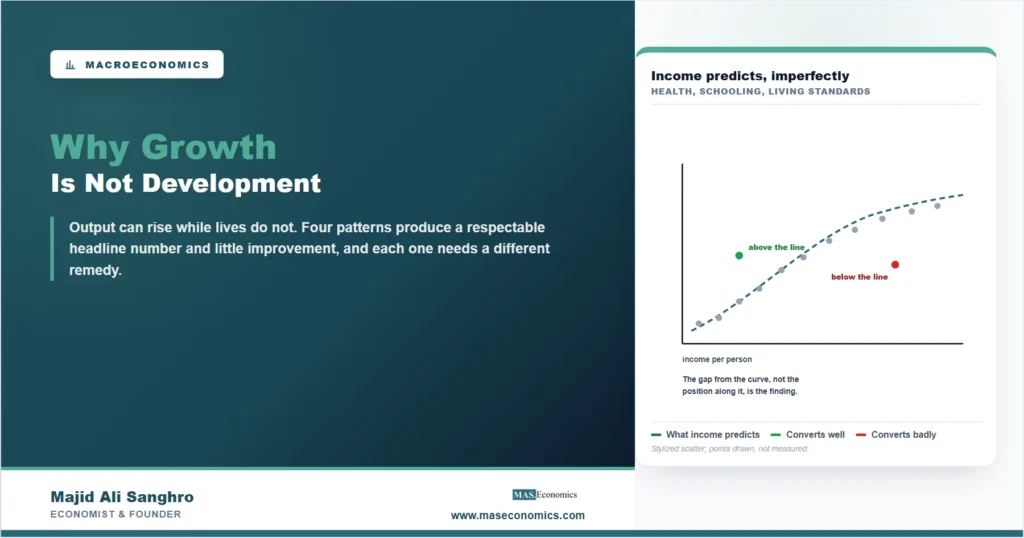
Two countries can report the same output per person and offer their citizens entirely different lives. In one, a child born this year can expect to finish secondary school and live into her seventies. In the other, with the same income per head, she is more likely to leave school early and less likely to reach sixty. Nothing in the national accounts distinguishes the two, because output per person counts what was produced and says nothing about what it was turned into. That gap is the whole subject: economic growth and development are related but separate things, growth is the rise in what an economy produces, development is the expansion of what people are actually able to do, and the interesting economics lives in the cases where the two come apart.
What GDP Counts, and What It Cannot
Gross domestic product measures the market value of final goods and services produced inside a country in a period, a definition our guide to what GDP is sets out in full, and its growth rate is the standard headline for how an economy is doing. It is a genuinely good measure of one thing. It is comparable across countries, produced quarterly, and correlated with almost everything people want, which is why our article on what GDP growth measures defends it as far as it goes.
The limits are not secret and were stated by the people who built it. Output is counted regardless of what it is: a hospital and a prison both add to it, and so does the cleanup after an oil spill. It counts production, not distribution, so an economy whose growth accrues to a narrow group reports the same number as one where it is spread widely, a difference our article on measuring inequality exists to capture. It counts what passes through markets, so unpaid household work and subsistence farming are largely invisible, which mechanically understates activity in poorer economies. It ignores depletion: an economy that grows by exhausting a forest or an aquifer records the income and never the loss of the asset. And it says nothing about health, schooling, safety or freedom, which are the things people name when asked whether life has improved. None of this makes GDP wrong. It makes it a measure of the size of the economy, which is not the same question as whether people are better off.
Development as What People Are Able to Do
The most influential answer to that second question came from Amartya Sen, who argued that development should be judged by people’s capabilities: the range of things they are actually able to be and do. Income matters in this view, but only as a means, and it converts into capability at very different rates depending on whether schools exist, whether clinics function, and whether a person is free to use what they have. A wealthy person who cannot read has money and not the capability that education provides; a poor community with a functioning clinic converts very little income into a great deal of health.
The Human Development Index was built to make that idea operational without pretending to measure everything. It combines three dimensions, a long and healthy life, knowledge, and a decent standard of living, indexing life expectancy, schooling and income per head onto a common scale and averaging them. Its virtues are exactly its limits: three indicators are few enough to be understood and audited, and few enough to leave out inequality, political freedom, security and environmental quality. The point of the index was never to be complete. It was to end the practice of ranking countries by income alone, and it succeeded at that, because a country whose ranking moves sharply when health and schooling are added has been told something about itself that GDP could not say.
The Four Ways the Two Come Apart
Growth and development usually move together, which is why the distinction is easy to forget. The useful cases are the ones where they do not, and there are four recognisable patterns.
| Pattern | What the data shows | Why it happens | What it takes to fix |
|---|---|---|---|
| Enclave growth | High income per head with health and schooling well below what that income predicts | Output comes from a capital-intensive resource sector that employs few people and funds little else | Converting rents into schools, clinics and other sectors before the resource runs down |
| Unequal growth | Rising average income with flat median income and static social indicators | Gains concentrate where assets and skills already are | Distribution: taxation, transfers, and access to education and land |
| Jobless growth | Output rising faster than employment, with underemployment persistent | Growth in sectors that add little labour, or productivity gains passed to capital | Labour-absorbing sectors, and the skills to move into them |
| Depleting growth | Strong measured growth alongside falling soil quality, water tables or air quality | Natural capital is drawn down and never recorded as a cost | Pricing the depletion, and measuring the asset alongside the income |

|
|||
The reverse case is just as instructive and less discussed. Some places achieve levels of health and literacy far above what their income would predict, by spending a modest budget on primary health care and basic schooling rather than on hospitals and universities that serve fewer people. That such outcomes are possible at low income is the strongest available evidence that development is not merely a by-product of growth waiting to arrive, and it is the empirical core of the capability argument. It is also why human capital is treated as an investment rather than as consumption: the schooling and health that development consists of are also the inputs that later growth runs on, which makes the relationship circular rather than one-directional.
Composition Matters More Than the Rate
Once the distinction is made, a second one follows: what an economy grows into matters more than how fast it grows. Development has historically meant a change in structure, labour moving out of low-productivity agriculture into higher-productivity industry and later services, which is the movement our explainer on the Lewis dual-sector model formalises. Growth that comes from that reallocation raises incomes for the people who move, spreads skills, and builds the firms that later invest. Growth of the same measured size from a capital-intensive enclave does none of it.
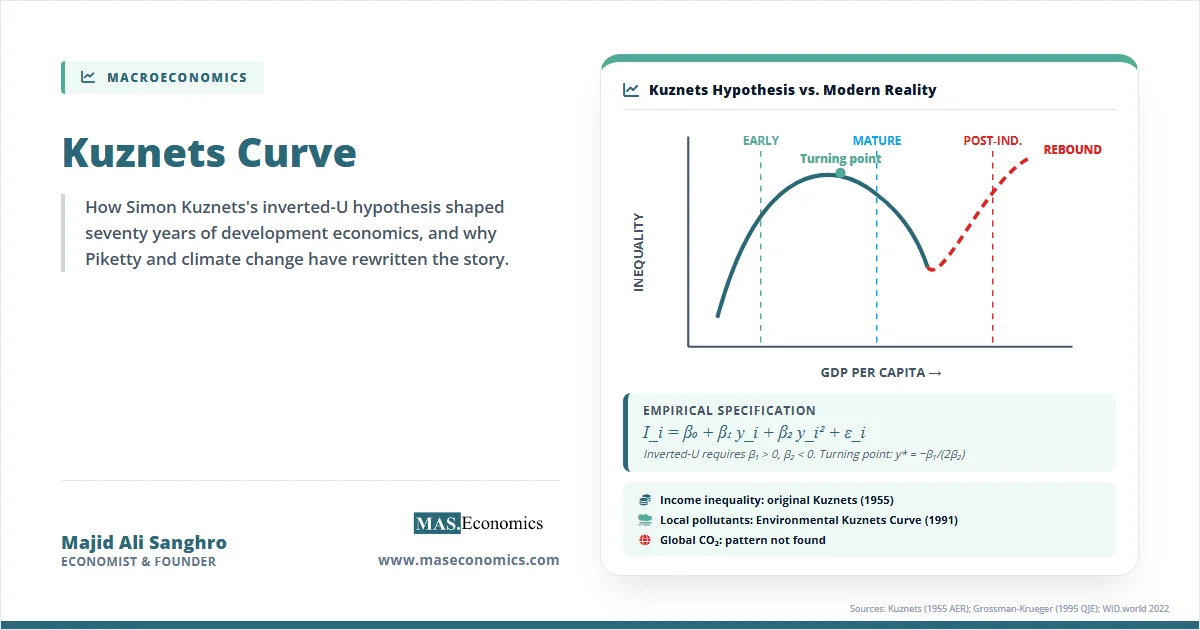
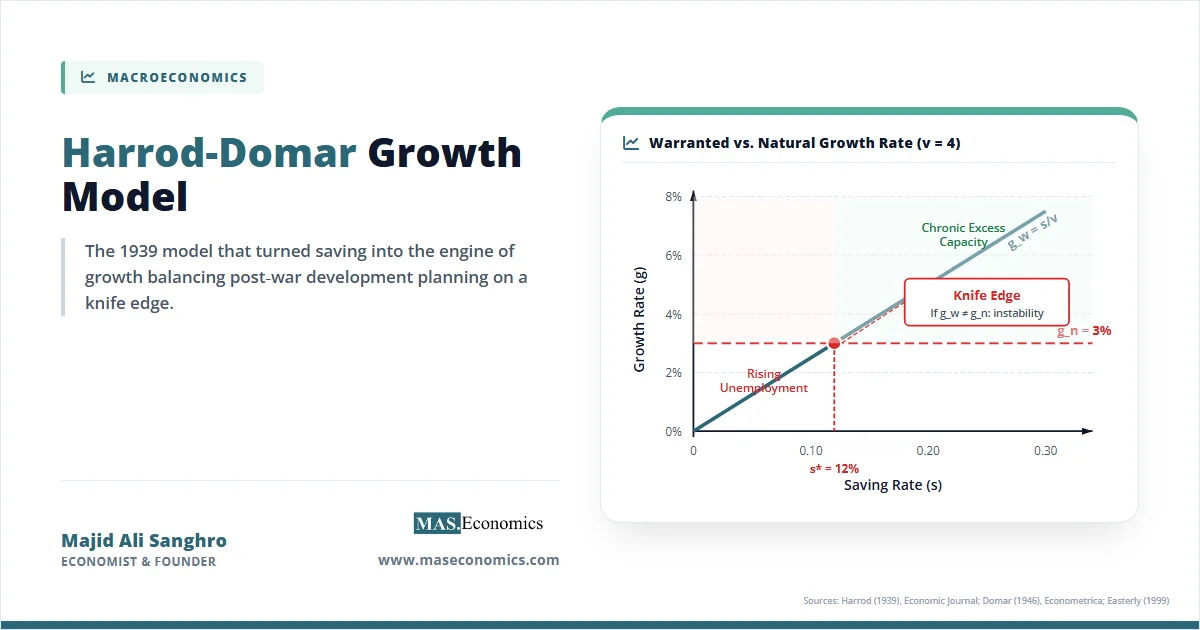
That is also why productivity rather than output is the variable to watch. Output can rise because more people work more hours, which raises GDP and leaves living standards where they were; output per hour rising is what allows a society to have both more goods and more time. The long-run models say the same in their own language: the Solow-Swan model makes accumulation run into diminishing returns so that sustained gains must come from technology, and endogenous growth theory makes ideas and human capital the engine, both of which are development claims dressed as growth theory. The relationship between growth and inequality across that transition is the subject of the Kuznets curve, whose empirical record is a caution against assuming any of it happens automatically.
What Changes When Development Is the Target
Three things change in practice. The first is what gets measured, and therefore managed. A ministry judged on GDP growth will fund what raises output this year; one judged on schooling, health and jobs will fund things whose return arrives after the next election. Choosing the indicator is a policy act, not a technical one, and it is why the arrival of the human development rankings changed budget conversations in a way that decades of criticism of GDP had not.
The second is the treatment of distribution. If development is the objective, then who receives the growth is part of the result rather than a separate question to be addressed later, and average income stops being a sufficient statistic. The third is the time horizon. Depletion and under-investment in people both raise measured output now and lower it later, so a development frame forces the balance sheet into view alongside the income statement.
None of which argues for ignoring growth. Sustained improvements in health, schooling and security cost money, and no country has delivered them at scale without a growing economy to pay for them, which is the honest limit of the capability argument. The relationship is that growth is the means and development is the end, and the two get confused because the means is far easier to measure than the end. A country reporting strong growth and stagnant development is not doing well and being mismeasured. It is converting output into lives badly, and that is a finding, not a statistical artefact.
MASEconomics Explains
3 economic concepts behind growth and development
These concepts are explored in depth across our educational articles library.
Conclusion
Economic growth and development answer different questions. Growth measures how much an economy produces and is the best available summary of an economy’s size; development asks what that output is converted into, judged by what people are able to do. GDP was never designed to answer the second question: it counts output regardless of its composition, ignores distribution, misses unpaid work and records the depletion of natural assets as income. The capability approach and the Human Development Index exist to fill that gap, not by measuring everything, but by refusing to let income stand alone.
The practical value of the distinction is in the divergences. Enclave growth, unequal growth, jobless growth and depleting growth all produce respectable headline numbers and little improvement in lives, and each has a different remedy. The reverse cases, places with modest incomes and strong health and literacy, prove the point from the other side: development is bought deliberately with primary health care and basic schooling, not received automatically as a dividend of output. Growth remains the means, because none of it is free. Development is the reason for wanting it.
Frequently Asked Questions
What is the difference between economic growth and economic development?
Growth is the increase in an economy’s output, usually measured as real GDP or GDP per person. Development is the improvement in what people are able to do, covering health, education, security and the distribution of income as well as its level. Growth is one input into development, and a country can have a great deal of the first with very little of the second.
Why is GDP not a good measure of wellbeing?
Because it counts output regardless of what the output is, ignores how it is distributed, misses unpaid household and subsistence work, and treats the depletion of natural assets as income rather than as a cost. It also omits health, schooling, safety and freedom entirely. GDP measures the size of the economy accurately; wellbeing is a different question.
What is the Human Development Index?
A composite index combining life expectancy, schooling and income per head on a common scale. It was designed to stop countries being ranked by income alone. Its narrowness is deliberate, since three auditable indicators can be understood and checked, but it leaves out inequality, political freedom and environmental quality, so it is a correction to GDP rather than a complete measure.
Can a country grow without developing?
Yes, and there are four recognisable patterns: growth concentrated in a capital-intensive enclave that employs few people, growth whose gains accrue to those who already hold assets, growth that adds output without adding jobs, and growth achieved by drawing down natural capital that is never recorded as a cost. Each produces a respectable headline number and little improvement in daily life.
What is the capability approach?
Amartya Sen’s framework, which judges development by the range of things people are actually able to be and do rather than by the goods they own. Income is a means whose conversion rate into capability varies with what public services exist and what a person is free to do, which is why the same income can support very different lives.
Does development require growth?
Largely yes, and this is the honest limit of the argument. Sustained improvements in health, education and security have to be paid for, and no country has delivered them at scale without a growing economy. The claim is not that growth is unnecessary but that it is a means: it can be spent well or badly, and the difference between those two is what development measures.
Thanks for reading! The size of an economy is easy to measure and the point of one is not, which is why the easy number does so much work it was never built for. Happy learning with MASEconomics