A country moves people out of farming into factories, wages rise, incomes multiply within a generation, and then the growth rate falls and stays down. It is no longer poor enough to win work on cost, and not yet capable enough to win it on technology or design. That squeeze is what the middle-income trap describes: a growth slowdown that arrives after the easy gains are exhausted and before the hard capabilities are built, leaving a country stuck at a fraction of frontier income for decades. The idea is now standard in policy documents and contested in the academic literature, and both facts are worth understanding, because the mechanism is real even where the word “trap” is doing more work than the evidence supports.
What the Claim Actually Says
The strong version of the claim is that middle income is a distinct state with its own dynamics, so that countries bunch there and cannot escape without a specific policy break. The weak version is that growth slowdowns are more likely at certain income levels than at random, because the sources of growth that work at low income run out at a predictable point. The two are often used interchangeably and they are not the same, and most of the disagreement in the literature is really disagreement about which one is being defended.
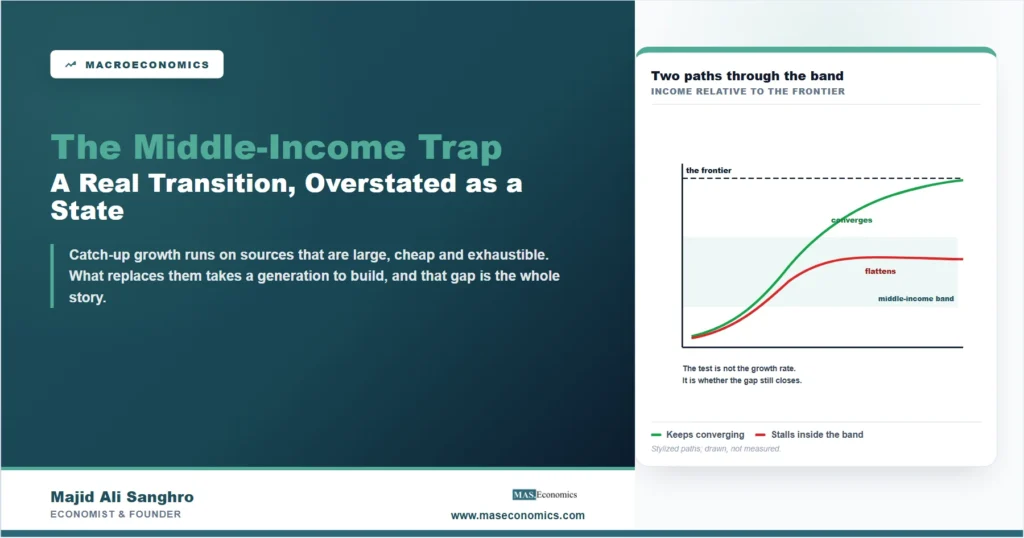
The definition problem is more than pedantic. “Middle income” can mean an absolute band in dollars, in which case the threshold moves as the band is revised, or it can mean a ratio to the frontier, usually income per person relative to the United States, in which case a country can grow steadily and still never converge. The second definition is the more informative one, because it asks the question that matters: is the gap closing? A country growing at three percent while the frontier grows at two is converging slowly. One growing at two while the frontier grows at two is not converging at all, however respectable the number looks in isolation, and the pattern in our data article on lost income convergence is exactly this question asked of the recent record.
Why the Easy Gains Run Out
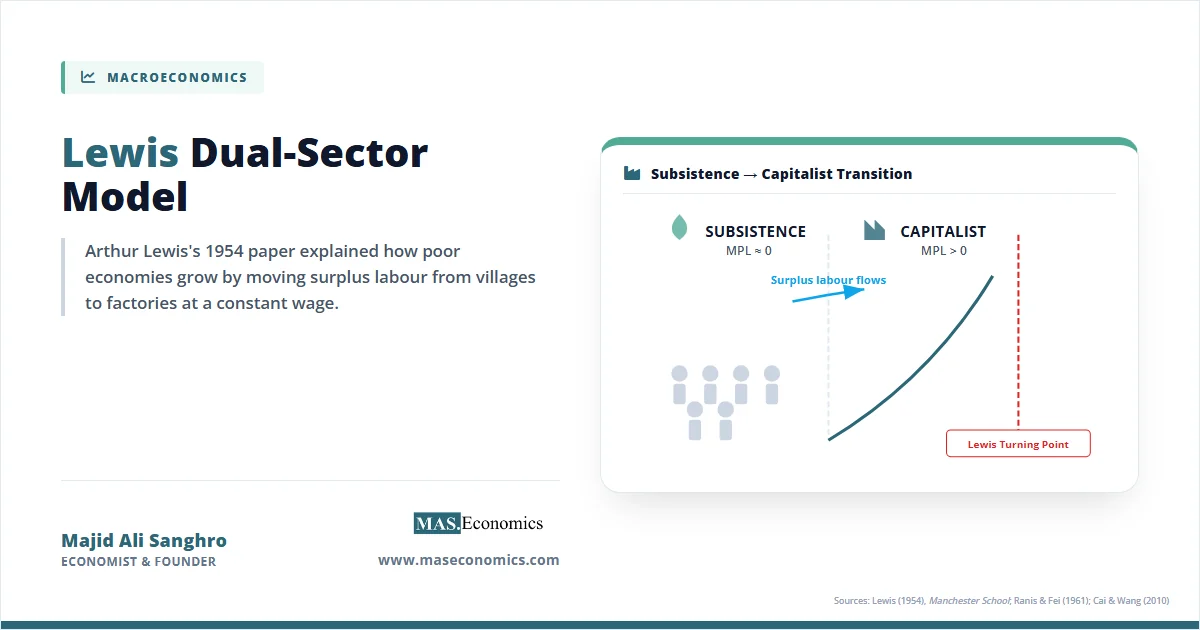
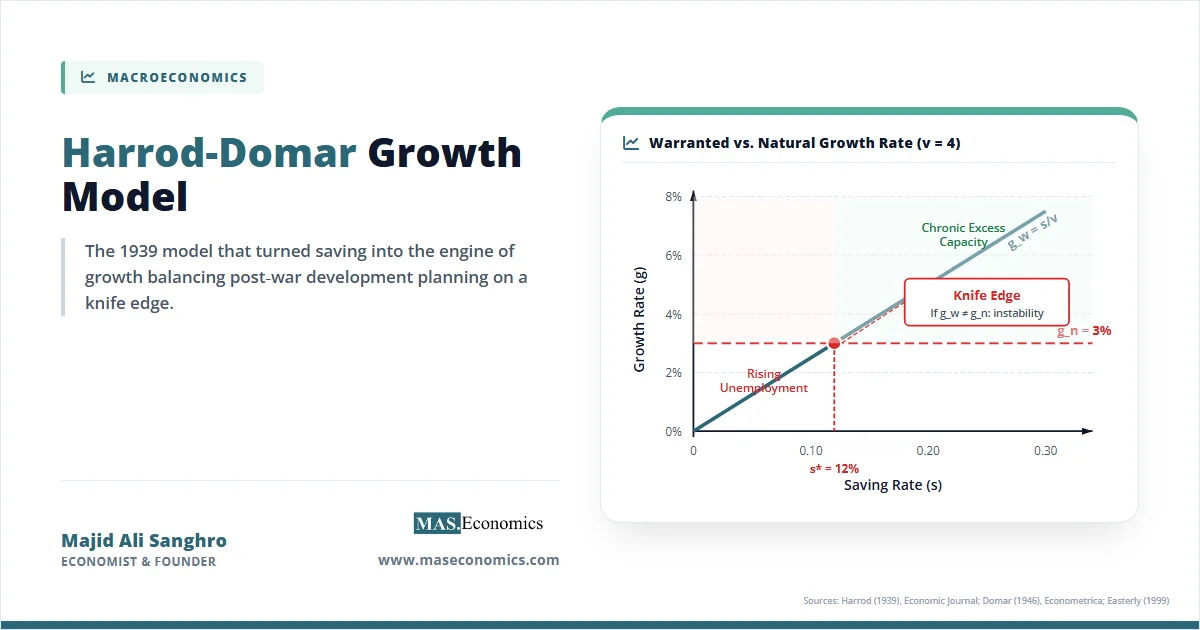
The mechanism is not mysterious, and it follows from the same models that explain the first phase of catch-up. Early growth in a poor economy comes from moving labour out of low-productivity agriculture into higher-productivity manufacturing, the process our explainer on the Lewis dual-sector model describes, and from accumulating capital where there was almost none. Both sources are large, cheap and quick, and neither is repeatable. Once surplus rural labour is absorbed, wages begin to rise with productivity rather than lagging it, and the cost advantage that won the first export markets erodes. Meanwhile capital accumulation runs into the diminishing returns that the Solow-Swan model puts at its centre, so each additional factory adds less than the last.
What is supposed to replace them is productivity growth from better technology and better organisation, which is where endogenous growth theory locates long-run prosperity. That transition is genuinely harder than the first one. Assembling imported components under licence requires an industrial estate, a port and a workforce with basic schooling. Designing the components requires research capacity, universities that produce engineers, firms large enough to fund uncertain projects, courts that enforce contracts, and finance willing to lend against intangible assets. The first list can be built in a decade by a determined government; the second is closer to a description of a society. A country can therefore find itself with wages too high for the work it knows how to do and capabilities too thin for the work it would need to do instead, which is the squeeze in one sentence.
Two further pressures usually arrive at the same time. Demography turns: the working-age share that expanded during the first phase begins to level off, a shift our article on ageing populations traces through its consequences. And the export basket stops becoming more sophisticated, so the country keeps selling the same products into markets where newer low-cost competitors have arrived, a competitive squeeze visible in the trade patterns our article on trade and inequality describes from the other side.
What the Evidence Supports, and What It Does Not
The empirical record supports the mechanism more comfortably than it supports the metaphor. Work by Barry Eichengreen, Donghyun Park and Kwanho Shin found that rapid-growth episodes end in slowdowns that cluster at identifiable income levels rather than occurring at random, with concentrations in the region of eleven thousand and again around fifteen thousand dollars per person in 2005 purchasing-power terms, and with slowdowns more likely where the working-age share is falling, where the exchange rate is undervalued, and where high-technology exports are a small share of the total. That is a real regularity and it is what most people mean when they invoke the trap.
The strong version has fared less well. Critics, notably in work by Im and Rosenblatt, have pointed out that countries do not obviously bunch at middle income in a way that a distinct trap would produce, that transitions upward and downward occur across the whole distribution, and that the appearance of a trap depends heavily on where the thresholds are drawn and on the years chosen. Their reading is that middle-income stagnation is ordinary slow growth with an unusually good name, and that the countries that stalled did so for identifiable reasons, poor schooling, closed markets, unstable macroeconomics, weak institutions, which do not require a special theory.
Both readings can be held at once, and the useful position is the practical one. Whether or not middle income is a distinct state, the transition from factor accumulation to productivity growth is a real discontinuity in what a country has to be good at, and countries fail at it often. Treating it as a trap is dangerous only if the label substitutes for the diagnosis.
| What to examine | The escaping pattern | The stalling pattern |
|---|---|---|
| Source of growth | Productivity growth rises as capital deepening slows | Growth still relies on more inputs rather than better use of them |
| Export basket | Moves steadily toward more complex products | Unchanged for a decade while competitors undercut it |
| Education | Secondary completion near universal, tertiary and technical training expanding | Enrolment up, learning outcomes flat, engineering capacity thin |
| Firms | A growing group of medium and large firms that invest and export | A few protected giants and a long tail of tiny informal firms |
| Institutions | Contracts enforced, entry contestable, macroeconomic policy stable | Rents defended by incumbents, entry blocked, repeated crises |

|
||
What Escape Has Actually Required
The economies that crossed from middle to high income in the post-war period did not do it with a single instrument. What they share is a sequence: first absorb technology that already exists, by importing it, licensing it and hosting the firms that own it; then adapt it, by building the engineering and management capacity to improve on what was imported; and only then attempt to extend the frontier with original innovation. The order matters, because a country that funds national laboratories before it has firms capable of using their output buys prestige rather than productivity. Our case study of the Singapore economy is the cleanest example of that sequence executed deliberately, and the trajectory described in our profile of China’s economy is the same transition attempted at a scale nobody has tried before.
Three ingredients recur. Human capital of the right kind, meaning not just years in school but the technical and managerial skills firms actually hire, which is why our article on human capital distinguishes attainment from capability. Openness combined with competition, so that domestic firms face the standard they are trying to reach rather than being protected from it, and so that comparative advantage is allowed to change rather than being frozen by policy. And a state capable of supporting industries without being captured by them, the difficult balance our article on the revival of industrial policy examines, since the same instruments that built export capability elsewhere have elsewhere funded permanent dependents.
The stalls are usually explained by the absence of one of those three rather than by the presence of a trap. Where growth was financed by borrowing rather than by productivity, the macroeconomic instability that followed consumed the gains, a pattern our profile of Pakistan’s economy examines through repeated stabilisation episodes. Where protection outlived its purpose, the industries it created never became competitive. Where schooling expanded without learning, the workforce arrived unqualified for the jobs the strategy assumed. Each of those is fixable and none of them is a law of nature, which is the most useful thing the sceptics have contributed to the debate.
MASEconomics Explains
3 economic concepts behind the middle-income trap
These concepts are explored in depth across our educational articles library.
Conclusion
The middle-income trap names a real transition and overstates it as a state. The transition is the shift from growth by accumulation, moving labour out of agriculture and building capital where there was none, to growth by productivity, which requires research capacity, deep skills, competitive firms and institutions that enforce contracts. The first set of sources is large and exhaustible; the second is slow to build and easy to postpone. Countries that fail to make the switch stop converging on the frontier while still reporting growth rates that look acceptable in isolation, which is why relative income rather than the growth rate is the diagnostic worth watching.
The evidence supports the mechanism and is cooler on the metaphor. Growth slowdowns do cluster at identifiable income levels, and they are more likely where the working-age share is falling and where technology-intensive exports are thin. But countries do not obviously bunch at middle income the way a distinct trap would produce, and the stalls that occurred have ordinary explanations: schooling that expanded without learning, protection that outlived its purpose, borrowing that substituted for productivity. That is the practical conclusion. A country in the band should not ask whether it is trapped, which is unanswerable and slightly fatalistic. It should ask which of the diagnostics it is failing, because each of them has a policy attached and none of them is destiny.
Frequently Asked Questions
What is the middle-income trap?
The pattern in which a country grows quickly from low income, reaches middle income, and then stops converging on richer economies for decades. The mechanism is a squeeze: wages have risen above the level that won the first export markets, while the research capacity, skills and institutions needed to compete on technology have not yet been built.
Why do countries get stuck at middle income?
Because the two sources of early growth are exhaustible. Moving labour out of low-productivity agriculture ends when surplus rural labour is absorbed, and accumulating capital runs into diminishing returns. What must replace them is productivity growth, which needs technical skills, firms able to fund uncertain projects, competition and contract enforcement. That is a much harder programme than building an industrial estate and a port.
Is the middle-income trap real?
The mechanism is well supported and the strong version is contested. Growth slowdowns do cluster at identifiable income levels rather than occurring at random, and they are more likely where the working-age share is falling and technology-intensive exports are a small share. But countries do not bunch at middle income in the way a distinct trap implies, and much of the appearance depends on where the thresholds are drawn.
Which countries escaped the middle-income trap?
The post-war escapes were concentrated in East Asia, with Singapore, South Korea and Taiwan the standard examples. What they share is a sequence rather than a single policy: absorb existing technology first through imports, licensing and foreign firms, then build the engineering and management capacity to adapt it, and only then attempt original innovation.
How is the middle-income trap measured?
Two ways, and they answer different questions. An absolute band in dollars is simple but moves whenever the band is revised. Income relative to the frontier, usually the United States, is more informative, because it asks whether the gap is closing. A country growing at the same rate as the frontier is not converging at all, however healthy the growth rate looks alone.
What is the difference between the middle-income trap and a poverty trap?
A poverty trap is about a threshold at very low income, where returns to assets are too low for accumulation to start, so help below the threshold is undone. The middle-income trap is about a transition failure much higher up: accumulation worked and then stopped paying, and what is missing is the capability to grow through productivity rather than the resources to begin.
Thanks for reading! The question is never whether a country is trapped, it is which of the five diagnostics it is failing, and every one of them has a policy attached. Happy learning with MASEconomics